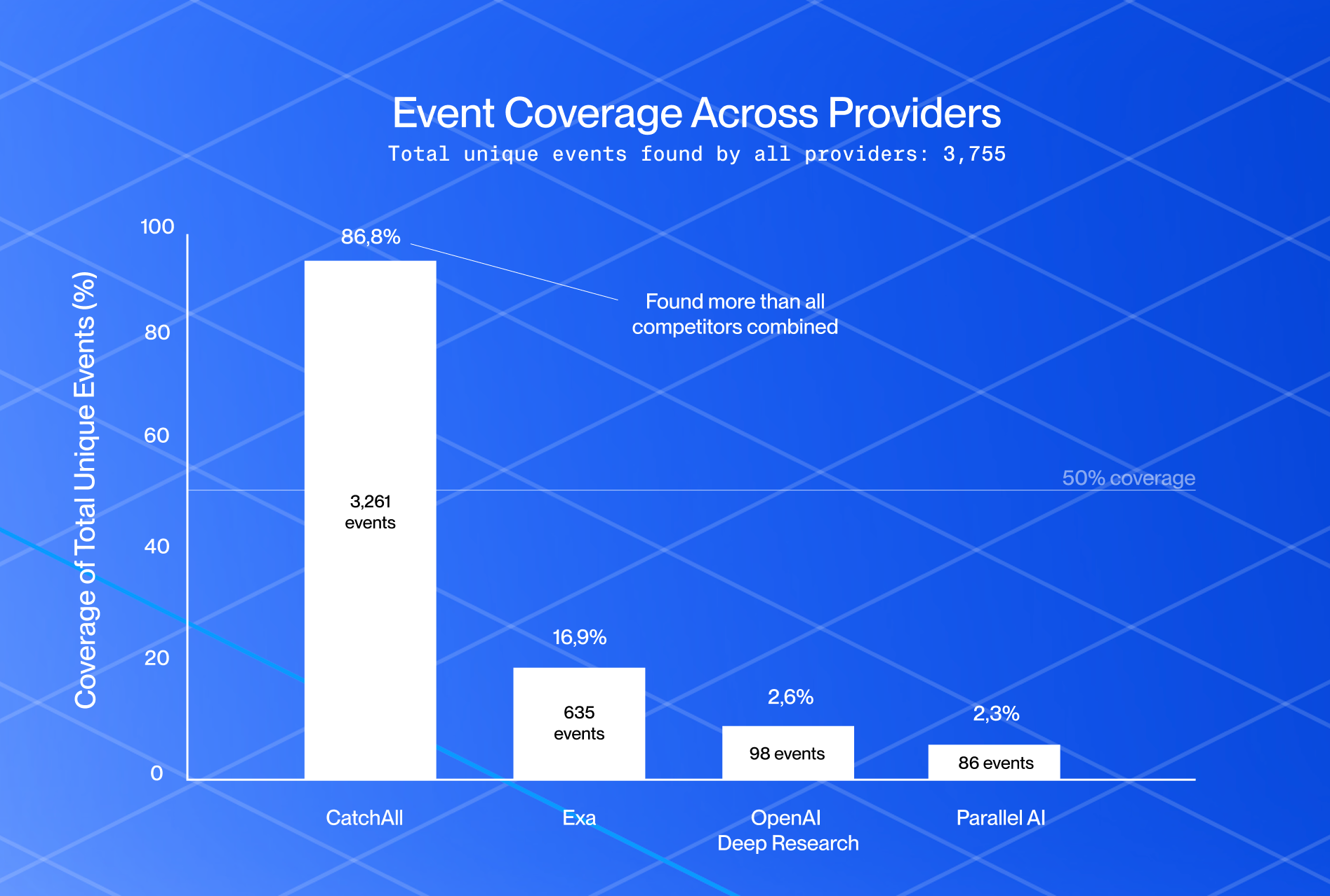








Web indexing sounds like background infrastructure until your monitoring workflow misses a same-day enforcement action. Or your RAG pipeline comes back with 40 near-identical wire articles about the same event. Those failures are usually baked into the index design, not the query. How a source list gets assembled. How often the crawler revisits niche publications. Whether enrichment runs at index time or gets dumped onto your pipeline instead. Those decisions, made long before anyone types a query, are what decide what you can and can't find.
TLDR:
- Web indexing converts raw web content into a structured, queryable corpus across five stages: discovery, crawling, parsing, normalization, and storage.
- Source curation before crawling decides recall quality, not crawl speed. A general-purpose index built on link-following misses niche regulatory sources precisely because they rarely show up in the link graph.
- Index-time enrichment (named entities, sentiment, topic classification) scales. Query-time enrichment doesn't: it re-runs against every candidate document on every request.
- Story clustering reduces hundreds of syndicated articles about the same event to a single record with multiple source citations, cutting most of the deduplication work on your side.
- Breaking event detection lives or dies on the gap between publication and the record becoming queryable. General-purpose indexes optimize crawl frequency by domain authority, so niche sources are revisited less often no matter how urgent the content is.
How does web indexing work as data infrastructure?
Web indexing is the engineering process that converts raw web content into a structured, queryable corpus. It has nothing to do with SEO rank signals. It is the data infrastructure that makes programmatic search possible.
Indexing runs in five stages: discovery (finding URLs via sitemaps, feeds, or seed lists), crawling (fetching page content over HTTP), parsing (extracting text, metadata, and links from HTML), normalization (standardizing formats, deduplicating records, resolving encoding), and storage (writing structured documents into a searchable index). Each stage introduces decisions that compound downstream.
The term covers two very different types of indexes. General-purpose indexes like Google's aim for broad web coverage, ranking results by authority signals for human search queries. Domain-specific indexes are built for programmatic consumption by developers and data teams, optimizing for recall, schema consistency, freshness, and enrichment: not ranking. A consumer searching for a recipe needs the first kind. A financial risk team querying for regulatory enforcement actions needs the second, which is part of why we're building a different web index.
How does the crawl-to-index pipeline work?
Crawling starts with a seed list: a curated set of URLs the scheduler knows to visit. The crawler fetches each page over HTTP, parses the HTML, extracts visible text and metadata, then follows outbound links to find new URLs. Those get added to the queue, and the cycle repeats.
Each fetch negotiates with the server. The crawler reads robots.txt first, which specifies off-limits paths and sometimes rate limits. Respecting it means some content is never indexed at all.
The revisit schedule is where freshness is won or lost. A crawler returning to a news source every 10 minutes captures breaking stories fast. One revisiting every 48 hours indexes yesterday's enforcement action today. Crawl rate sets a hard ceiling on how current any downstream query can be.
Storage schema determines what queries are possible later. Indexes storing structured fields (headline, body summary, named entities, publish timestamp, and source domain) allow filtering and aggregation without client-side preprocessing. Indexes storing raw HTML push that parsing burden onto the consumer.

Why does source curation determine index quality?
Source curation sets recall: if a source isn't on the list, no crawl speed will surface it. The list is built before a single page is fetched, which makes it a bigger lever than crawl frequency or storage schema.
A general-purpose search index treats source discovery as an emergent property of link-following: start with popular seed URLs, follow outbound links, rank by PageRank signals. The result is a corpus heavily weighted toward high-authority domains that other high-authority domains already link to. Niche regulatory trade journals, state agriculture department bulletins, and local government enforcement portals rarely appear in that link graph, not because they lack signal value, but because few other sites link to them, so the crawler has no path in.
A domain-specific index inverts this. Source lists are built from explicit decisions about which government portals to cover, which press wires to trust, and which corporate newsroom subdomains to track separately from their parent domains. A risk team querying for EPA enforcement actions against a specific manufacturer needs EPA press releases, the Federal Register and state environmental agency notices indexed. If those sources are not in the source list, recall on that query drops sharply regardless of how fast the crawler runs.
The source coverage gap is structural. Crawling longer or indexing faster does little for sources the crawler rarely reaches; closing the gap takes a deliberately built source list.
How do crawl freshness and ingestion latency affect downstream use?
Freshness is a composite measurement, not a single dial. Three separate clocks run in sequence: how often the crawler revisits a source, how long the ingestion pipeline takes to parse and enrich a fetched page, and how long the index takes to make the written record visible to search. Each adds latency independently.
Crawl frequency sets the first ceiling. A source visited every 10 minutes can surface a story within minutes of publication. Most general-purpose indexes optimize crawl frequency by domain authority, meaning niche sources get visited less often regardless of how time-sensitive their content is.
The acceptable latency window depends entirely on the query type. Breaking event detection needs end-to-end ingestion measured in minutes, not hours. Scheduled reporting workflows can tolerate hours. As RisingWave noted in 2026, nightly full re-indexing scales with corpus size, not with how many documents actually changed, so most of that embedding cost is waste for knowledge bases where only a fraction of documents update daily.
The mismatch between latency tolerance and actual pipeline behavior is where most indexing systems fail. An index built for archival recall gets used for near-real-time alerting, and the gap only becomes visible when a monitoring workflow misses an event that was already published.
How do deduplication and story clustering clean the index?
Deduplication collapses identical and near-identical copies of an article, and clustering groups different articles about the same event into one story. Raw crawl output needs both. Wire services push the same article to hundreds of outlets at once. Syndication networks republish it under different bylines. A breaking event spawns waves of coverage that are structurally identical except for the timestamp and the byline. None of that sorts itself out, so the cleanup has to happen before any analytical query runs.
Deduplication handles the exact and near-exact matches first. Exact duplicates get caught by comparing hashes of normalized text, simple enough. Near-duplicates are the harder case: similarity scoring, typically cosine similarity over text embeddings, decides how close counts as "the same," and anything past that threshold gets treated as one document. One record survives. The rest get suppressed or linked back to it.
Story clustering goes a step further. As Feedly's engineering team described, clustering groups articles covering different angles of the same event, while deduplication only catches content that's identical or nearly so. Feedly splits the work accordingly: locality-sensitive hashing handles deduplication, and density-based clustering over article similarity works out which articles belong to the same underlying story. Those get surfaced together, so a reader can work through the full coverage of a story in one place instead of twenty.
Without clustering, a search for a regulatory enforcement action comes back with 200 articles about the same event, ranked by recency or authority. With clustering, that becomes one story record with every source attached. For a monitoring workflow, that is the difference between one signal and a review queue somebody has to work through by hand.
| Dimension | Deduplication | Story clustering |
|---|---|---|
| What it catches | Identical and near-identical copies of one article, such as wire copy and syndicated reprints | Different articles about the same event, including separate reporting, other angles and follow-ups |
| Method | Hashes of normalized text for exact copies; similarity scoring over text embeddings, with a threshold, for near-copies | Clustering over article similarity, which assigns each article to the story it reports |
| What is kept | One record per article; the other copies are suppressed or linked back to it | One story record with every source attached |
| Result in the review queue | Reprints of the same article stop repeating, but separate reports of the event still arrive as separate items | One item per event, with the number of newsrooms covering it as a signal of how widely it was reported |
How does enrichment at index time change what queries are possible?
Index-time enrichment means the signals below are computed once and stored as structured fields on the document. Query-time enrichment means the same signals get recomputed on every request against every candidate document. The first approach scales; the second does not.
Signals applied at index time typically include named entity extraction (people, organizations, locations), sentiment scoring at headline and article level, topic classification, language detection, and AI-generated summaries. Each becomes a queryable field rather than something inferred from raw text at request time, so a pipeline that needs negative coverage of an organization reads a pre-computed sentiment score instead of running its own model across every article.
Translation is the least obvious case and often the most consequential. When non-English articles are translated and enriched at index time, an English-language query like "Deutsche Bank" surfaces German, French, and Japanese coverage too, without the querying system handling multilingual retrieval itself.
For data teams building RAG pipelines or monitoring workflows, this removes a preprocessing stage entirely: enrichment has already run server-side before the API response leaves the index, so there's no separate language-processing infrastructure to build.
How do general-purpose indexes and domain-specific indexes differ?
The core design split comes down to what each index was built to optimize. General-purpose indexes like Google's solve a discovery problem across billions of pages for human users. Domain-specific indexes solve a retrieval problem within a defined content universe for programmatic consumers.
| Dimension | General-purpose web index | Domain-specific news index |
|---|---|---|
| Source selection | Opportunistic, authority-weighted | Curated, authority-scored per domain |
| Output format | Ranked links | Structured JSON with metadata |
| Enrichment | Built for ranking, rarely exposed as fields | Entities, sentiment, topics at index time |
| Deduplication | Rarely exposed to API consumers | Story-level clustering |
| What sets revisit frequency | Domain authority, so a niche publisher is slow because it is unpopular | Per-source relevance, so a niche source can be revisited quickly when the use case needs it |
| Recurring delivery | Rarely built into search APIs | Scheduled monitors with delta detection |
A domain-specific index writes enrichment, clustering, and parsed fields into the stored document before the API response is generated. For a system querying the same index hundreds of times per day, that difference compounds into either a preprocessing burden or its absence.
Recurring delivery is the dimension that rarely gets discussed. General-purpose search APIs rarely offer delta detection: every query returns a fresh ranked list with no memory of what the previous query returned. Domain-specific indexes designed for monitoring ship only what changed since the last run, which is the architectural requirement for any alert system that should not fire twice on the same story.
Why does AI search need a different kind of index?
AI search needs structured, citable, low-noise results, because AI agents and RAG pipelines query a search API at runtime. A ranked list of HTML links has to be fetched, parsed and deduplicated before any of it can enter a context window. Every one of those steps adds latency, cost, and failure surface inside the request path.
The syndication problem compounds this quickly. A general-purpose index returns dozens of structurally identical articles about the same event from different outlets. Each occupies context window space, and the agent has no way to distinguish primary reporting from republished wire copy without running its own deduplication pass. As the systematic review of RAG systems published on arXiv notes, retrieval quality tracks closely with answer quality, and noisy or irrelevant retrieval is a recurring weakness of RAG systems.
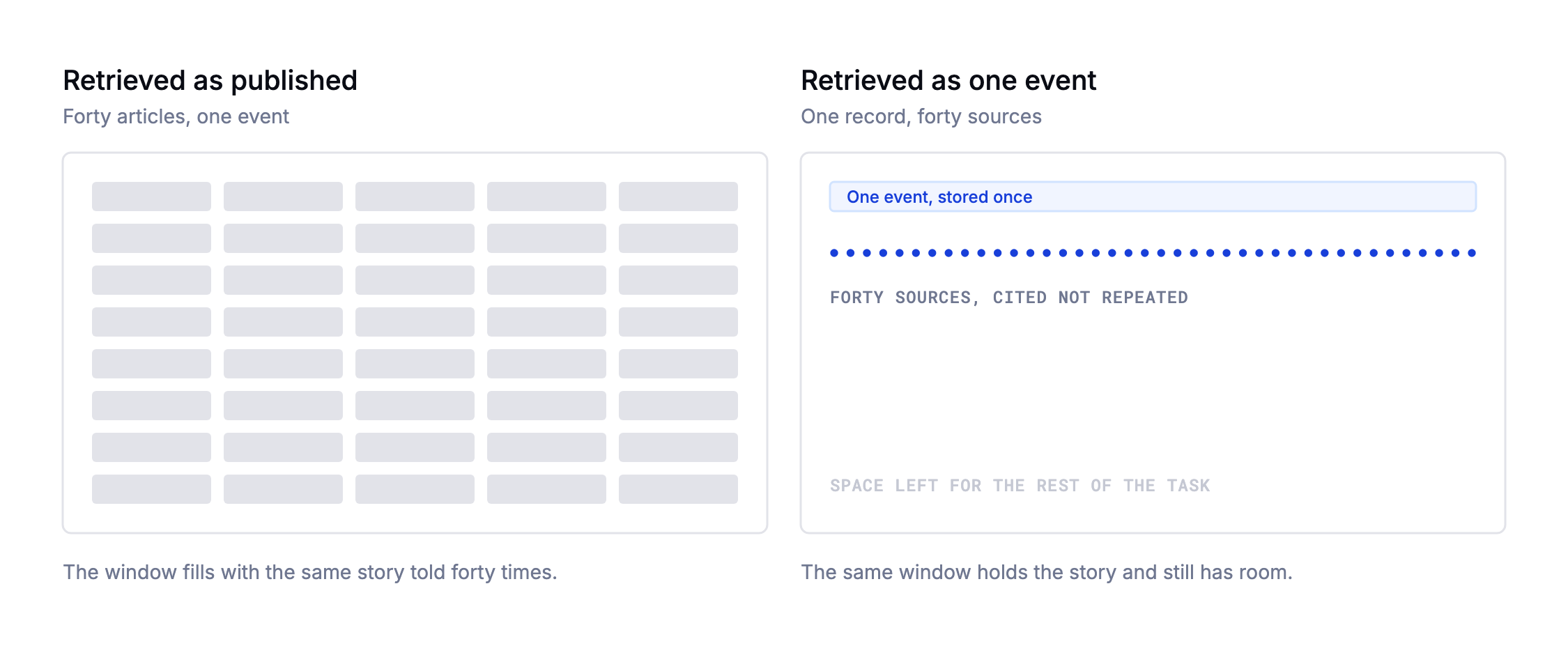
Clustering yields a second signal almost for free: how many distinct newsrooms carried the story. That count is something an agent can reason over and cite. A story reported by dozens of newsrooms is a stronger input than one reported by a single outlet: the first supports a confident claim, and the second calls for a hedge or a second source. A ranked list of links gives the agent no such distinction.
Missing enrichment at index time forces re-processing at query time. For an agent, that means running entity and sentiment models over raw text while the user waits, a gap that event-driven web search is designed to close.
That cost compounds per task, not per call. An agent working a research question issues several searches, refining the query or following a new entity at each hop, and pays the full tax on every one of them. Latency adds up across hops, noisy results from an early search can steer the next query off course, and one failed fetch can stall the whole chain. Clustering and enrichment at index time move that work out of the loop, so each hop returns results the agent can use as they arrive.
How should teams query a news index for analytical use cases?
Use boolean queries on /articles when the terminology is fixed, as in regulatory monitoring, and plain-language queries on /search when events move fast and the vocabulary is unpredictable. Most of the work is choosing the endpoint that fits the use case and, on /search, the effort level.
How do plain-language and boolean queries differ?
/search takes a question in plain words or loose keywords and does the ordering for you; /articles takes a boolean query and returns every match. Plain words suit breaking geopolitical events, where the vocabulary around a fast-developing crisis is unpredictable. Relevance ranking scores every article on its match to the request, publisher authority, newsroom coverage and freshness; medium effort adds a cross-encoder rerank of the top stories, and high effort adds an LLM pass that merges stories about the same event. Boolean matching suits regulatory monitoring, where statute fixes the terminology and naming the agency and the action with AND, OR and NOT does most of the work. It also returns every match, which is what you want when a missed enforcement action costs more than a ranked sample saves.
How to set date windows and monitor cadence together
Every analytical query needs a time window. The window and monitor frequency should be set together: a 7-day window on a weekly monitor has no gap, but a 7-day window on a monthly monitor leaves three weeks of blind spots.
Which query patterns fit each use case?
| Use case | Endpoint and query | Window | Notes |
|---|---|---|---|
| Regulatory enforcement actions | /articles with a boolean q naming the agency and the action | 7 days | Every match, newest first, 5 credits per page; re-run weekly |
| M&A signals by sector | /search with a plain-language q naming the companies, effort: medium | 30 days | Best articles grouped into stories, 5 credits per search; re-run monthly |
| Breaking geopolitical events | /search with a plain-language q, effort: high | Past 24h | Merges stories about the same event, 10 credits per search; re-run daily |
| Competitor product launches | /search with company names as keywords and NOT to cut noise, effort: low | 14 days | First ranking only, 1 credit per search; re-run weekly |
The News API’s /search returns the best articles of the last 30 days, ranked and grouped into stories. /articles serves the exhaustive case: it takes a boolean query, returns every match newest first across the last 12 months, and pages through the first 1,000 results per query. To re-run a query on a schedule and receive only what is new since the last run, use an Agent monitor. Effort level is the other dial worth setting per /search use case, and the next section covers what each one costs.
What does a purpose-built news index look like in practice?
The right index for programmatic use is one built for retrieval, not discovery. For AI agents, RAG pipelines, and monitoring workflows, that means a purpose-built news index with curated sources, index-time enrichment, and story-level clustering. NewsCatcher's News API, for example, runs on a proprietary index of 140,000+ sources. Most articles carry an AI summary, and non-English articles also get an English headline and summary, so an English query can surface German, Japanese or Arabic coverage too. Enterprise plans add named entities, sentiment and themes to every result as structured fields.
The /search endpoint exposes three effort levels that reflect different points on the quality-versus-latency tradeoff. Low effort (1 credit) runs first-ranking only and suits high-volume feeds and dashboards. Medium effort (5 credits) applies a cross-encoder rerank of the top stories and handles plain-language queries well. High effort (10 credits) adds LLM-level judgment to merge stories covering the same event, trading speed for the best overall quality: the right mode for research briefings where a missed story has a real cost. Enterprise plans can also include a 1,024-value embedding per article, which supports semantic clustering and similarity search in downstream RAG pipelines without running a separate embedding model against raw text.
Every result says which story it belongs to (the group of articles that report the same event) and how many newsrooms cover it. Copies of one article always come back as one result, collapse can return one article per story, and min_newsrooms keeps only widely covered stories, so most deduplication happens before results reach your pipeline.
How do you evaluate a web index for programmatic use?
The difference between a general-purpose index and a domain-specific one shows up in recall, not speed. Your results inherit the seed list, the crawl schedule, and the enrichment decisions made long before your query arrives. Getting those inputs right is what separates a monitoring workflow that fires on the right signal from one that misses it entirely.
When choosing an index for programmatic use, five criteria determine whether it meets your requirements:
- Source count and curation method. A curated list of 140,000+ sources gives a defined recall boundary for the verticals you name, which an emergent corpus built by following links cannot. Ask how sources are added, how often the list is audited, and whether the specific verticals your pipeline covers (government portals, regulatory agencies, trade press) are explicitly included.
- Enrichment exposed as structured fields. Named entity extraction, sentiment scoring, topic classification, and language detection are only useful if they were computed at index time and come back as fields you can read. If those signals must be recomputed against raw text on your side, the index is not saving your pipeline any work.
- Publication-to-query latency. The number that matters is the time from publication to queryable record, not crawl frequency alone. Do not take a vendor figure on trust. Ask whether the response carries both the publication time and the crawl time, then measure the gap yourself on your own sources: the News API returns
published_atandcrawled_aton every article, and you can sort by either. - Deduplication and clustering behavior. An index that ships raw syndicated articles forces your pipeline to resolve hundreds of near-identical records per event. Verify whether clustering happens at index time or only at query time.
- Delta delivery for monitoring workflows. An index with no memory of previous queries pushes the state management onto you. One with scheduled monitors that return only what changed since the last run does not. This is the difference between an alert system that works and one that pages someone twice about the same story.
FAQ
How does robots.txt limit what a news index can cover?
A compliant crawler reads robots.txt before each fetch and skips every path the publisher disallows, so those pages never enter the index, even from a source on the curated list. Publishers can disallow whole sections or specific crawlers, which is why two indexes covering the same domain can hold different subsets of it. Ask any vendor whether it honors robots.txt and how it treats disallowed sections.
How often should a news index re-crawl government sources?
Set the revisit interval per source from its publishing rhythm, not one schedule for every domain. An agency newsroom that posts notices throughout the day needs frequent visits, while a bulletin that updates weekly only wastes crawl budget when checked hourly. Where a source publishes a sitemap or feed, check it between full visits to see what changed.
What happens to an indexed article when the publisher updates it?
A re-crawl detects the change, and the index either overwrites the stored record or adds a new version with its own timestamp. Overwriting keeps the corpus smaller; versioning lets you see what a source said before a correction, which matters for audit trails and for monitors that should flag material updates.
Why do paywalled and JavaScript-heavy pages leave gaps in a web index?
A crawler sees only the freely accessible part of a paywalled article, and content built client-side in JavaScript appears only if the crawler executes that code in a headless browser. That costs more per page than a plain HTTP fetch, so it is usually reserved for sources where it is needed.
How do you check whether an index covers a specific source?
Query for recent articles you already know a source published, including a few from niche domains, and count how many come back. A miss on a niche domain points to a gap in the source list rather than slow crawling.