







Ask an agent about a company's latest acquisition and it'll answer from whatever it saw before its training cutoff. If the deal fell apart last month, you'll still get a confident, well-reasoned answer about a deal that no longer exists. Live news in the agent's context fixes that, and wiring it up isn't much work once you've picked the route that suits your team.
In regulated industries, the slow part is procurement. Legal will ask two things before anything ships. Does the provider's license let you put its articles into an AI system? And who's liable once they're in there?
This guide covers how to pick the best route for getting live news into your agent, and what to have ready when legal and procurement ask.
What are agentic AI workflows?
An agentic AI workflow is a process built around a goal, with an AI agent doing the work. The agent breaks the goal into steps and works through them on its own. Most AI assistants act as agents now. What makes it a workflow is that someone decides the goal, when it runs and where the result goes.
Tool use is how an agent gets live news into a workflow. The agent reads an internal database or the CRM, searches a document store, and acts on what it finds, because everything it knows beyond its training data comes through a tool. When a step depends on what happened this week, say a regulator's announcement or a supplier's bankruptcy filing, the tool it needs is a live news API.
At a consulting firm, that might be a Monday workflow that briefs analysts on a client's market, with the agent pulling the week's coverage first. At a bank, the goal could be flagging credit events on borrowers as soon as they're reported. A pharma team can run one that tracks competitors' regulatory approvals and posts each new one to the team.
Why do AI agents need real-time news data?
An agent's own knowledge ends at its training cutoff. While most AI assistants today have a built-in web search feature, it typically surfaces only a fraction of the articles that were actually published.
A workflow you run on a schedule that needs every relevant article needs an API. A news API hands it the newest articles as structured data, each with a publication date, a source and the companies it mentions.
What to look for in a news API for AI agents
Agents use news APIs differently from people looking at a dashboard. An agent reads every field it's given, but often can't tell when a layout looks off, or when something changes upstream. It might start failing without any errors at all. Put these in the technical spec when you compare providers.
- Full article text. Headlines and snippets are a good starting point, but an agent that has to reason over the news needs the whole article. You could write your own scraper, but it's much more convenient when the API already includes the full text.
- Deduplication. When a big story breaks, dozens or even hundreds of outlets publish near-identical versions of it, and an API that returns every copy fills the agent's context with noise. That's both expensive and makes for worse output. A good news API groups them into one story, with citations, so the agent just needs to read each event once.
- Enrichment done on the provider's side, with sentiment, named entities and themes already attached. Otherwise every article needs a separate processing step, often an LLM call, before your agent can use it.
- Coverage beyond English. An agent watching suppliers in Poland or Brazil needs local sources in local languages, or it will only hear about events once the international wires pick them up.
- Low update latency, the gap between an article going live and the API returning it. An agent that reacts to news, like a new regulatory ruling, can only act once the API returns the article.
- An uptime SLA. When a news API stops working, your workflow won't necessarily notice right away. The agent's answers just get worse. For anything running in production, you want a provider that takes uptime seriously and puts it in writing.
- Archive depth, for agents that need history. An agent checking a supplier's track record needs years of coverage, not just last week's, and a new knowledge base starts empty unless you can load past coverage into it.
- License terms that explicitly permit commercial use of news content, including inside systems that use AI, since a general commercial license may not allow AI use.
The table below shows how much each of these matters, depending on what kind of agent you're building.
| Criterion | Importance |
|---|---|
| Full article text | Essential |
| Deduplication | Essential |
| Enrichment done on the provider's side | Useful, saves a processing step |
| Coverage beyond English | Essential for non-English markets |
| Low update latency | Essential for agents that react to events |
| Uptime SLA | Essential in production |
| Archive depth | Essential when the agent needs history |
| License terms that permit AI use | Essential |
How does a news API fit into a RAG pipeline?
RAG, or retrieval-augmented generation, means handing the model relevant documents before it answers. In a RAG setup, the news API does the retrieval, so the model works from fresh coverage instead of training data that may be months or years out of date.
RAG doesn't need an agent, but an agent can use RAG as a tool and decide for itself when to look something up, a setup known as agentic RAG.
The flow works like this:
- A user query or an agent trigger fires.
- The news API fetches articles filtered by keyword, topic, date or source.
- Those articles get chunked and ranked for relevance.
- The top results go into the LLM prompt as grounding context.
- The LLM generates a response anchored to current information.
How to integrate a news API with Python
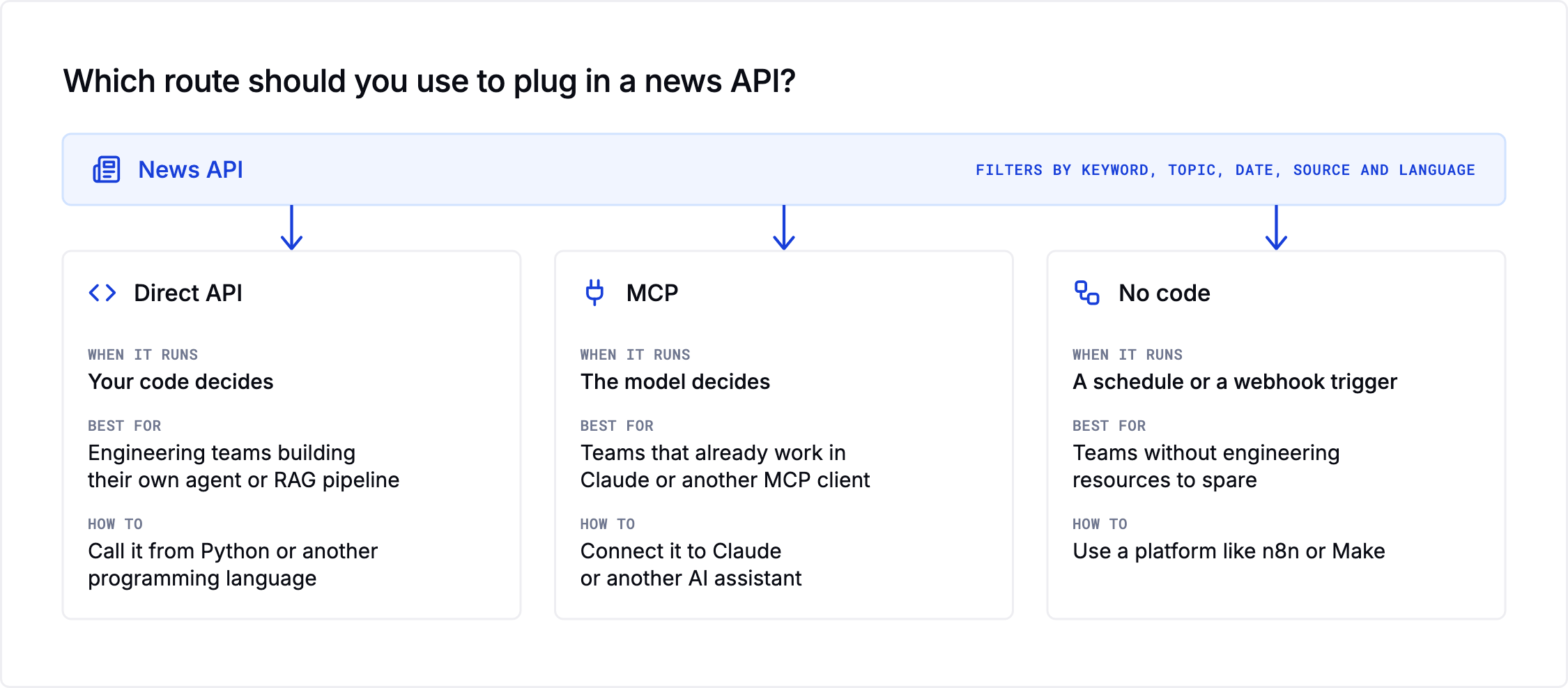
If your team writes Python, the shortest route to integrate a news API is as follows: you authenticate with an API key, search for the articles you need, and hand the results to the agent's context window or retrieval step. The function below covers the first two parts, using NewsCatcher's News API.
import requests API_KEY = "YOUR_API_KEY"
BASE_URL = "https://v3-api.newscatcherapi.com/api" def fetch_news(query: str, window: str = "1h") -> list[dict]: response = requests.get( f"{BASE_URL}/search", headers={"x-api-token": API_KEY}, params={ "q": query, "from_": window, # how far back to search: "1h", "24h", "7d" "lang": "en", "sort_by": "date", "include_nlp_data": "true", # adds an nlp block: summary, sentiment, entities }, timeout=30, ) response.raise_for_status() return response.json().get("articles", [])
Three details matter once this runs in production.
- If the agent checks every 30 minutes, ask for the last hour (
from_="1h") so the runs overlap, and turn onby_parse_date. The hour then counts from when each article reached the API instead of its publish time, so late arrivals aren't missed. Skip any articleidyou've already stored. - Keep
raise_for_status(). If a request fails, the run stops instead of handing the agent an error message it might treat as news. A 429 error means you've sent too many requests, so wait and retry. A 422 means a parameter is wrong, so fix the request instead. - Each article object has
title,link,published_date, and the text incontent. Turn oninclude_nlp_dataand there's also annlpblock with a shortsummary. Use that summary in the prompt when the agent doesn't need the full text, since it costs a fraction of the tokens.
How to connect a news API to Claude with MCP
Model Context Protocol (MCP) is an open standard for connecting AI models to outside tools. Once you've connected Claude to a news API's MCP server, Claude can search the news by itself in the middle of a conversation, whenever it decides a question needs current information.
If you're using a hosted MCP server, such as the one for NewsCatcher's News API, you don't need to build anything. It's already running at https://news-mcp.newscatcherapi.com/mcp and comes with nine tools for working with the API, such as search_articles, get_latest_headlines and get_breaking_news (setup docs).
In Claude.ai or Claude Desktop, you add it as a custom connector and put your API key in the URL. In Claude Code, it's a single command:
claude mcp add --transport http news "https://news-mcp.newscatcherapi.com/mcp" --header "x-api-token:YOUR_API_KEY"Other MCP clients, like Cursor, VS Code, Windsurf and Gemini CLI, use the same URL and take the key in an x-api-token header.
When Claude calls a tool, the server passes the query on to the News API, and the filtering by date, source, language or keyword happens there, before anything reaches Claude. That cuts token usage, and Claude gives better answers because it reasons over a short list of relevant stories.
Use MCP for questions that come up during a session. For scheduled ingestion or webhook delivery, use the Python route or a no-code workflow instead.
How do you connect a news API to n8n or Make?
With n8n or Make (formerly Integromat), you can build news API calls into agent workflows with several steps, without writing a full application.
How does n8n handle news API integration?
n8n handles it with an HTTP Request node. The API key goes into a header credential, and the nodes you add after it parse, filter and route whatever comes back. Here's a typical setup.
- A Schedule Trigger runs every 15 minutes, or a Webhook node starts the run when another system calls it.
- The HTTP Request node queries the news API for a keyword, with a
from_window that matches the schedule. - A Code node keeps only the fields you need, like the title, source and published date.
- A Filter node removes articles below a relevance threshold.
- Whatever is left gets sent to Slack, a vector database or an LLM prompt.
How does Make handle the same workflow?
Make gets there with a chain of visual modules. An HTTP module fetches the news, a JSON parser picks out the fields, and a Router sends each article to Slack, a vector database or an LLM prompt, depending on its topic or sentiment.
Both platforms also let you write code. As of October 2026, the main differences are hosting and billing.
| Aspect | n8n | Make |
|---|---|---|
| Where it runs | n8n's cloud, or your own servers (free Community edition) | Make's cloud only |
| What you pay for | Each workflow run, however many steps it has | Each module run, usually one credit |
| Custom code | JavaScript or Python, in a Code node | JavaScript or Python, in a Code app (paid plans) |
| Calling the news API | HTTP Request node, key in an x-api-token header | HTTP module, key in an x-api-token header |
For regulated teams, n8n is usually the better fit. Self-hosted, it keeps the workflow, and every article that passes through it, on servers the team controls.
Which licensing questions should enterprises ask a news API provider?
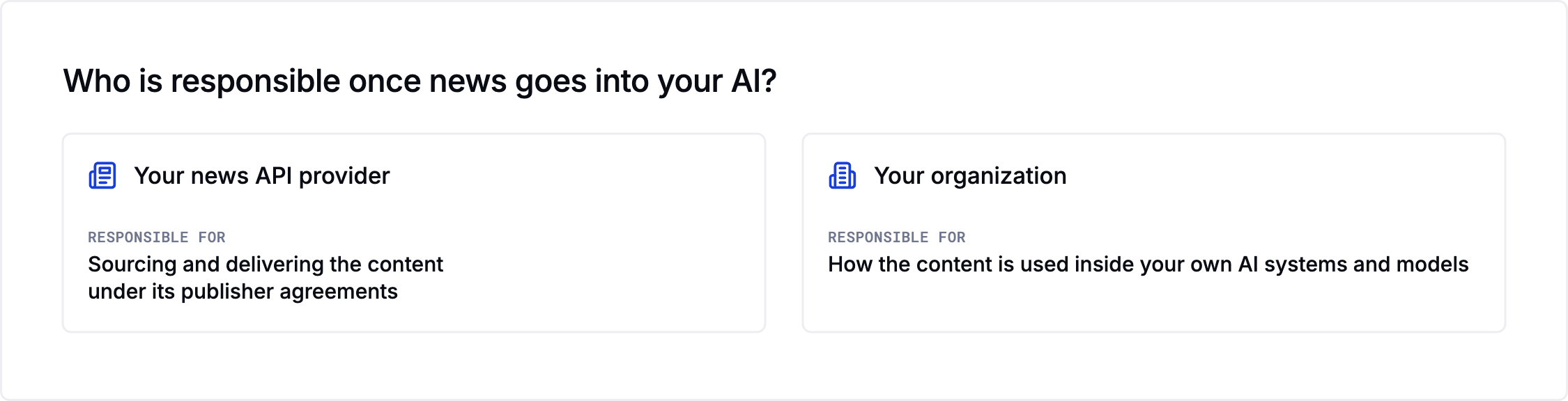
When enterprises review a news API for AI use, it comes down to two questions. Does the provider's license allow its content to be delivered into AI systems? And who is liable once that content is inside them? Get both answered before you sign.
The first question is about agentic usage rights. To a procurement team, putting articles into an AI agent or a RAG system is a different use from showing them on a dashboard. They'll want it in writing that the provider's license permits it. Ask for a copy of the provider's data licensing terms and look for the clause on AI use. In NewsCatcher's case, the data licensing terms cover commercial use of news content, including structured delivery to downstream AI systems.
The second question is about liability, and responsibility splits in two. The provider answers for sourcing and delivering the content under its publisher agreements. What happens to the content inside your own AI systems and models is your organization's responsibility, which is why your legal counsel should look at the downstream obligations under copyright law, and at any AI-specific rules where you operate. In regulated industries, vendor reviews often won't clear onboarding until this is confirmed.
How do regulated industries approach news API procurement for AI?
Vendor assessments in regulated industries like financial services and banking, pharma and government go further than a typical SaaS review. If you're the architect of the AI system, have these documents ready before the procurement committee asks for them.
| Document | What it shows procurement |
|---|---|
| SOC 2 Type II report | Security controls were independently audited over an observation period, rather than checked at a single point in time |
| Penetration test results | How the systems held up under outside testing, ideally including zero-knowledge (black-box) tests |
| US entity incorporation | Which legal entity signs the contract and which jurisdiction governs it |
| Data residency and retention policies | Where news content is stored, for how long, and whether it crosses borders that matter to your compliance team |
| Uptime SLA with remediation terms | What the provider owes you when the API goes down, beyond an availability claim on a marketing page |
FAQ
How should duplicate articles be handled when a news API feeds a RAG system?
The costliest duplicates are copies of one story. One Reuters or AP article can get republished by dozens of news outlets, and if every copy reaches the prompt, you pay for the same paragraphs many times over while the agent reads the same framing again and again. NewsCatcher's News API can remove those copies before they reach you with exclude_duplicates. It keeps the most authoritative version, tells you how many copies it removed in duplicate_count, and checks each article against the previous seven days.
Does update latency affect an agent's output quality?
Mostly for agents that have to act within seconds. For monitoring, research and RAG, archive depth and enrichment matter more than a few minutes of delay. As of October 2026, the NewsCatcher News API makes articles searchable 5 to 10 minutes after publication, which suits those well but is too slow for uses like high-frequency trading.