










Your data pipeline has different needs depending on what you're building. Are you looking to monitor news coverage with traceable sources and structured metadata? Or do you need coverage across forums, documentation, blogs, and other niche sources? News APIs and web search APIs are built for these different scenarios. This post walks through how to recognize which one is right for you.
What does a news API do?
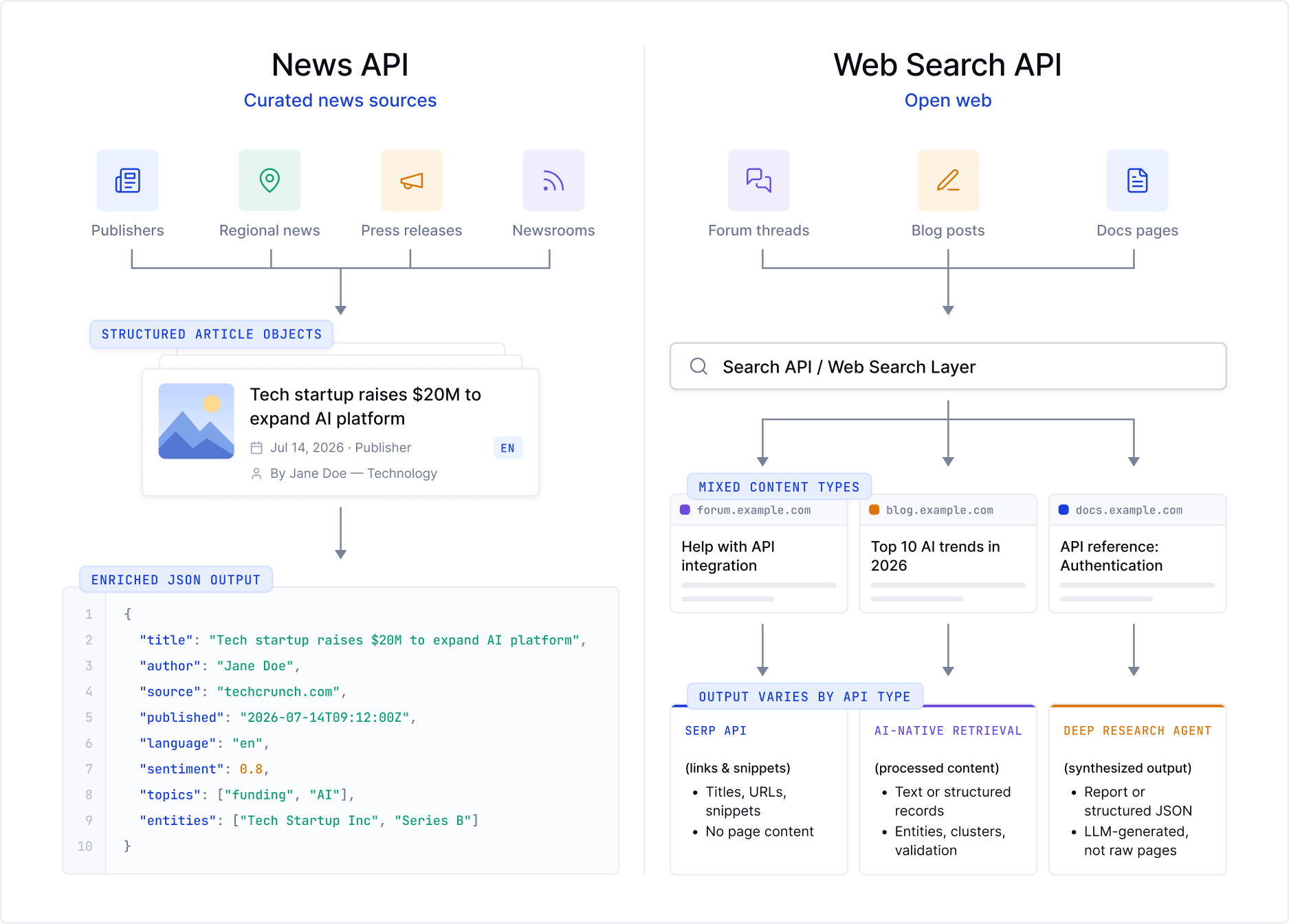
A news API connects directly to a continuously updated index of published journalism. Instead of crawling the open web, it pulls from a curated network of news sources, including national outlets, regional publications, press releases and newsrooms, returning structured article objects with fields like headline, publication date, source name, and sentiment scores.
The query model is built around editorial content. You filter by keyword, topic, source, language, country, or date range, and get back articles that a journalist or editor intentionally published. Coverage is typically historical as well as near real-time, so you can retrieve articles published years ago alongside breaking stories.
For teams building media monitoring tools, financial sentiment pipelines, or AI agents that need traceable, citable sources, news APIs offer something web search cannot: verified editorial sources. Every result comes from a curated publisher list, with structured metadata like publication date, author, and outlet attached at scale. If that sounds like what you're looking for, see our guide on how to choose a news API.
What does a web search API do?
A web search API queries a continuously updated index of the open web. Feed it a query, and depending on the specific API you're using, you get back anything from ranked URLs and snippets to extracted content and structured records.
The scope is deliberately broad. A web search API might cover forums, blogs, product pages, social content, academic papers, government sites, and news articles mixed together in a single result set. Ranking logic often mirrors general search engine behavior, weighing authority signals, relevance scores, and freshness across all content types.
For some teams, that breadth is the point. Use cases like retrieval-augmented generation (RAG), general knowledge grounding, and open-domain question answering require pulling context from anywhere on the web, not from a curated vertical.
The trade-off is that you get mixed content types with inconsistent structure. Structured data extraction from web search results requires attention to JSON schemas and validation, and relevance to any specific domain like finance or geopolitics depends heavily on how you write your queries.
What are the three types of web search APIs?
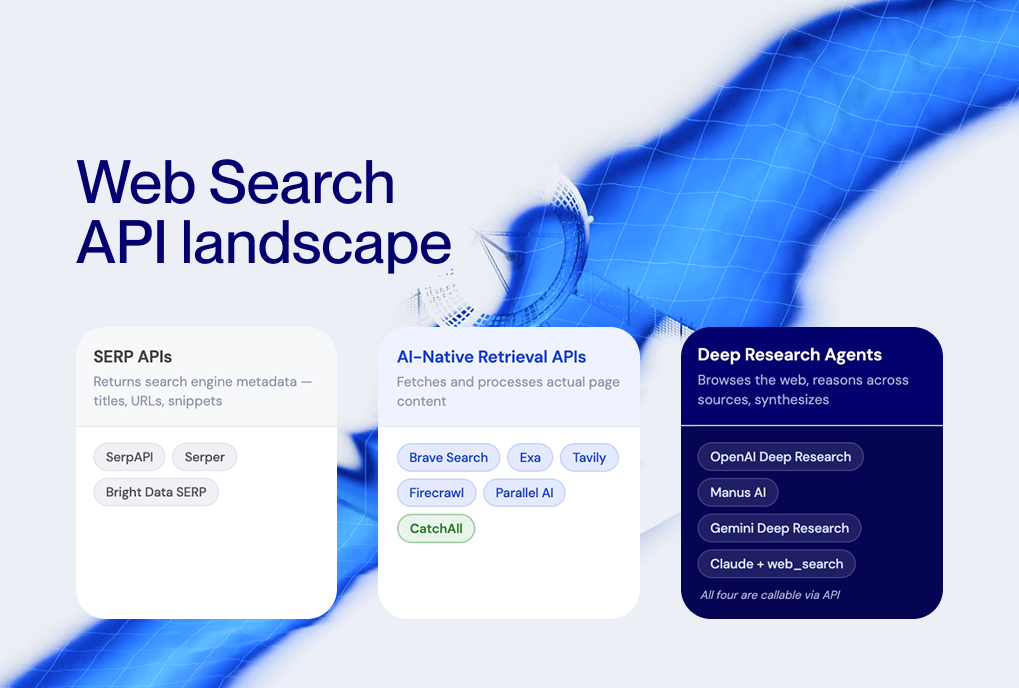
The term "web search API" can be somewhat confusing, as it covers three distinct product categories. Getting the distinction wrong could mean spending time and effort building features like extraction, validation, or deduplication: infrastructure you thought the API was handling. For a full breakdown including pricing and benchmarks for each category, see our guide to web search API types.
- SERP APIs return titles, URLs, and snippets. The same things a search engine shows a user. Page content is not included; if you need what's at the URL, you'll have to build the scraper yourself. Tools: SerpAPI, Serper, Bright Data SERP.
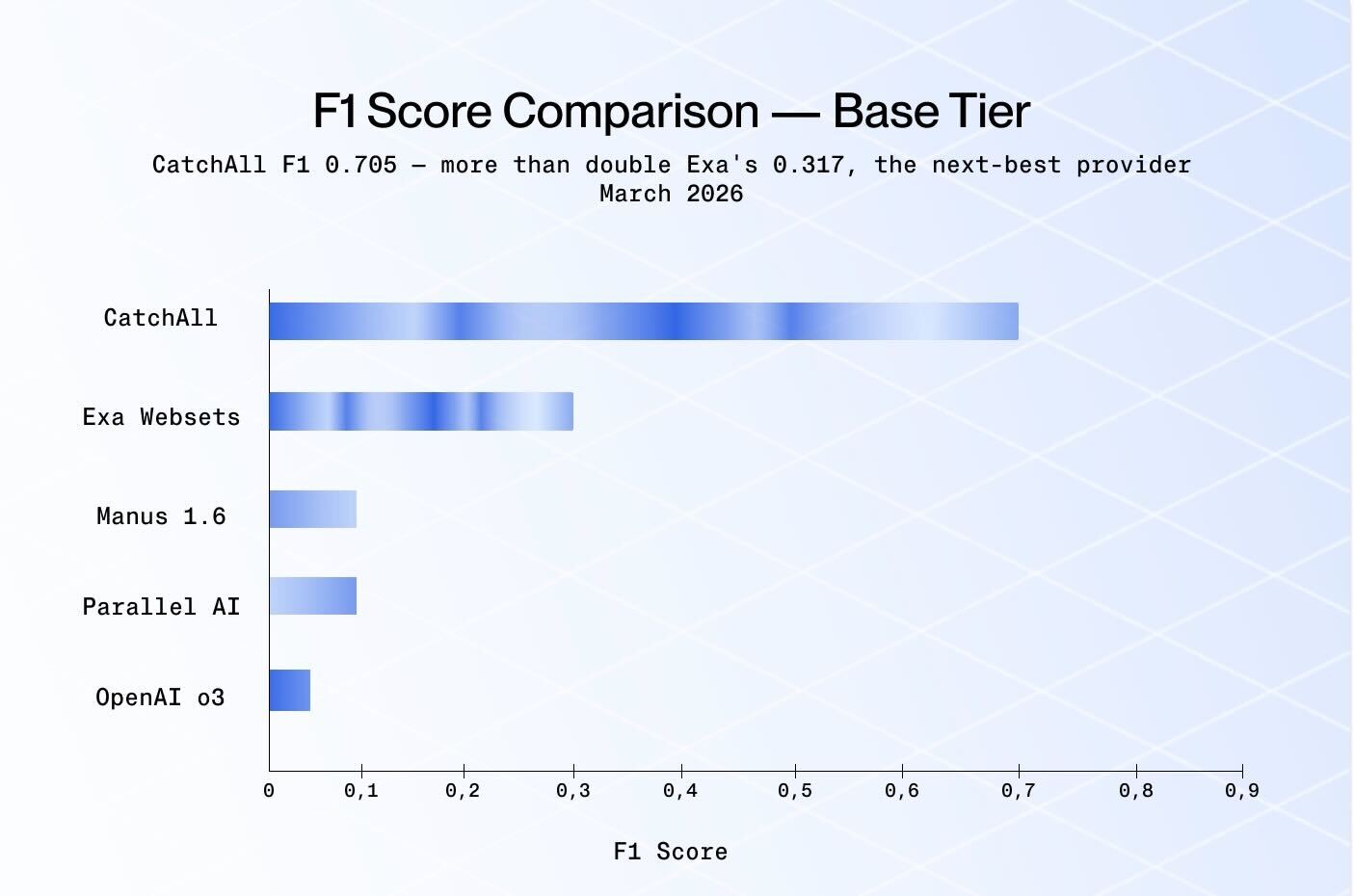
- AI-native retrieval APIs fetch and process the actual page content behind search results. The depth varies widely: on the lighter side, tools return cleaned text excerpts; meanwhile, full-pipeline tools like CatchAll cluster near-duplicates, validate records against custom criteria, extract named entities, and return deduplicated structured records. Tools: CatchAll, Exa, Tavily, Firecrawl, Brave Search API.
- Deep research agents use an LLM to browse sources and synthesize findings into narrative or structured JSON output. The right fit when a person reads the result, not when it's intended for a pipeline that consumes it. Tools: OpenAI Deep Research, Manus AI, Gemini Deep Research.
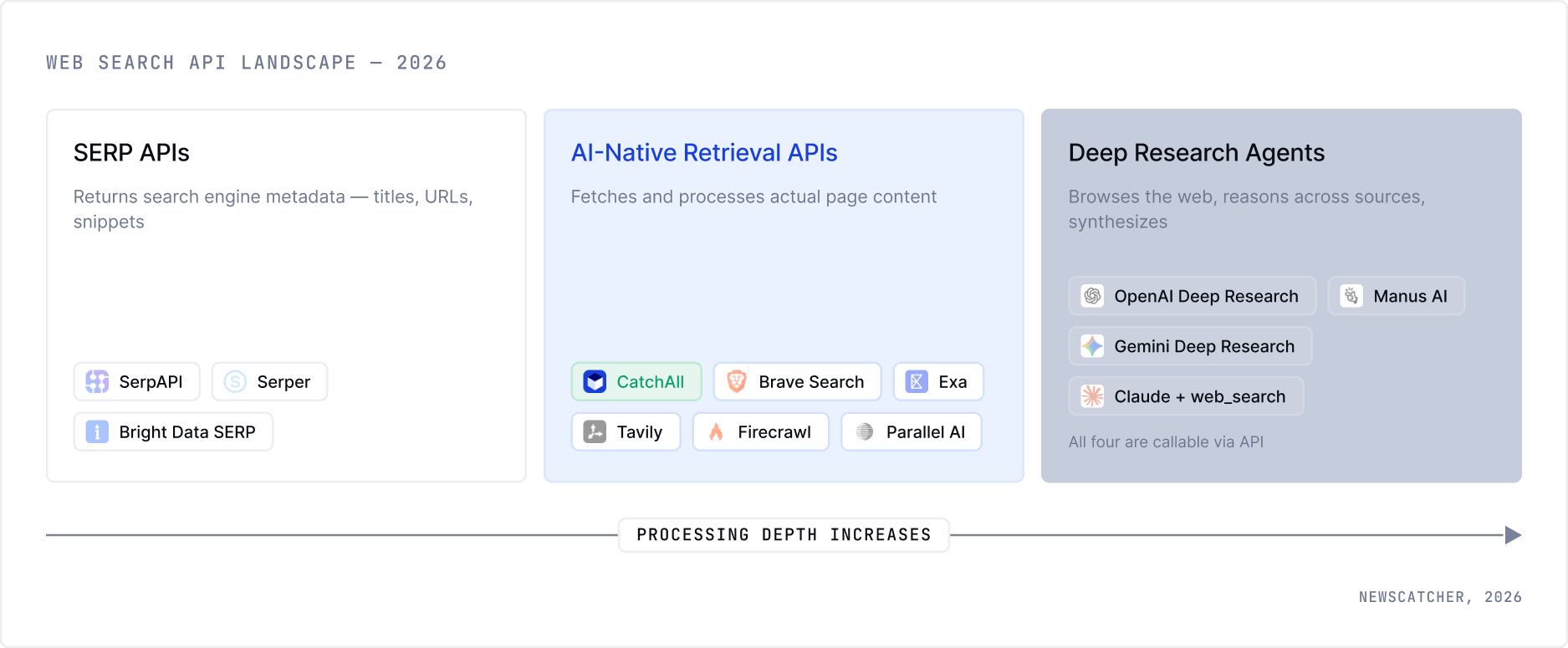
News API vs web search API: Core differences
How you work with each API type differs across six concrete dimensions.
| Dimension | News API | Web Search API |
|---|---|---|
| Source coverage | Curated index of verified news publishers: national and regional outlets, press releases, newsrooms | Open web: news, forums, blogs, product pages, academic papers, government sites |
| Query style | Keyword, boolean, and filter-based search (source, language, date, topic) | Varies by type: From keyword strings (SERP APIs) to natural language queries (AI-native retrieval, deep research agents) |
| Output format | Article objects with headline, body text, sentiment, author, and outlet metadata | Varies by type: SERP APIs return ranked URLs and snippets; AI-native retrieval APIs return anything from processed content to text excerpts, to validated and enriched structured records; deep research agents return synthesized narrative or structured records. |
| Metadata | Includes publication date, author, outlet, sentiment, and entities | Varies by type: from none (SERP APIs) to extracted entities and structured fields (AI-native retrieval APIs) |
| Response latency | Near real-time (seconds) | Varies by type: SERP APIs respond in under a second; AI-native retrieval APIs range from seconds to several minutes; deep research agents typically take several minutes per job |
| Delivery model | Synchronous API pull | Varies by type: SERP (synchronous); AI-native retrieval (mostly synchronous; full-pipeline tools like CatchAll run asynchronous jobs with poll/webhook delivery); deep research (long-running, asynchronous) |
When should you use a news API?
A News API fits your stack when the source, timing, and structure of information are what matter most. If you're building a financial signal monitor, a competitive intelligence feed, or a media monitoring tool, you need articles from verified publishers with accurate timestamps.
You get structured metadata out of the box: publication date, source domain, author, sentiment signals, and category tags. That structure cuts the preprocessing work your pipeline would otherwise handle.
The clearest signal that you need a News API is editorial provenance. When your application needs to answer "which outlet reported this first" or "how is this story trending across regions," a general web search index won't give you that resolution. Teams building PR and media monitoring tools (where media monitoring means tracking and analyzing brand mentions across traditional and digital channels) will find this distinction especially important.
When should you use a web search API?
Web search APIs cover three architectures, and the right type depends on what your pipeline produces. The scenarios below map primarily to AI-native retrieval APIs with notes on where SERP APIs and deep research agents fit instead.
A few scenarios where web search is the right call:
- AI-native retrieval: You're building retrieval-augmented generation pipelines where answer quality depends on source diversity across the open web.
- AI-native full pipeline: Your use case requires indexing niche domains, community sites, or technical documentation that dedicated news APIs won't crawl. NewsCatcher's CatchAll web search API for real-world events was built for these broader discovery scenarios.
- SERP API: You need to track search rankings, monitor SERP features, or generate URL discovery feeds for a custom downstream pipeline. The search result metadata is the data you need, not the page content behind it.
- Deep research agent: Your output is meant to be read and acted on by a person, not consumed by a pipeline. You need synthesis and reasoning across sources, not exhaustive record enumeration.
How to choose between a news API and a web search API
When the distinction between these two API types is clear, the decision usually follows naturally. A few questions cut through most of the ambiguity:
- Do you need content from a specific set of known publishers, or do you need to cast a wide net across the entire web? News APIs index from curated source lists, while web search APIs crawl broadly without editorial curation.
- Does freshness matter in minutes or days? News APIs are optimized for near-real-time article delivery; web search APIs vary widely in crawl frequency.
- Do you need publisher metadata like sentiment, author, and outlet fields out of the box? News APIs return enriched, publication-ready article records. With web search, it depends on the type: SERP APIs return raw snippets you parse yourself, while AI-native retrieval APIs return structured records, but without editorial metadata attached.
- Is your query intent informational or research-based, or do you need to monitor a specific topic or brand continuously? Research and informational queries point to a web search API. Monitoring could run on both sides: news APIs track ongoing press coverage, while web search APIs like CatchAll support recurring monitors, which are useful when information is scattered across sources. For continuous tracking, the tiebreaker is which sources you need covered.
How do NewsCatcher's news API and CatchAll compare?
NewsCatcher ships two APIs with different architectures, built for different retrieval patterns. Understanding the distinction is the fastest way to pick the right one.
News API: Structured article retrieval at index time
The News API indexes 140k+ global sources across 50+ languages and processes 1.5 million+ articles daily. Every article is normalized at index time: text enrichment runs on the raw text before the article hits your query results, so sentiment labels, named entities, themes, and summaries arrive as structured fields in the JSON response without any downstream processing step on your end.
The delivery model is synchronous. You send a keyword, boolean, or filter-based query (by source, language, date range, country, or topic) and get back article objects in seconds. Clustering groups articles covering the same story using embedding-based similarity, so you can deduplicate a topic stream or track coverage spread across hundreds of outlets simultaneously.
This architecture makes the News API the right fit for continuous monitoring pipelines, financial sentiment models, and RAG pipelines that need source-attributed and timestamped news context. The same goes for PR and media monitoring tools, where publisher identity and publication date are first-class signals.
CatchAll: Event-centric extraction across the open web
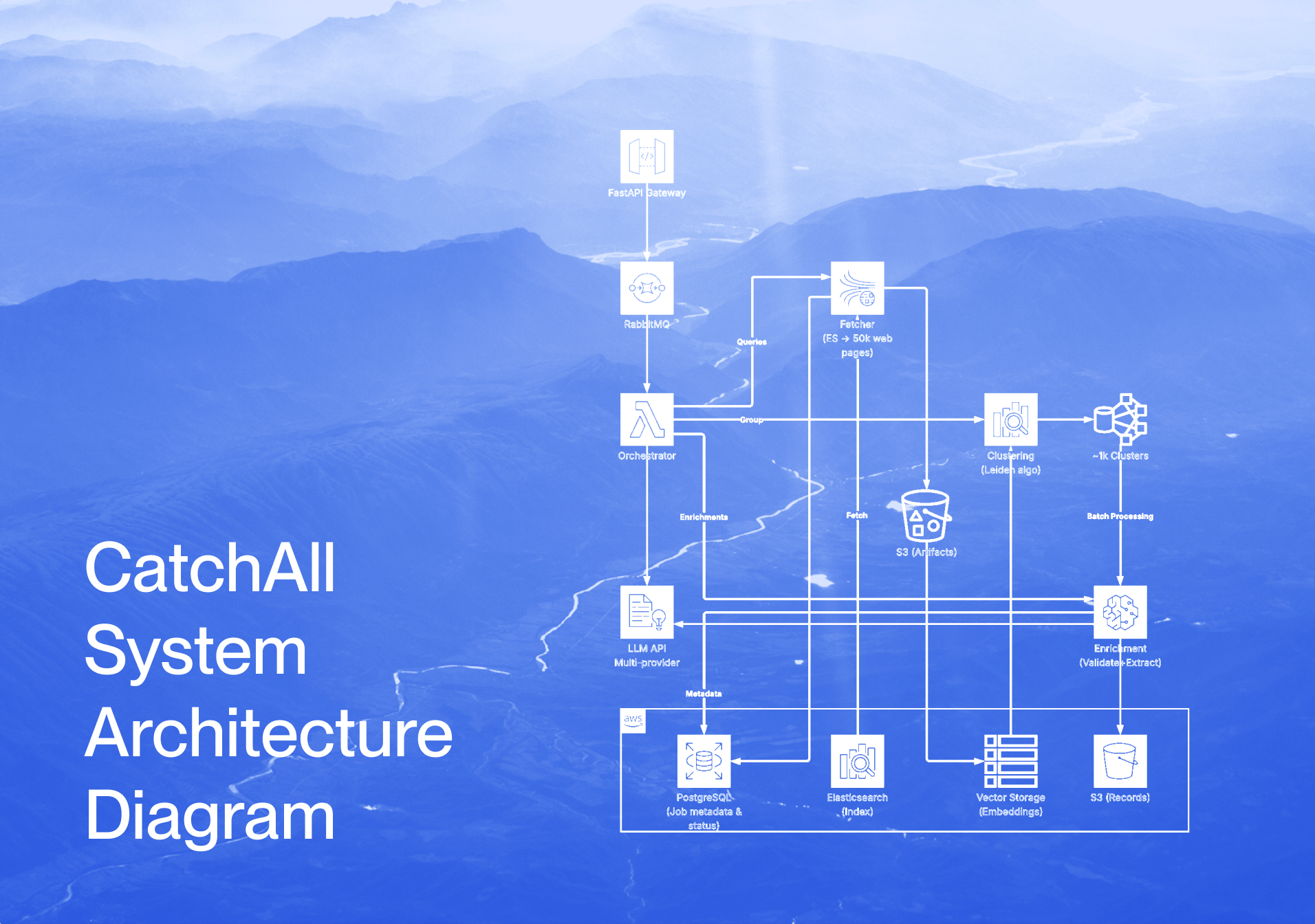
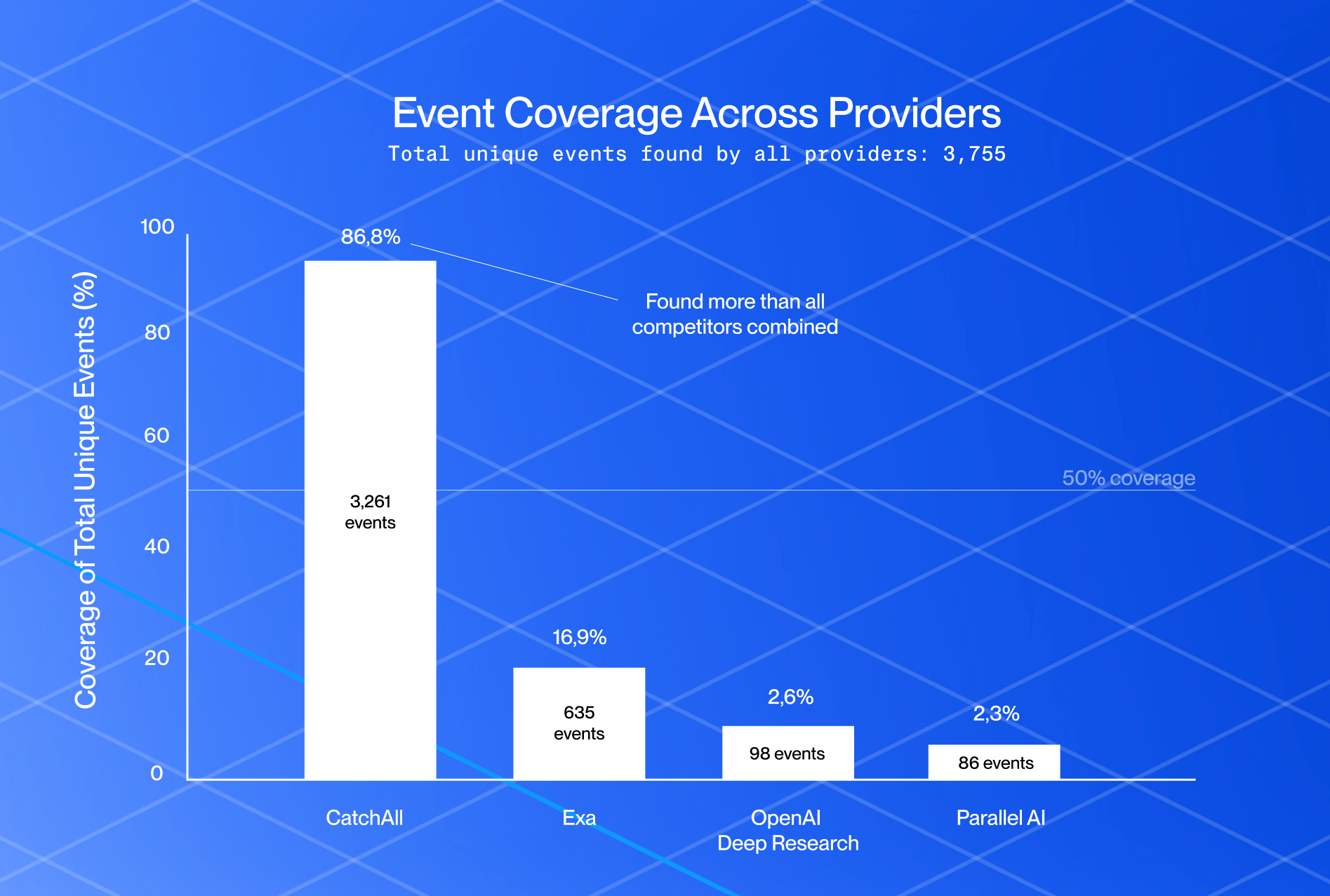
CatchAll is built on a larger index of 2+ billion web pages. That number is the practical difference between the two products: the News API returns what its curated publisher network covers, while CatchAll catches events wherever they surface, including corners of the web no news index reaches. More breadth also means more raw noise, so instead of returning a ranked list of links, it runs a multi-stage pipeline: it analyzes your plain-language query to generate targeted search queries and validation rules, fetches 50,000+ pages per job, clusters related pages into discrete real-world events using the Leiden community-detection algorithm, validates clusters against your criteria, and extracts structured JSON records with dynamically generated schemas.
The delivery model is asynchronous. Each job typically takes 10-15 minutes to process. You poll a status endpoint or receive results via webhook, and output arrives as structured event records with guaranteed fields (record ID, title, enrichment object, citations array) plus variable fields tailored to your query. You can define custom validators to filter which events qualify as well as custom enrichments to control what data gets extracted.
CatchAll also supports recurring monitors: schedule a query to run automatically and receive new events since the last execution, delivered by webhook. This is the right fit for teams building deep research agents (see our CatchAll + LangChain guide) or competitive intelligence tools, anywhere you need structured extraction from sources a curated news index won't cover, like trade publications, filings, and the long tail of the open web.
Both APIs support historical archives (News API back to 2019; CatchAll depending on your plan's search depth) and geographic and language scoping. The choice between them comes down to retrieval pattern: article pull from a curated news index, or event extraction from the broader web.
FAQ
Can I build a RAG pipeline that uses both NewsCatcher's News API and CatchAll at the same time?
Yes, and for many AI agent architectures it makes sense to do both. Route continuous topic monitoring and article-level grounding through the News API for near-real-time, structured retrieval. Use CatchAll for deeper, event-centric research jobs where you need coverage beyond traditional news outlets, with structured JSON and citation arrays included. The two APIs serve different retrieval patterns, so combining them by workflow type gives you broader coverage without sacrificing output structure in either path.
What is the difference between a news API and a web search API in terms of output structure?
A news API returns pre-structured article objects (including headline, full body text, publication date, author, outlet, and sentiment signals) pulled from a curated index of publishers. A web search API output depends on the type: SERP APIs return ranked titles, URLs, and snippets from a search engine index; AI-native retrieval APIs range from cleaned text excerpts to fully validated, deduplicated structured records; and deep research agents return synthesized narrative or structured JSON generated by an LLM. How much additional parsing you need varies widely across these three categories.
Should I use NewsCatcher's News API or CatchAll when building an AI agent that needs to monitor regulatory changes?
Use CatchAll for regulatory monitoring. It indexes government portals, state agency sub-pages, and niche trade publications that a standard news index won't cover, and it clusters related pages into discrete event records with extracted entities like agency names, ruling types, and effective dates. The News API works well for tracking media coverage of regulatory events, but CatchAll is purpose-built for the structured, recurring signal extraction that compliance and risk teams need. The same logic applies to any domain where the signal is fragmented across sources beyond traditional media, e.g. supply chain disruptions, product recalls, commercial real estate activity, and more.









.png)

.png)