










tl;dr: Enterprise risk management software helps teams manage known risks. A web search API adds the missing external layer, helping teams detect early signals across suppliers, cyber incidents, regulations, geopolitics, reputation, and market instability before they escalate.
Introduction
A smoke detector doesn’t wait for the whole building to catch fire. It monitors tiny particles in the air and triggers while there’s still time to act.
Risk teams need the same kind of early-warning signal. But enterprise risk rarely arrives as one clear alarm. It shows up in fragments across supplier updates, lawsuits, cyber reports, public filings, regulatory notices, local news, and company announcements.
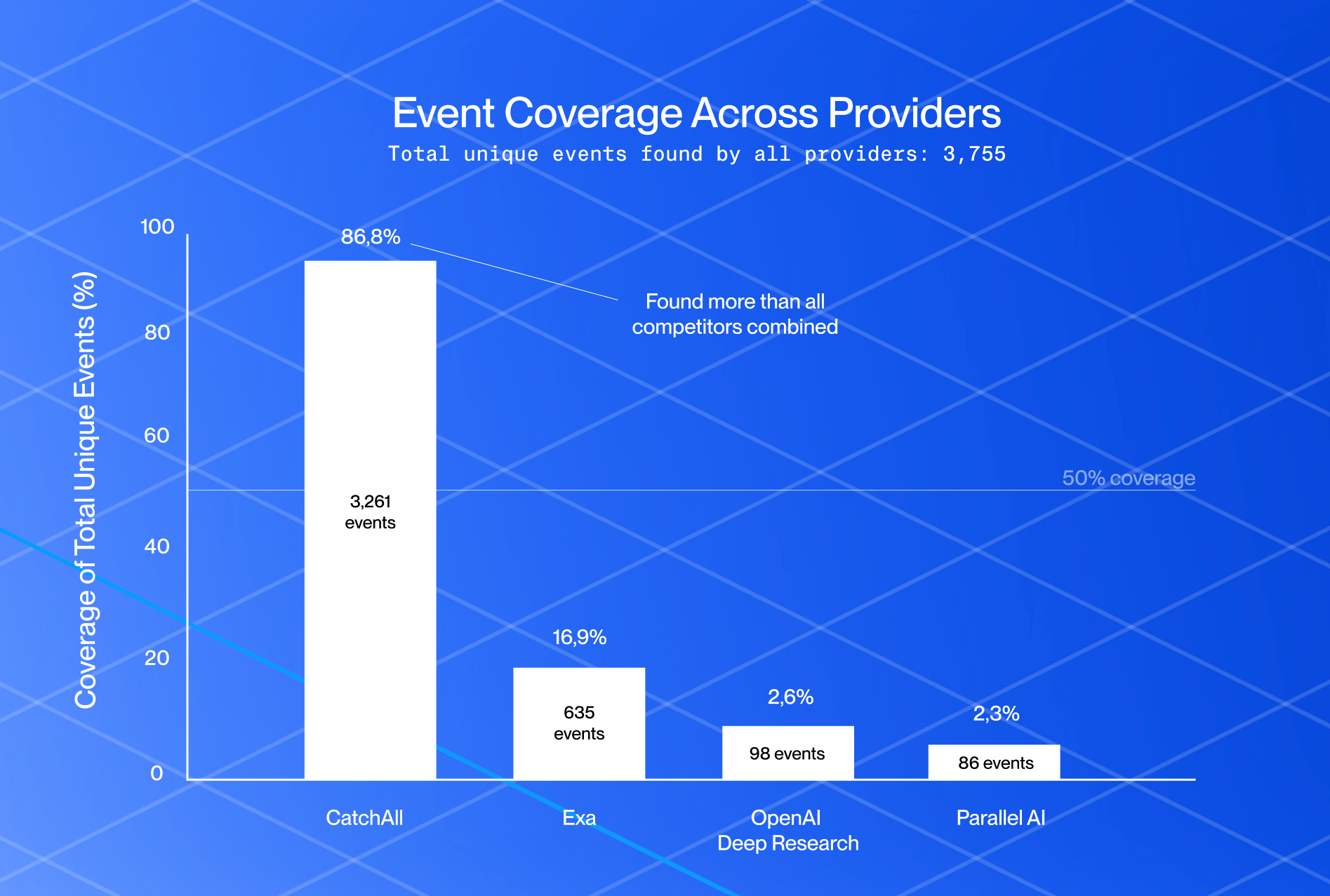
CatchAll closes that gap with high-recall web search. It helps risk teams catch scattered signals across the web early, from supplier disruptions and cyber incidents to regulatory actions and lawsuits, before they compound into crises.
Why do enterprise risk teams need broader external monitoring?
Enterprise risk teams need broader external monitoring because many risks appear both outside and inside the company. Traditional enterprise risk management software focused on internal risks like audit findings, compliance controls, vendor records, policy exceptions, and incident reports.
But many modern risks start outside the company.
Amneal Pharmaceuticals is a useful example. Before the FDA issued its 2025 warning letter, public recall notices had already flagged recurring quality issues, from overfilled drug containers to particulate and microbial contamination. The warning letter did not appear out of nowhere. It escalated a pattern already visible across regulator-posted signals.
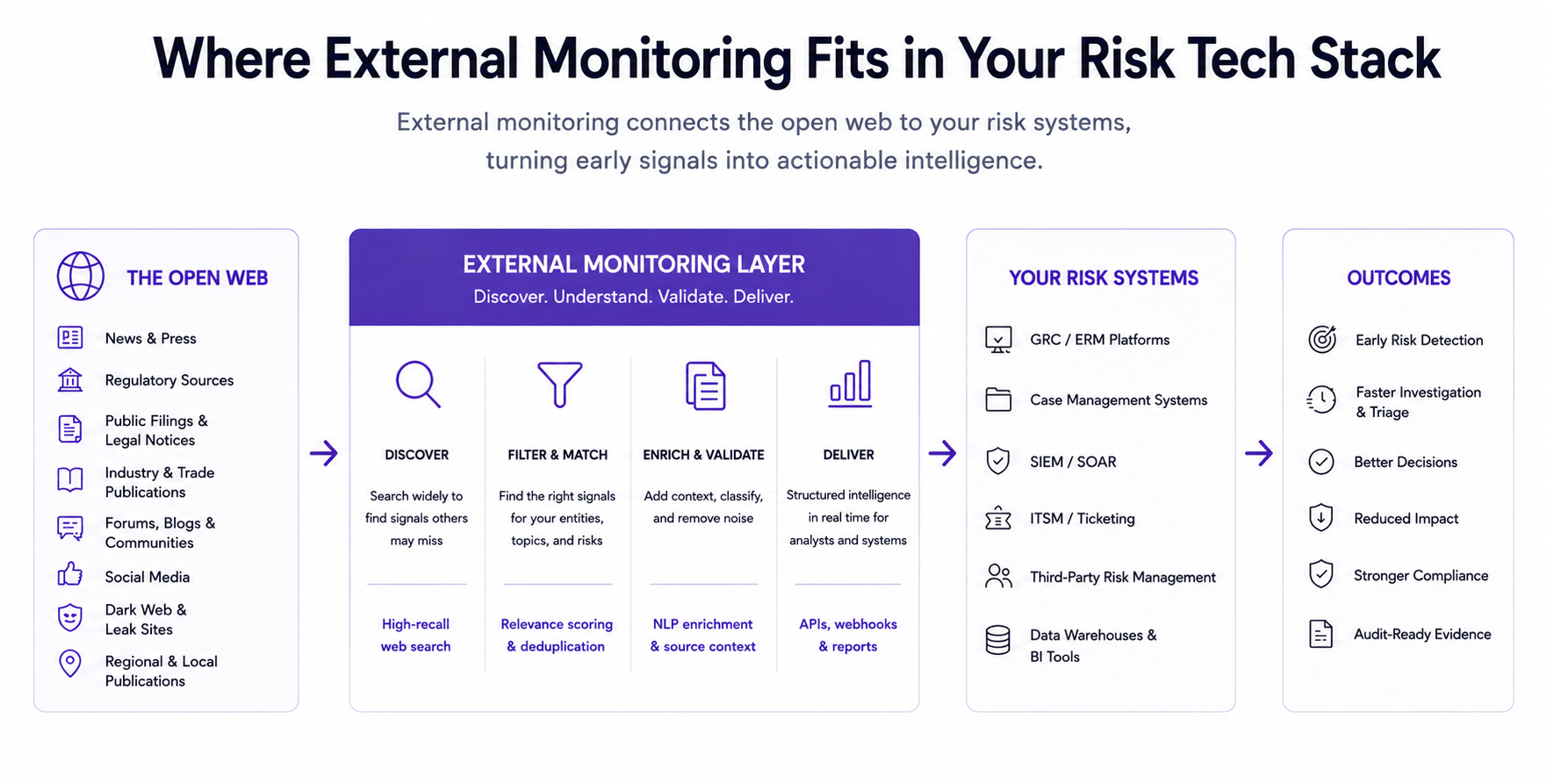
That is why risk teams need broader external monitoring. Analysts cannot manually track every supplier, vendor, facility, region, and risk category every day. They need a way to catch signals earlier, connect them across sources, and decide what needs attention before external risks become business-critical. That’s where web search APIs come in.
How does a web search API support risk intelligence?
Risk teams use web search APIs to continuously monitor external signals, rather than relying on manual research cycles.
But not every web search API is useful for risk intelligence. Teams need more than links, snippets, or summaries. They need source-backed signals they can verify, enrich, deduplicate, and route into risk workflows.
The right web search API helps with:
- Source expansion: Monitor beyond usual feeds and watchlists, including regional press, niche industry sites, public filings, legal notices, blogs, and foreign-language sources.
- Coverage for new use cases: Search across many variations of a risk theme, like supplier disruption, insolvency, lawsuit, recall, data breach, sanctions, plant closure, or regulatory action.
- Company watchlists: Scope monitoring to the companies that matter most, such as suppliers, vendors, counterparties, portfolio companies, competitors, or M&A targets.
- Validating sources: Check whether a signal appears across other sources, and analysts can also separate one-off noise from issues gaining traction, reducing alert fatigue.
- Analyst productivity: Give analysts source-backed signals they can review and escalate faster, rather than making them manually dig through scattered sources.
Is a web search API the only external intelligence layer risk teams need?
No. A web search API is one external intelligence layer, not the entire external risk intelligence stack.
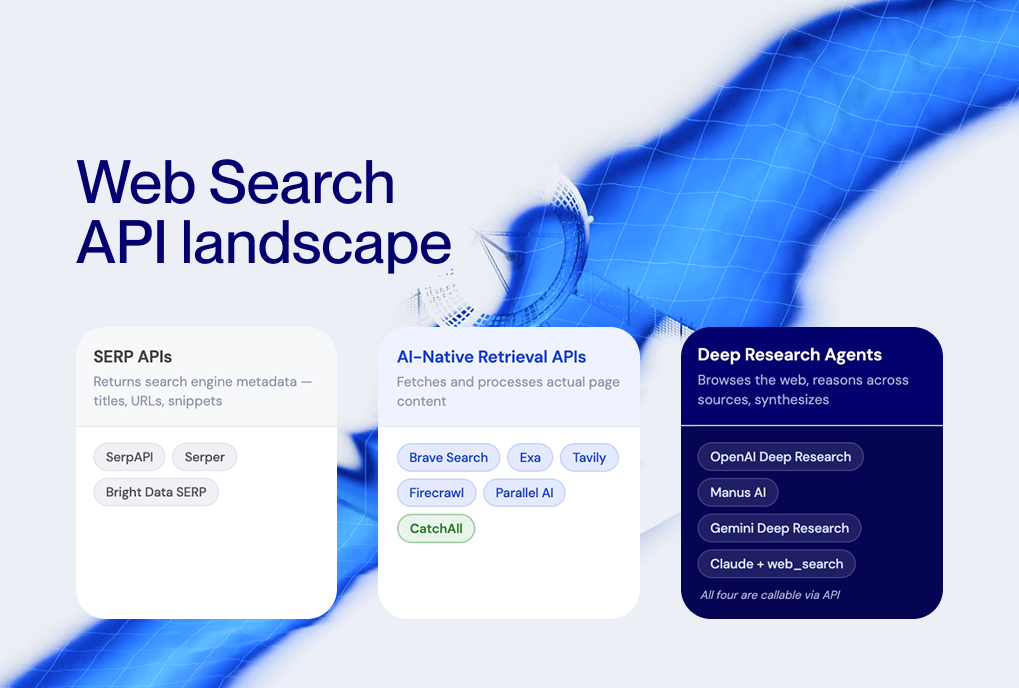
CatchAll Web Search API fits into the open-web layer. It helps teams search beyond narrow alerts and manual research, then structure public signals so risk teams can review them faster.
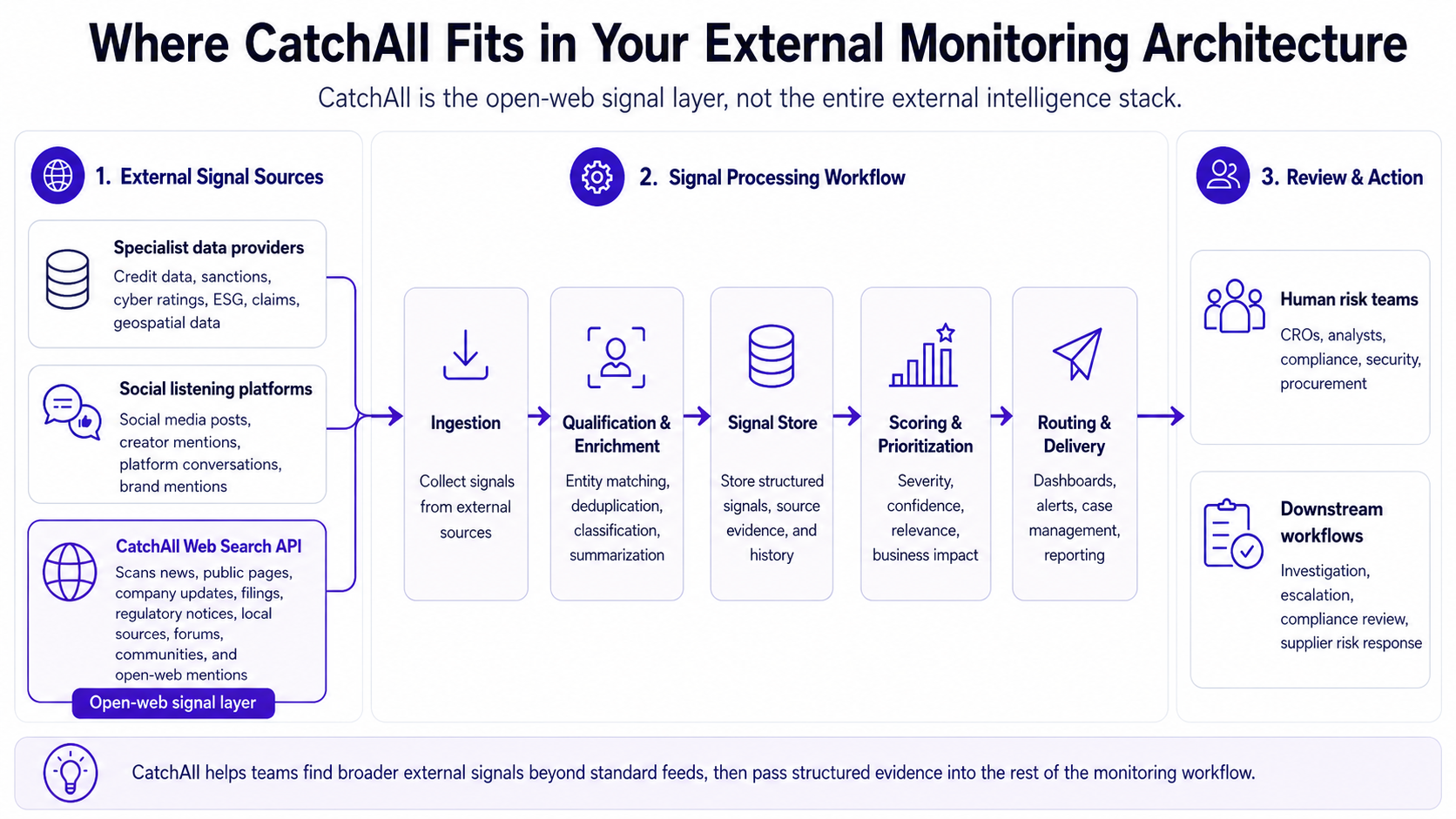
A complete external risk intelligence stack may include:
How risk teams use web search APIs in practice
Risk teams use web search APIs to turn external monitoring into a repeatable workflow.
Instead of manually checking news sites, regulatory portals, vendor pages, and search results, teams can run scheduled searches across the open web and route relevant findings into their risk systems.
Common workflows include:
- Supplier and third-party monitoring: Track vendors, suppliers, and counterparties for lawsuits, layoffs, plant closures, sanctions, financial distress, delivery issues, or regulatory action.
- Cyber risk monitoring: Detect breach reports, ransomware claims, exposed data mentions, vendor incidents, infrastructure outages, or vulnerabilities affecting systems the business depends on.
- Regulatory monitoring: Follow enforcement actions, warning letters, policy changes, product recalls, public notices, and agency updates across jurisdictions.
- Geopolitical and macro risk monitoring: Track strikes, port disruptions, sanctions, protests, extreme weather, energy shortages, or regional instability that could affect operations or supply chains.
- Operational disruption monitoring: Track facility closures, transport delays, labor strikes, local outages, accidents, weather events, or production issues that could affect business continuity.
- Reputation and market monitoring: Monitor negative coverage, complaints, boycott language, executive scrutiny, competitor moves, funding trouble, acquisitions, or product shutdowns.
In each case, the API helps teams move from search when something feels urgent to continuous scanning.
How to build an early warning risk intelligence system
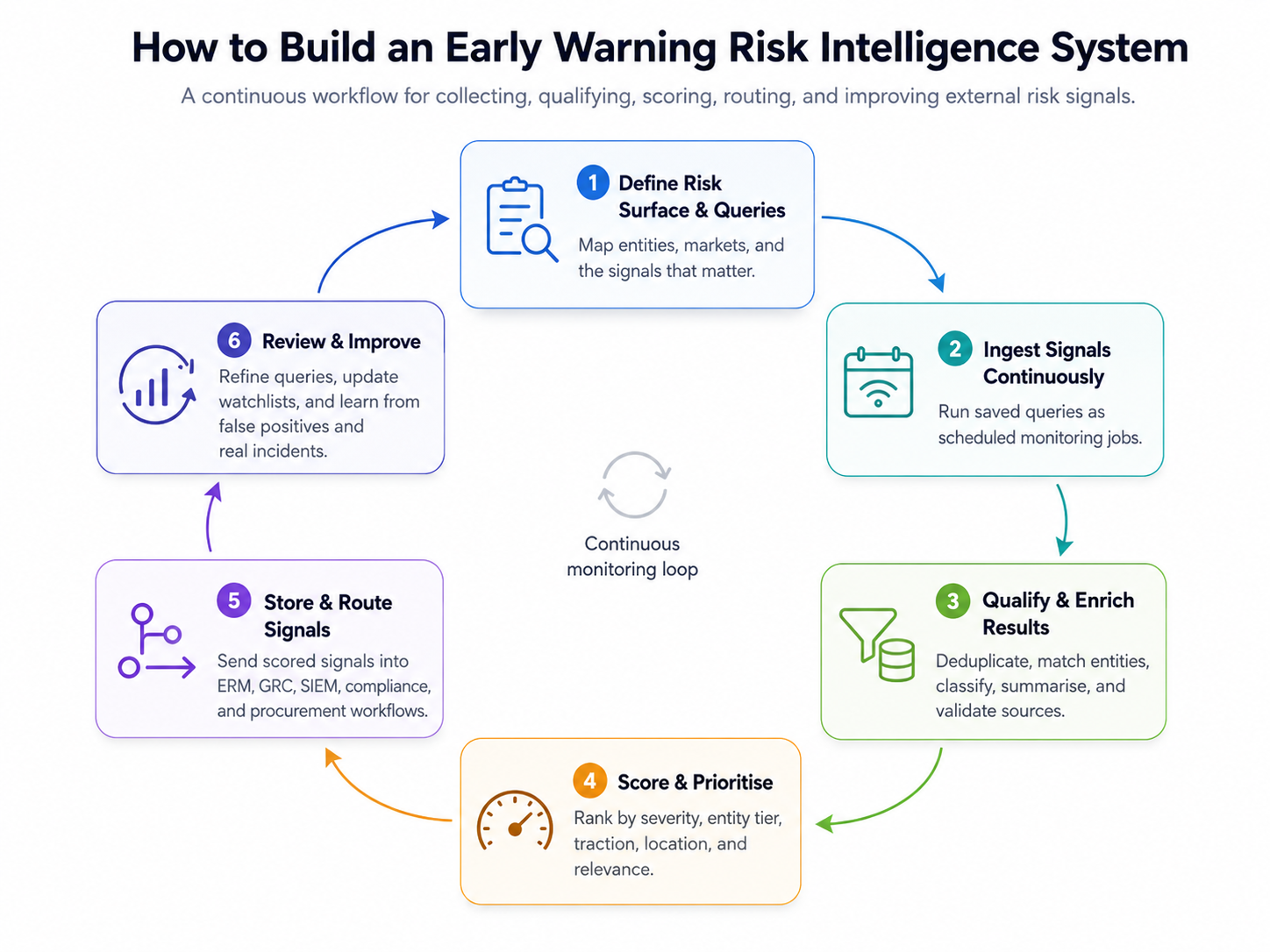
An early warning risk intelligence system is a layered workflow that can collect signals, filter noise, score risk, store the record, and send the right information to the right team.
Step 1: Define your risk surface and queries
Map the entities your team needs to monitor: suppliers, vendors, facilities, counterparties, subsidiaries, competitors, regulators, and key markets. Then define what signals matter for each.
Well-constructed queries directly shape the quality of what CatchAll returns.
Supplier and third-party risk:
- Find lawsuits, layoffs, plant closures, sanctions, or financial distress affecting companies in our tier-1 supplier list in the past 30 days
- Find delivery disruptions or insolvency filings affecting logistics vendors in Southeast Asia in the past 14 days
Cyber and operational risk:
- Find breach reports, ransomware claims, or outage notices affecting our software vendors in the past 14 days
- Find vulnerability disclosures or cyber incidents affecting financial services companies in the past 7 days
Regulatory and compliance:
- Find enforcement actions, warning letters, or license suspensions affecting healthcare companies in the US in the past 60 days
- Find ESG violations or regulatory fines affecting companies in our vendor watchlist in the past 30 days
Geopolitical and macro:
- Find port disruptions, strikes, sanctions, or energy shortages affecting logistics routes in Southeast Asia in the past 30 days
- Find trade restrictions or political instability affecting our operations in EMEA in the past 7 days
Step 2: Ingest signals continuously
Run saved queries as scheduled monitoring jobs instead of one-off searches. This lets risk teams track suppliers, vendors, facilities, regulators, and risk topics continuously, so they can spot new signals as they appear rather than waiting until an issue becomes urgent.
Step 3: Qualify and enrich results
Raw signal volume isn't useful on its own. After ingestion, the qualification layer should:
- Deduplicate: consolidate multiple sources covering the same event into one signal
- Entity match: link each signal to the correct supplier, vendor, or market in your watchlist
- Classify: tag by risk type: supplier, cyber, regulatory, geopolitical, reputational, operational
- Summarise: generate a one-sentence summary of what happened and why it may matter
- Validate: confirm the source is credible before the signal reaches an analyst
Sphera's 2026 data shows 94.5% of organisations have AI integrated into risk management, but impact is consistently capped by data foundations. AI accelerates detection; it cannot compensate for missing or unverified upstream data.
Step 4: Score and prioritise
Not every signal warrants escalation. Rank signals by:
- Severity of the event, if confirmed
- Tier of the affected entity (tier-1 supplier vs peripheral counterparty)
- Source traction: Is this appearing across multiple independent sources?
- Geographic overlap with active operations or supply routes
- Connection to risk categories already tracked by the organisation
Step 5: Store and route signals
Scored signals should move automatically into the systems where action happens:
- ERM and GRC platforms: risk recordkeeping, control tracking, audit trails
- SIEM systems: cyber and operational incidents for security teams
- Compliance tools: regulatory and ESG enforcement signals
- Procurement dashboards: supplier and vendor disruption alerts
- Executive reporting: high-severity signals requiring leadership visibility
Each routed signal should carry a full record: entity, risk category, source, event date, location, severity, and recommended action. This chain — signal → assessment → decision → action — is what makes risk intelligence defensible under governance scrutiny.
Step 6: Review and improve
After each review cycle, analysts should mark false positives, refine query logic, update company watchlists, and track which signal types consistently precede material disruptions. The system becomes more precise with use, narrowing toward the specific risk profile of the organisation over time.
How to evaluate a web search API for risk monitoring
Several capabilities separate a risk-grade web search API from a general-purpose one, and they include:
- Coverage: Does it search beyond mainstream news and obvious websites, including filings, notices, local pages, company updates, and niche sources?
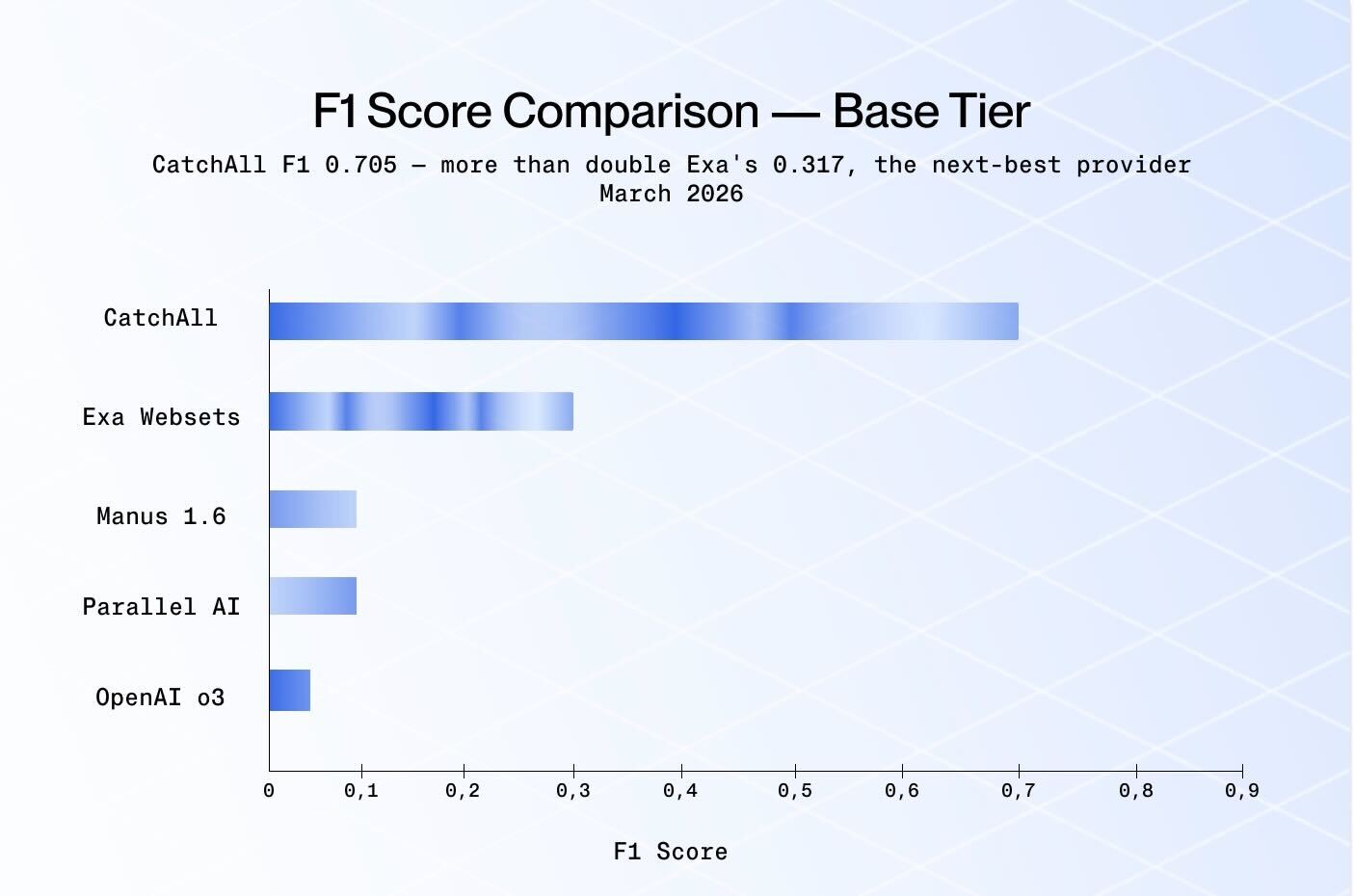
- Recall: Can it find weak signals across obscure, local, or fragmented sources before they become mainstream?
- Freshness: Can it support fast-moving risks like cyber incidents, regulatory updates, supplier disruptions, and geopolitical events?
- Noise control: Does it reduce irrelevant results, duplicates, and low-value alerts so analysts are not buried in noise?
- Structured outputs: Does it return usable fields like source, date, entity, event type, summary, location, and relevance?
- Entity monitoring: Can it continuously monitor specific suppliers, vendors, counterparties, subsidiaries, regions, industries, or topics?
- Source transparency: Can analysts verify where the signal came from before escalating it?
- Integration readiness: Can results feed into ERM, GRC, SIEM, compliance, procurement, cyber, dashboards, or reporting systems?
- Security and API fraud controls: Does it support authentication, access controls, logging, rate limits, and safeguards against bad inputs or unauthorized use?
- Scale and reliability: Can it monitor thousands of companies, vendors, facilities, regions, and risk categories without relying on manual research?
- AI workflow fit: Can the output support classification, scoring, summarization, routing, and analyst review?
The best fit is a web search API that helps teams catch more relevant signals without overwhelming analysts or weakening the security of the risk stack.
How do integration and security affect risk monitoring systems?
Integration makes risk monitoring holistic. But the more connected the workflow becomes, the more the API layer matters.
A risk intelligence system may pull data from external APIs, process it with AI, and trigger alerts across teams. If that layer is not secured properly, it can create new risks: bad inputs, unauthorized access, false alerts, scraped data, manipulated scores, or exposed workflows.
That is where API security and API fraud controls matter.
Risk teams should look for secure authentication, access controls, encrypted data in transit, audit logs, rate limits, input validation, source-level evidence capture, and human review for high-impact alerts.
The structure of the data matters too. A useful signal should include the entity, risk category, signal type, source, event date, location, severity, confidence, and recommended route.
Summary
Risks start everywhere. One source often looks small, but when they cluster, they point to material events that deserve attention.
A web search API adds a broader external monitoring layer to enterprise risk management software. It helps teams scan the public web continuously, structure scattered signals, and feed better intelligence into risk workflows.
CatchAll Web Search API is built for exactly this use case: high-recall retrieval, structured outputs, and integration readiness for GRC, SIEM, compliance, and executive reporting workflows. Start with 2,000 free credits at platform.newscatcherapi.com.




.png)

.png)