







Most portfolio monitoring tracks what companies report, missing signals that move faster, like leadership changes, enforcement actions, and supply chain disruptions, which surface first in news coverage. This guide covers how to build monitoring that scales across a full portfolio.
TLDR:
- Quarterly data reports outcomes after the fact, so news coverage surfaces triggering events such as executive exits and enforcement actions days or weeks before the numbers move.
- Build per-company monitoring profiles instead of portfolio-wide templates, since a SaaS company and an industrial manufacturer need different signal categories and cadence.
- Sentiment scoring and IPTC topic filters cut raw alert volume without dropping material events, filtering for negative sentiment and tags like litigation or regulatory affairs.
- Portfolios of ten or more companies in compliance-heavy sectors need API-based pipelines, since manual scanning and alert tools break down past roughly five companies and miss regulatory sources entirely.
What is portfolio company news monitoring?
Portfolio company news monitoring is the practice of tracking published news coverage about companies in an investment portfolio to detect signals that affect investment value before they appear in a quarterly report.
Financial metrics tell you what happened. News tells you why, and often sooner: a CFO departure or a regulatory inquiry reaches coverage well before a cap table or covenant tracker reflects it.
Monitoring typically spans three event groups:
- Executive changes, regulatory actions, and enforcement notices
- Reputational events, including legal disputes and ESG controversies
- Competitor moves and supply chain disruptions
Because private company news spans fragmented sources, no centralized channel exists equivalent to SEC filings or earnings transcripts. Investment teams need deliberate monitoring infrastructure, not general-purpose search alerts.
Why do quarterly reporting cycles miss critical investment signals?
Quarterly data packages arrive late by design. By the time a portfolio company submits its Q3 financials, the events that shaped those numbers have already happened, and problems that surface in a spreadsheet have typically compounded.
The structural issue is that internal KPIs measure outcomes, not causes. Revenue decline, margin compression, customer churn: these register in reporting packages after the triggering event, whether a key executive left, a regulatory action was filed, or a major customer announced a strategic pivot. News coverage of those triggers appears days or weeks earlier.
Continuous external monitoring fills that gap across trade press, regional business journals, regulatory bulletins, and court filings. A quarterly review checks once; an automated news pipeline checks constantly across sources no single analyst has time to track.
Human bandwidth is the binding constraint. A March 2026 V7 Labs analysis argues that portfolio monitoring is structurally under-resourced relative to deal sourcing, because deal work drives compensation and reputation. The practical result is that manual scanning between reporting periods often doesn't happen, and automated alerts remove the dependency on an analyst happening to see the right article on the right day.
Which investment signals can news data surface?
Structured news monitoring covers signals across several distinct categories, each with a different urgency profile.
| Signal type | Examples | Recommended cadence |
|---|---|---|
| Leadership changes | CEO departures, board appointments | Daily |
| Regulatory actions | Enforcement notices, license suspensions | Daily |
| Litigation | Lawsuits filed, settlements reached | Daily |
| ESG controversies | Environmental incidents, labor disputes | Weekly |
| Competitive moves | Funding rounds, product launches, acquisitions | Weekly |
| Supply chain disruptions | Port strikes, supplier bankruptcies | Daily |
| Market entry or exit | Geographic expansion, facility closures | Weekly |
Cadence matters as much as signal type. Regulatory actions and leadership changes move fast enough to affect customers or lenders within days, while ESG controversies compound slowly but carry longer reputational tails. Match each signal type to a monitoring frequency before configuring alerts.
How do you define monitoring goals and baselines for each holding?
A Series B SaaS company and a mid-market industrial manufacturer share almost no overlap in relevant signal categories. The SaaS company warrants close attention on competitive funding rounds and executive departures; the manufacturer needs daily coverage of regulatory filings, supplier disruptions, and trade policy changes. A generic alert template generates noise for one and gaps for the other.
For each holding, document sector and subsector to determine which regulatory bodies and trade publications apply, key personnel whose departures or appointments carry material weight, the primary competitive set for tracking funding and product moves, and any known regulatory or legal exposure that sets the cadence for enforcement monitoring. In a CatchAll watchlist CSV, key personnel go in the key_persons column and name variants in alternative_names, so each profile maps directly to one row. This produces a per-company monitoring profile, not a portfolio-wide template.
Baselines set the standard for a meaningful change. If a company averages two press mentions per week, a spike to fifteen in three days signals something worth investigating.
How does entity disambiguation prevent noise from polluting your alerts?
Entity disambiguation works by resolving name variants to one underlying entity and scoring how central a company is to each article, so passing mentions drop out before they reach an analyst. Without it, name ambiguity floods an alert pipeline: a portfolio company named "Apex" or "Signal" shares its name with dozens of unrelated organizations, so every article mentioning that string arrives in your feed.
Named entity recognition identifies organization mentions in article text, and alias resolution extends that by matching variants like "Apple Inc.," "Apple Computer," and "AAPL" to the same underlying entity. The harder problem is relevance: an article mentioning a company in passing carries very different weight than one where that company is the primary subject.
CatchAll returns an ed_score between 1 and 10 for every company on your watchlist that appears in a record, indicating whether that company is the central subject or a peripheral mention. Plain queries without a connected watchlist return no ed_score.
The categorical answer sits in association_type. Each connected company is labeled event_associated when it is a primary actor in the event and mention when it appears as a passing reference. Filter on that field first to drop incidental hits. In practice, a higher ed_score means a more central company, so use it to rank the remaining records and tune a cutoff against your own watchlist.
When assessing any news pipeline for this capability, verify that it resolves aliases, scores centrality rather than mere presence, and exposes that score in the API response.
How do sentiment analysis and topic filtering reduce alert volume?
Hundreds of raw alerts per day creates the same problem as no alerts at all: nothing gets read. Two filtering layers cut that volume without dropping material events.
The first is sentiment scoring at the article level. The News API returns a sentiment score for news articles for both the title and body, letting you filter to negative coverage only. A product launch press release scores positive and stays out of the queue, while a regulatory fine or executive misconduct story scores negative and routes to an analyst.
The second layer is topic classification. IPTC and IAB taxonomy tags categorize each article by subject, so you can pass only items tagged under categories like "litigation" or "regulatory affairs" and suppress general business news. Syndicated reposts of the same article across dozens of outlets collapse further through clustering into one cluster.
How do you detect ESG controversies and regulatory changes using news data?
ESG monitoring needs its own query logic, separate from day-to-day signal tracking, because controversies surface across regulatory bulletins, local court filings, trade press, and NGO reports with no single authoritative source. Disclosure obligations from the SEC, ESMA, EFRAG, and ISSB are expanding ESG disclosure requirements and taxonomies, so what counts as a material ESG event for LP reporting is itself a moving target.
Useful categories per holding include:
- Environmental incidents: spills, permit violations
- Labor and safety: injuries, union actions
- Governance: board conflicts, misconduct allegations
- Regulatory filings: agency enforcement actions, fines
ESG and legislative signals generally warrant a 30-day monitoring window checked weekly, while enforcement actions and recalls warrant a shorter 7-day window checked more often. Regulatory announcements cluster by agency publication schedule rather than the news cycle, so that distinction has real consequences for what gets caught and when.
How can news data enable early supply chain disruption detection?
Supply chain disruptions surface in news before they surface in a portfolio company's numbers. Port strikes, supplier bankruptcies, and logistics disruptions register in regional trade press and government transport bulletins days or weeks before an operations team escalates internally. In RapidRatings' 2025 Annual Risk Survey of more than 100 senior supply chain professionals (fielded December 2024 to January 2025), 81% reported their business was impacted by supplier disruption in the past two years.
Generic keyword alerts on a company name will not catch a port closure affecting that company's primary import route. Query logic needs to be organized around the disruption type, not the entity alone:
- Port and maritime strikes
- Geopolitical escalations near supplier regions
- Extreme weather disrupting logistics
- Supplier distress via supply chain risk monitoring
- Sanctions and export control changes
Map each portfolio company's known dependencies first: a company sourcing from Southeast Asia needs different daily signals than one relying on European cold chain logistics. Weather events, port strikes, and active conflicts warrant daily cadence, while sanctions and border policy updates can run weekly.
How do you separate investment-grade signals from market noise?
Most news about a portfolio company is not investment-relevant. A republished press release appearing across forty regional outlets is one event, not forty signals. Treating each instance as a separate data point inflates alert volume and buries the events worth acting on.
Two structural problems drive this noise. A single wire story gets picked up by dozens of aggregators within hours, producing identical records with different URLs, and low-authority republishers copy original content wholesale, adding nothing but an extra entry in your feed. Neither category carries new information.
Citation count is a useful proxy for actual market breadth, and CatchAll exposes one per record. A CFO departure covered by the Wall Street Journal, two regional business journals, and a sector trade publication reflects genuine coverage, while a story cited once and then republished thirty times via syndication has one underlying source, so exposing that count in your pipeline lets you filter accordingly. Embedding-based clustering collapses those syndicated variants into a single record before they reach your alert queue. After deduplication, the association type label filters out articles where the company is an incidental mention and not the actual subject.
How do you build a repeatable daily monitoring routine for portfolio teams?
Run two review tiers for each portfolio company: a daily review for regulatory enforcement actions, leadership changes, litigation filings, and supply chain disruptions, where signals can move from reported to consequential within 72 hours, and a weekly digest for ESG developments, competitive funding rounds, and market entry announcements, where a few days of latency carries no real cost. Each tier needs a named owner and a fixed review window, since alerts that arrive without one or the other get ignored.
Routing by urgency keeps inboxes functional:
- High-urgency alerts (enforcement, litigation, executive departures) push directly to a dedicated Slack channel with a named analyst as the default reviewer.
- Medium-urgency signals (competitive moves, ESG flags) batch into a Monday digest that the relevant deal team member reviews before the week's portfolio calls.
Ownership is the part most firms skip. Each portfolio company should have a named analyst responsible for reviewing its alert queue, with a backup for vacation coverage. Without that assignment, alerts pile up unread until something goes wrong.
How do the main news monitoring approaches compare: manual, Google Alerts, RSS, and API-based pipelines?
Each approach works until it doesn't, and the breaking point is almost always portfolio scale.
| Capability | Manual scanning | Google Alerts | RSS aggregators | News API pipeline |
|---|---|---|---|---|
| Coverage depth | Analyst-dependent; misses niche trade press | High-PageRank bias; misses regional and regulatory sources | Source list limited to what you configure | 140,000+ indexed sources including trade press and regulatory outlets |
| Structured output | None | Email text only | Feed metadata only | JSON with entities, sentiment, taxonomy tags |
| Deduplication | None | Syndicated duplicates arrive as separate alerts | Minimal; depends on feed | Embedding-based clustering collapses variants |
| Entity resolution | Manual | String match only | String match only | Named entity extraction; per-company centrality scoring via CatchAll |
| Alert volume control | None | No filtering controls | Limited | Sentiment, topic, and entity filters |
Manual scanning and Google Alerts work for portfolios of five companies or fewer. RSS aggregators extend that range, but any source you do not add stays invisible.
Switch to an API pipeline when the portfolio spans more than ten companies across multiple sectors, or when holdings operate in heavily supervised financial services industries where enforcement actions need to surface alongside editorial coverage.
Which API-based tools handle portfolio company news monitoring at scale?
The two products do different jobs. The News API delivers enriched articles from published news, with sentiment scores, named entity arrays and IPTC tags applied at index time. CatchAll searches the open web and returns one deduplicated record per event on a schedule you set; with a company watchlist connected, each record also carries a score for how central each company is to it. A portfolio pipeline usually wants both: the News API for sentiment and topic filtering, CatchAll for entity precision and delivery.
The News API indexes 140,000+ sources across 50+ languages and holds 2 billion+ articles. Because the enrichment runs at index time, pipelines receive structured JSON with no separate enrichment step.
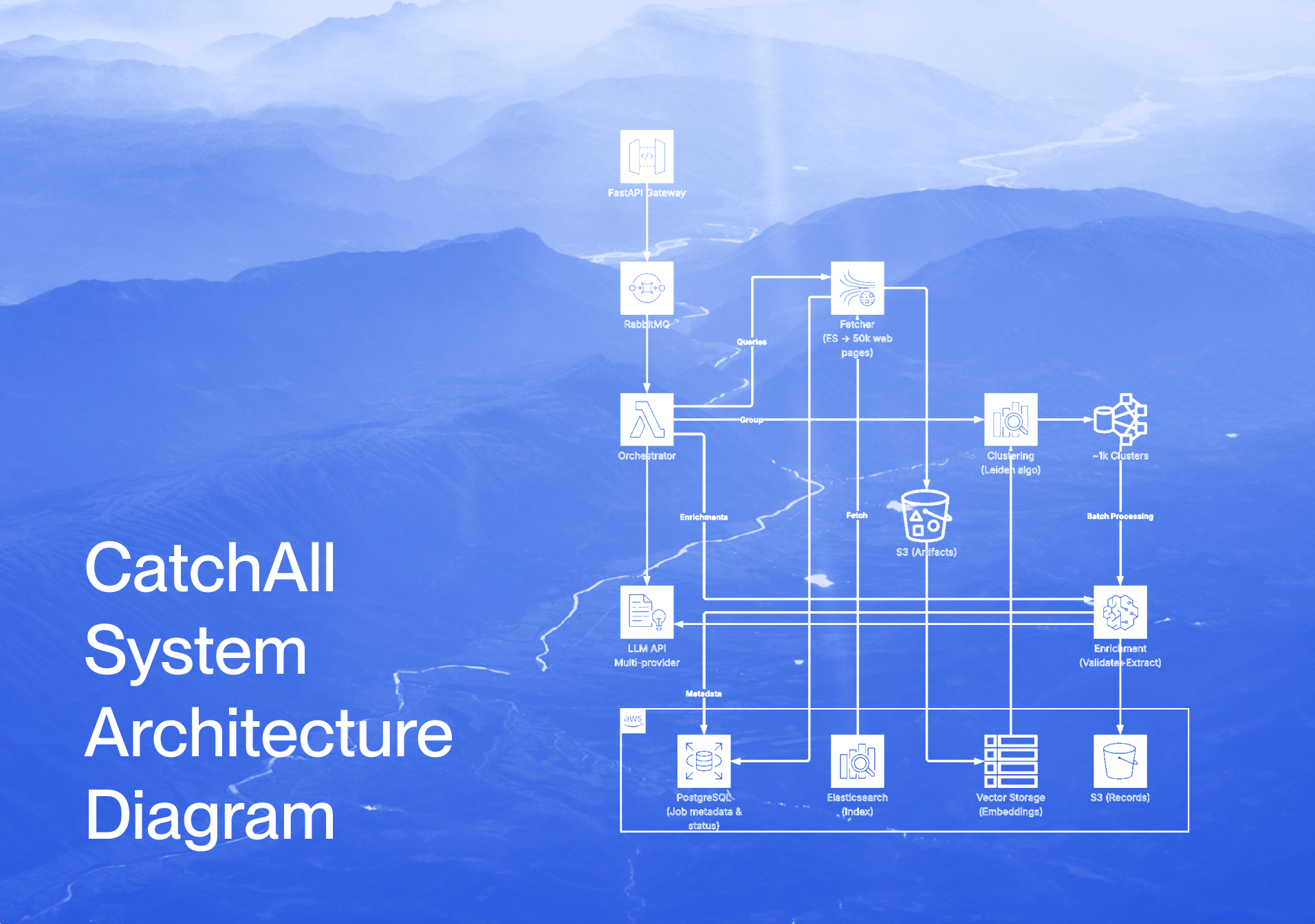
For event discovery beyond published news, CatchAll processes 50,000+ pages per job across the open web and returns one deduplicated record per event instead of dozens of syndicated variants.
Company watchlists score every connected company in a record with an ed_score from 1 to 10 and label it as a primary actor or a passing mention, so incidental hits drop out before they reach an analyst queue. CatchAll's recurring monitors run the query on your cadence and deliver only new events via webhook, Slack, or JSON pull. The how-to guide to monitor a portfolio of companies walks through the full setup, from the watchlist CSV to the scheduled monitor.
What does news monitoring add that quarterly reports can't?
News data fills the gap that internal KPIs can't. Once you map each holding to its relevant signal types and set the right cadence, the monitoring runs itself and your team reviews signals instead of scanning feeds.
Frequently asked questions
What's the fastest way to set up automated portfolio company news monitoring without building your own enrichment pipeline?
Use a news API that applies entity extraction, sentiment scoring, and topic tags at index time, so your pipeline receives structured JSON instead of raw article text. Pair it with CatchAll's recurring monitors that deliver only new events since the last run, and scheduling, deduplication, and enrichment are handled before anything reaches an analyst.
How does entity disambiguation work when monitoring company names that overlap with common words or require alias support?
Name variants, subsidiaries and ticker symbols go in the watchlist's alternative_names column and resolve to one entity. CatchAll then separates primary subjects from passing mentions in two ways. The association_type field labels each connected company event_associated (a primary actor) or mention (a passing reference), and the ed_score from 1 to 10 ranks how central the company is. Filtering to event_associated removes incidental hits, while string-match tools pass every mention of a common-word company name through unfiltered.
NewsCatcher News API vs. Google Alerts for portfolio company news monitoring: which handles regulatory and trade press coverage better?
The News API indexes 140,000+ sources including government bulletins, regulatory outlets, and niche trade press. Google Alerts biases toward high-PageRank domains, misses state-level regulatory filings and regional business journals, and offers no entity resolution or deduplication, so enforcement actions and license suspensions in compliance-heavy holdings go undetected.