










Tavily gives developers a simple way to connect AI applications to current web information. It works well for prototypes, chatbots, and agents that need a small set of relevant search results with minimal search infrastructure.
But production AI systems need more than a short list of ranked pages. An enterprise research agent needs to find every relevant regulatory update. A market intelligence system may need regional reports that do not appear on the first page of search results.
These requirements lead teams to evaluate Tavily alternatives based on retrieval quality, search coverage, recall, latency, data structure, and pricing. And the best option depends on whether the system needs fast answers, broad discovery, semantic search, event monitoring, or SERP data.
The following table compares Tavily alternatives at a glance.
What Is Tavily and Who Is It Best For?
Tavily is best for developers who want a search API for AI agents and retrieval-augmented applications.
Its Search endpoint returns ranked URLs, content snippets, relevance scores, and an optional generated answer. You can choose between basic, fast, ultra-fast, and advanced search depths. Additionally, results can be filtered by date, country, topic, and domain.
Tavily's Key Strengths:
- Fast integration with Python and JavaScript SDKs, clear request parameters, and response formats for LLM workflows.
- Offers 1,000 free monthly credits, with pay-as-you-go pricing at $0.008 per credit.
- Enterprise plans include adjustable rate limits, security controls, dedicated support, and service-level agreements.
Limitations:
- A maximum of 20 results per standard search is insufficient for extensive discovery or large enumeration tasks.
- Ranked page results require further deduplication or event clustering.
- Search that works well for answering one question still misses long-tail sources needed for monitoring and intelligence.
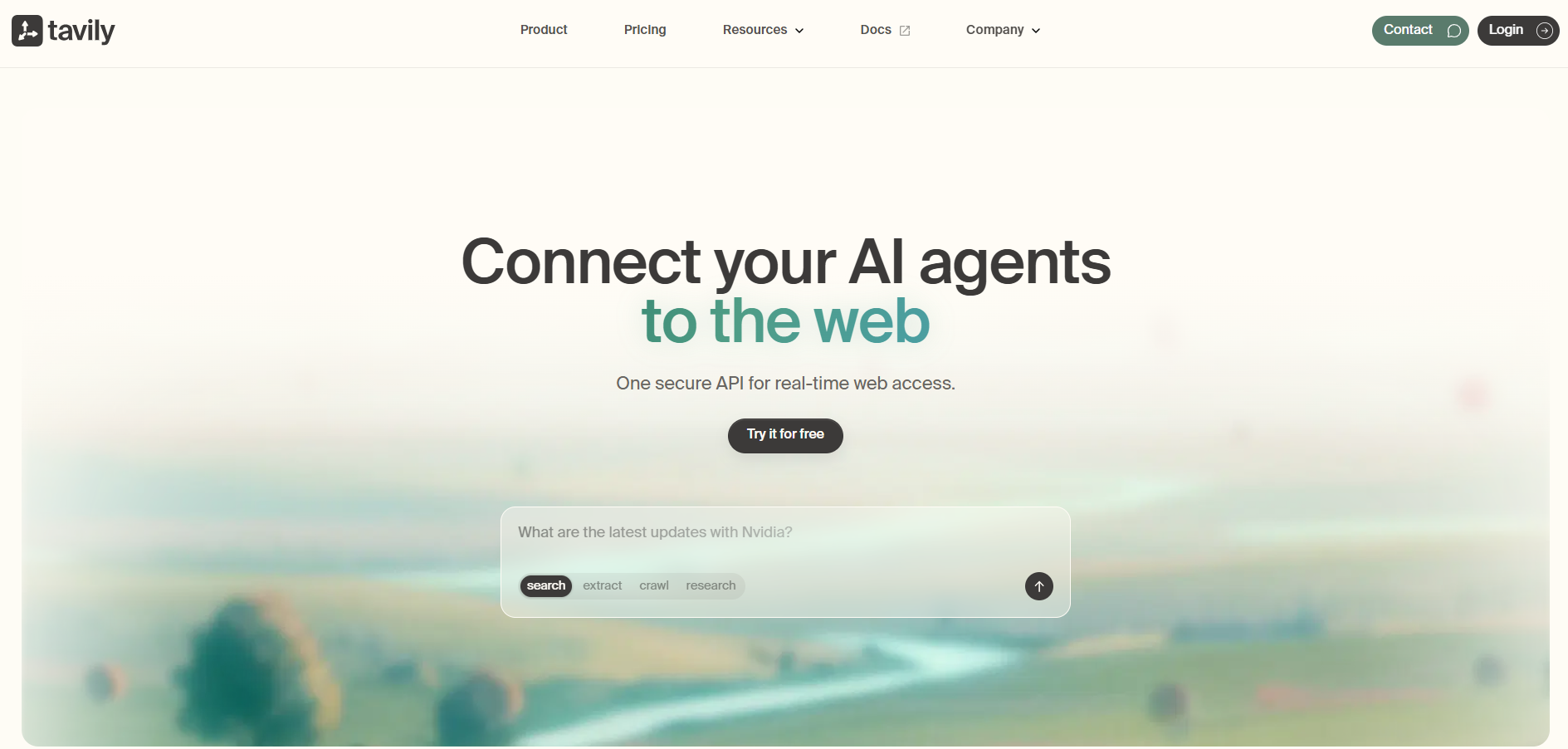
Tavily is suitable for user-facing assistants, coding agents, simple RAG pipelines, and internal prototypes. Consider other providers if the absence of a relevant source poses financial or compliance risk.
What Are the Main Tavily Alternatives for Enterprise AI Workflows?
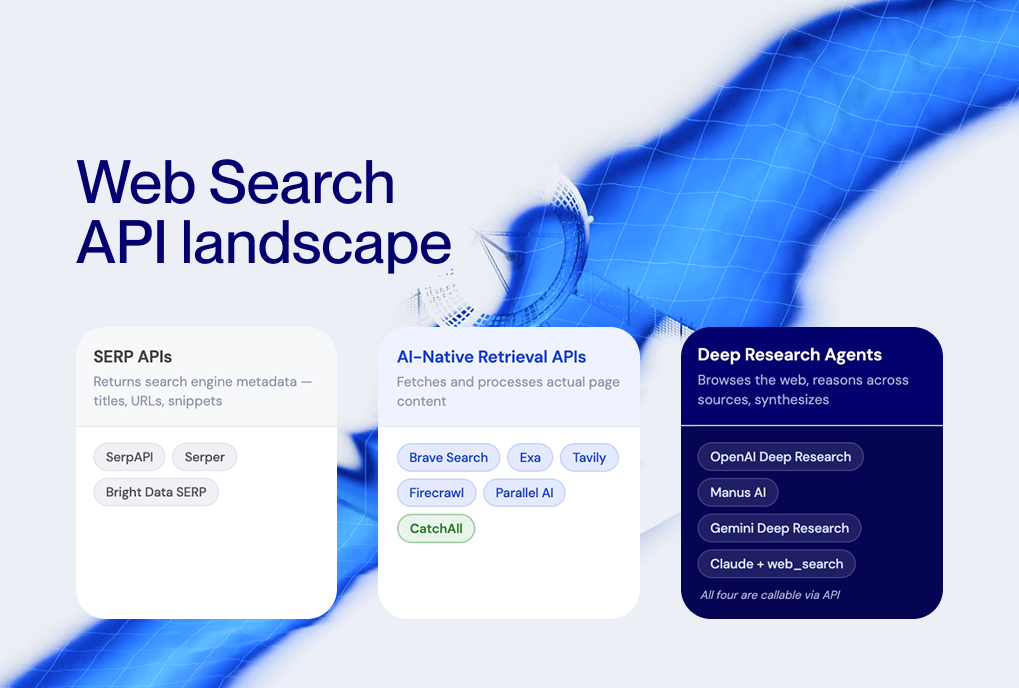
The best alternatives to Tavily are CatchAll, Exa, OpenAI Web Search, Perplexity Search API, and Brave Search API.
Each provider solves a different retrieval problem. So you should first decide whether your workflow needs a ranked list of results, a complete dataset, raw page content, event records, SERP elements, or a generated answer.
CatchAll
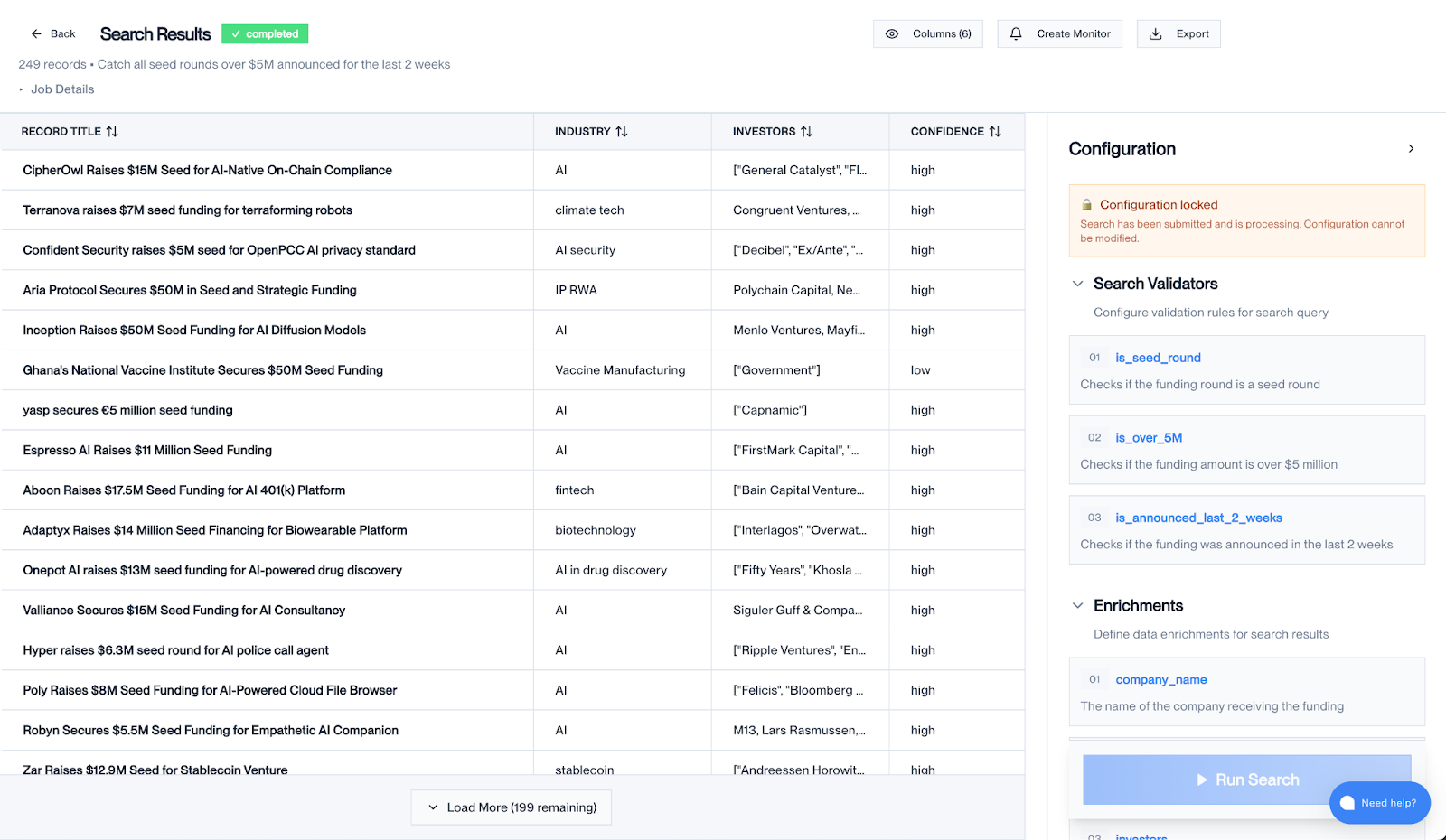
CatchAll is a recall-first option among Tavily alternatives for enterprise workflows that prioritize retrieval completeness over first-page ranking.
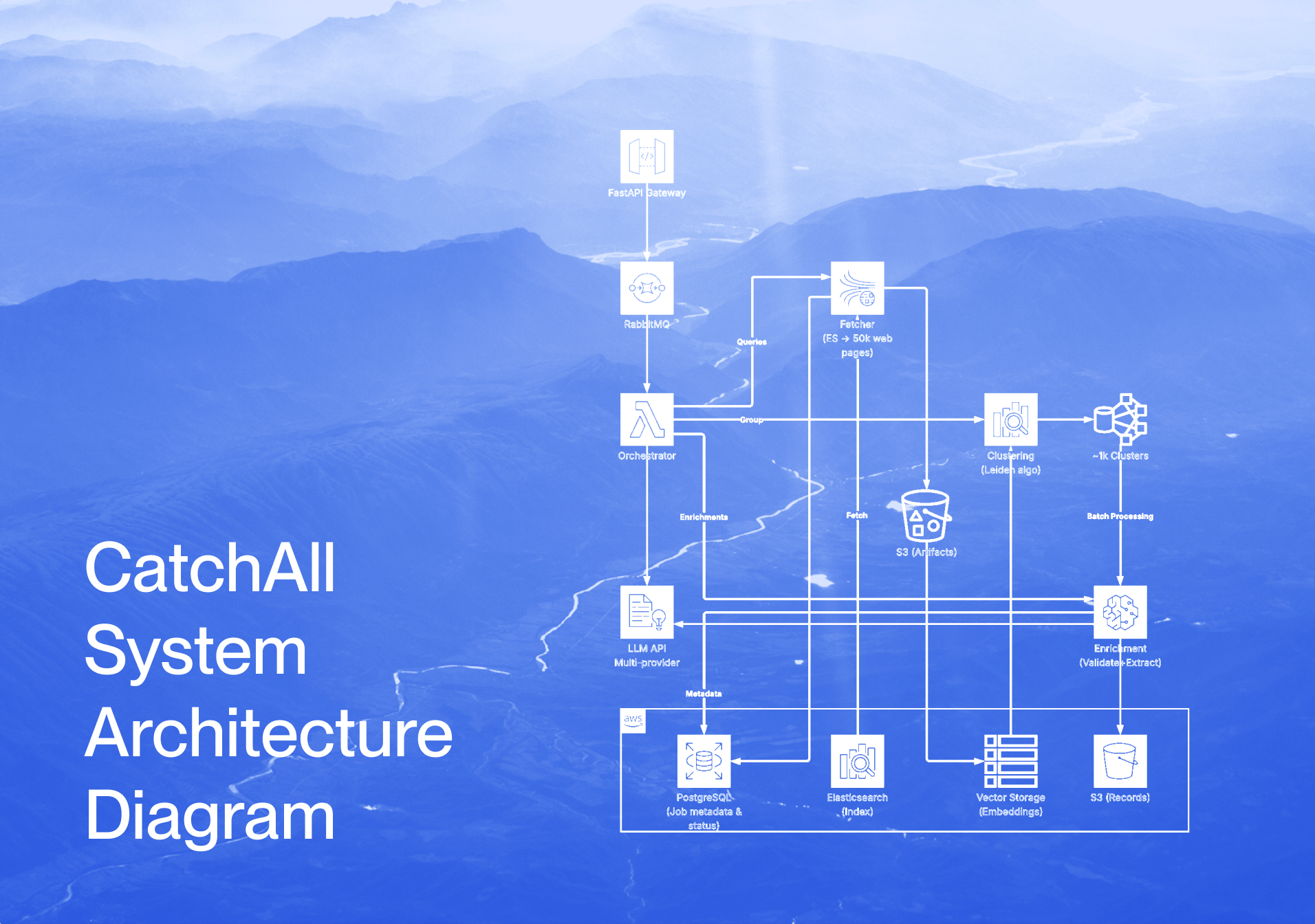
Most web search APIs optimize the first few results because users rarely inspect hundreds of links. But CatchAll uses a recall-first process. It rewrites a request into several targeted search queries and scans more than 50,000 pages per job. It then clusters related pages, validates each cluster against the query, and returns one structured JSON object for each event.
CatchAll's Key Strengths:
- Returns validated and deduplicated event records.
- Provides dynamic structured fields and source citations.
- Supports scheduled monitors and company watchlists.
- Charges per validated record rather than per scanned page or generated token.
- Supports international sources and multilingual entity variants.
Limitations:
- Its event-centered output may not fit navigational queries or basic factual lookups.
- Teams that only need five quick links may not benefit from its deeper retrieval process.
Ideal Use Cases: Market intelligence, regulatory monitoring, merger and acquisition tracking, risk analysis, supply-chain monitoring, research datasets, and agents that must produce comprehensive reports.
Exa
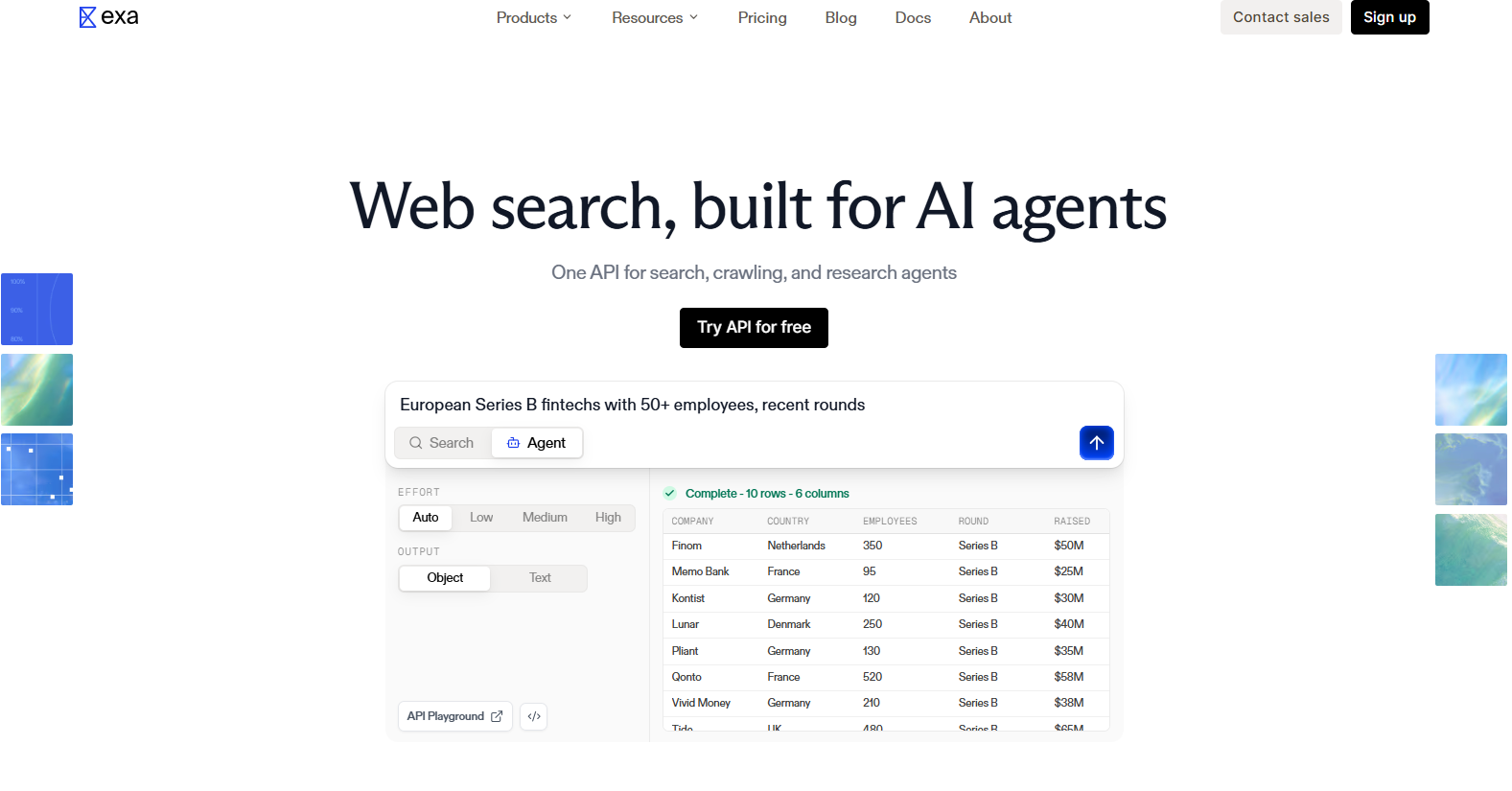
Exa is another strong alternative to Tavily for RAG systems that need semantic web search and direct access to page content.
Its Search endpoint can retrieve pages and return text, relevant highlights, summaries, metadata, and freshness information. It also provides instant, fast, auto, deep-lite, deep, and deep-reasoning search modes.
Exa's Key Strengths:
- Combines semantic retrieval and content extraction.
- Supports fast interactive search and deeper multi-step research.
- Provides domain, category, and publication-date controls.
- Supports custom output schemas for synthesized results.
Limitations:
- Costs increase when teams use deep search, reasoning, summaries, or more than ten results.
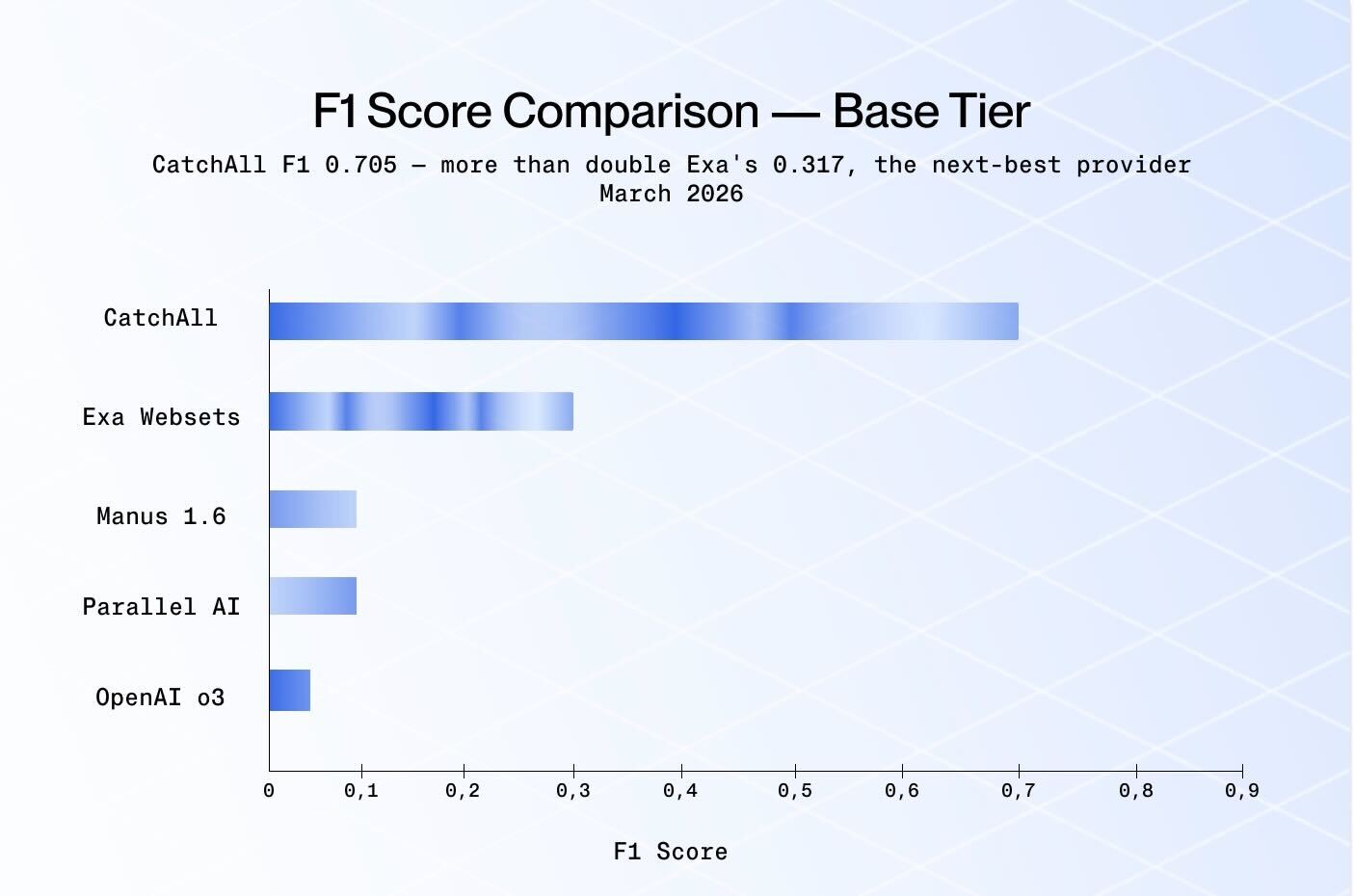
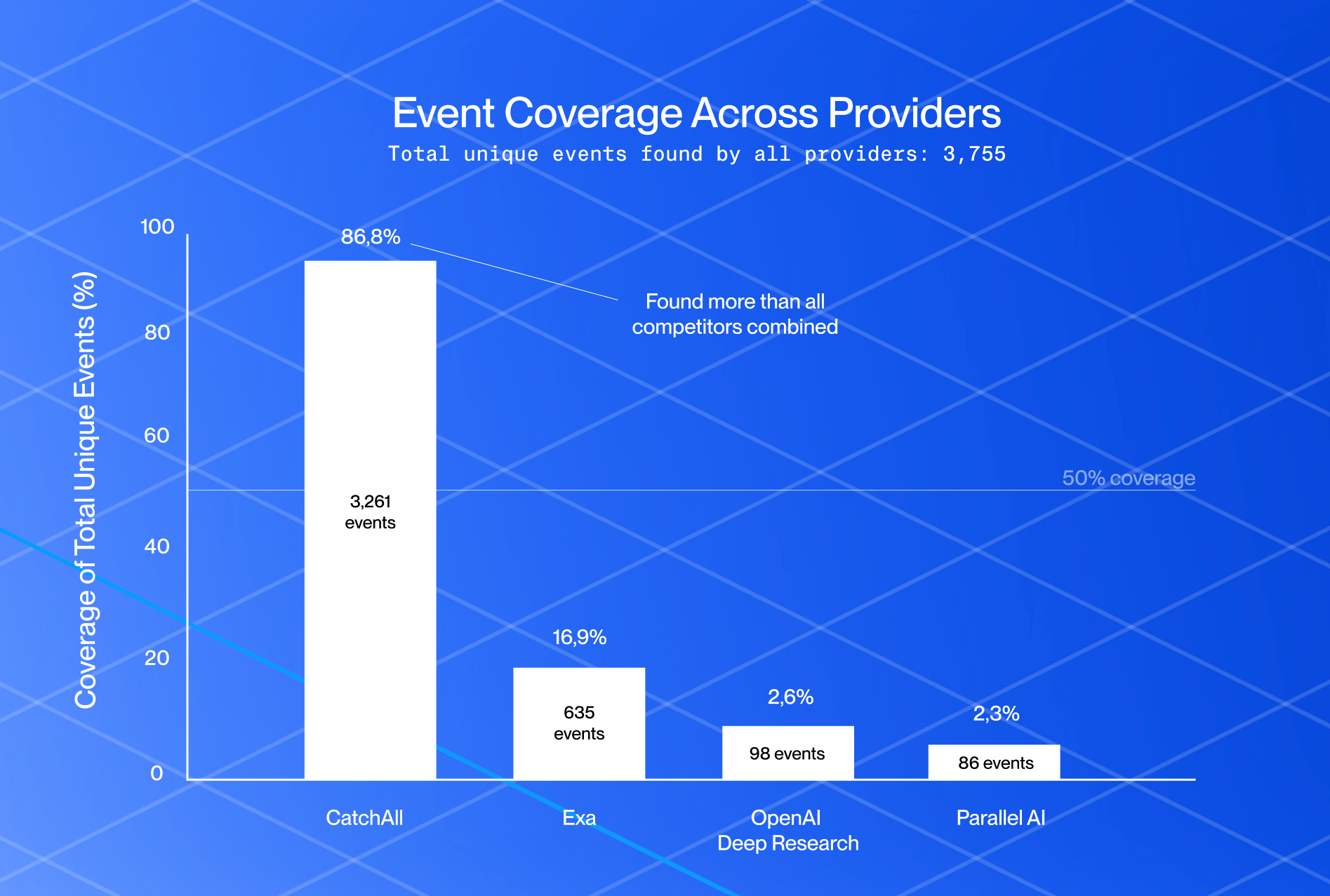
- Lower recall than CatchAll for complex enterprise queries (64.5% fewer true positives in NewsCatcher's benchmark).
- Page-level results still need event clustering for monitoring workflows.
- Some filters do not work with company and people categories.
Ideal Use Cases: Semantic RAG, academic research, company discovery, people search, financial document retrieval, and applications that need clean page content.
OpenAI Web Search
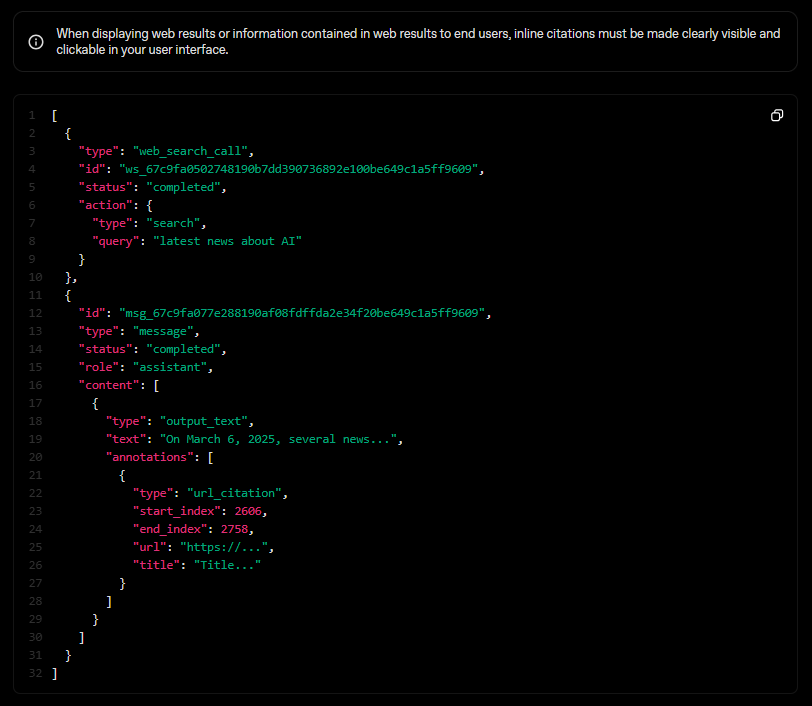
OpenAI Web Search is the most direct choice for teams that already build their agents with the OpenAI Responses API.
The hosted web search tool lets a model decide when to search, inspect sources, and generate a cited response in a single API call. It supports non-reasoning search for fast lookups, agentic search with internal planning, and deeper research patterns.
OpenAI Search's Key Strengths:
- Combines reasoning, tool use, web retrieval, and answer generation.
- Returns inline citations without a separate citation pipeline.
- Supports search, page opening, and in-page finding with compatible reasoning models.
Limitations:
- Teams pay both web-search tool fees and model token costs.
- It provides less provider independence than a standalone search API.
- It is less suitable when a team needs a reusable, provider-neutral retrieval dataset.
Ideal Use Cases: Customer-facing assistants, research agents, support agents, and internal tools already built on the OpenAI API.
Perplexity Search API
Among Tavily search alternatives, the Perplexity Search API is for teams that want real-time ranked web results with clear filtering controls.
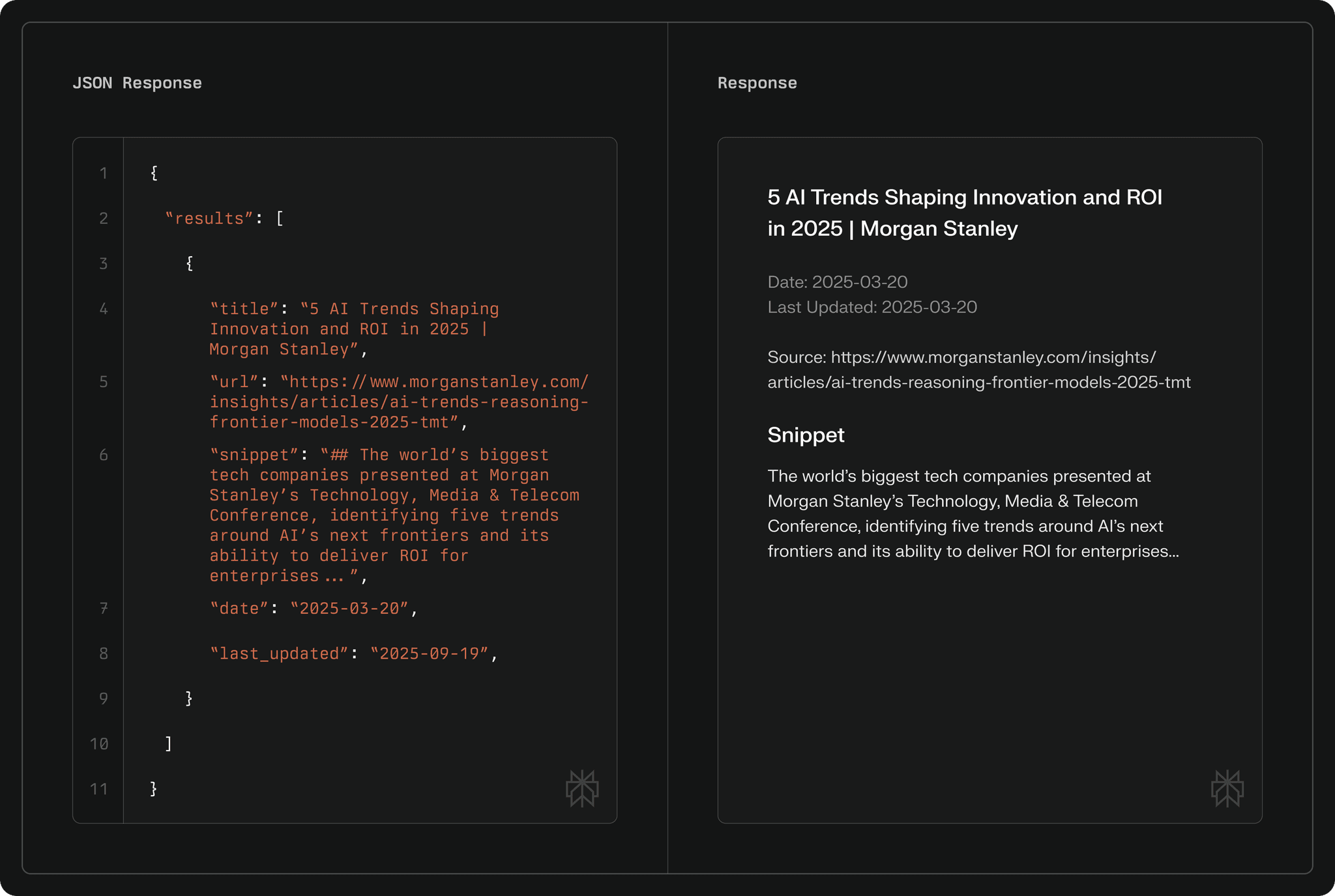
The API returns structured results with titles, URLs, snippets, publication dates, and last-updated dates. It supports multiple queries, domain filters, language filters, regional search, content extraction, and token-budget controls.
Perplexity's Key Strengths:
- Returns raw, ranked web results in structured JSON.
- Provides content extraction for downstream RAG.
- Offers a simple request-based pricing model.
Limitations:
- Teams need Sonar or the Agent API to generate answers, which means paying both search fees and model token costs.
- Results represent pages, not normalized events.
- Enterprise monitoring systems need scheduling, deduplication, and state management.
Ideal Use Cases: Research assistants, regional information discovery, general-purpose RAG, and systems that need controlled raw search results.
Brave Search API
Brave Search API is a good option for teams that want a large independent web index, predictable request pricing, and enterprise privacy controls.
Brave operates its own search index and indexes more than 30 billion pages, with more than 100 million page updates per day. The API supports web, news, image, video, local, spellcheck, and LLM-context endpoints.
Brave also provides Search Goggles, which let you rerank results or remove specific domains.
Brave's Key Strengths:
- Provides custom reranking and filtering.
- Offers up to five query-relevant snippets from a page.
- Charges $5 per 1,000 Search requests and includes $5 in monthly credits.
- Supports 50 queries per second on its standard Search plan.
Limitations:
- The API returns ranked pages rather than extracted event datasets.
- You need to build your own event clustering and cross-run deduplication.
- Broad enumeration tasks may require query expansion and pagination.
Ideal Use Cases: Privacy-focused agents, general web search, large-scale RAG, search-enabled applications, and organizations that prefer an index independent of major search platforms.
The main difference between these Tavily search alternatives is how they retrieve, structure, and optimize information for AI applications. The table below summarizes the key differences.
What Should Enterprises Look for in an AI Search API?
Enterprises should evaluate an AI search API based on retrieval quality, search coverage, reliability, pricing predictability, and enterprise support. These factors determine how well AI agents, RAG systems, and research workflows perform in production.
When comparing Tavily alternatives, consider the following:
Why Does Search Recall Matter for Enterprise AI Workflows?
Search recall matters because AI systems can only use the information they retrieve. If a search API misses relevant documents, the resulting analysis, RAG responses, or research outputs will be incomplete.
A recall-first search API retrieves a broader set of relevant information before filtering it, reducing the risk of missing critical sources.
So, when evaluating Tavily search alternatives, prioritize a recall-first API like CatchAll if your workflows depend on comprehensive retrieval for enterprise research, monitoring, or market intelligence.
Summary
There is no single Tavily alternatives search API that fits every production workload. The right choice depends on your retrieval requirements, AI architecture, and enterprise priorities. CatchAll is designed for recall-first enterprise search, monitoring, and market intelligence. Exa works well for semantic RAG and content extraction. OpenAI Web Search is for teams that want search and generation within the OpenAI stack. Perplexity offers controlled, structured results for general research and Brave provides a large independent index and strong privacy options.










.png)

.png)