










We've compared nine news APIs on important aspects that decide whether they actually work in production.
A news API is an effective way to get structured access to the news. Some popular use cases include risk monitoring, supply chain oversight and market intelligence. Increasingly, these streams are fed to pre-trained AI models, systems that inherently lack a complete and up-to-date view of what is going on; news APIs ensure they can base their analysis on real-world data.
The types of news APIs out there range from simple feeds of news headlines covering a few thousand sources to pipelines that return complete articles, clustered into events and fully enriched with things like entities and topics. Google News RSS is a popular alternative, but has clear limitations: heavily capped usage, no archive, a lack of filters and, importantly, no deduplication. The latter means you’ll often get a wire story as hundreds of near-identical copies, producing noise in your pipeline. In this guide, we compare the best news APIs available in 2026, with practical guidance on which type fits which use case.
How Did We Compare the News APIs?
We compared nine of the most popular news APIs on eight dimensions.
- Access and pricing: Whether you can get a key today or need a sales/demo call, what the tool’s usage costs you, and what you actually get for that money. Most vendors have tiers with very different features in each, so it’s key to check what applies to the tier you are actually buying.
- Licence terms: Whether you are allowed to launch a product that uses the API. Several free tiers explicitly forbid commercial use.
- Deduplication: The most popular news stories get covered by hundreds of newsrooms and mirrors, while stories in the long tail may appear in only a single source. If the API doesn’t have a strong mechanism for deduplication and clustering, your pipeline may end up having more noise than signal about the thing you’re monitoring.
- Content depth: Whether the API returns the article body or just a link to it. If you need to analyse article content, a tool that only gives you a link means you’ll need to build and maintain a scraper.
- Freshness and archive: How quickly an article arrives in the tool and how far back you can search. Lookback period is often dependent on the tier you choose.
- Retrieval limits: What limits does the API have on page size, and what’s its cap on number of results? These things can be invisible during testing, but they show up quickly in production.
- Enrichment: Taking full advantage of news data often involves having useful metadata to work with. Most leading providers offer enrichments like entities, sentiment and topics.
- Support and tooling: What you can reach when something breaks, whether there is an uptime commitment at the tier you are actually on, and whether the vendor ships an MCP server for agent use.
One dimension we’ve deliberately left out here is source count. One provider could be counting raw domains, including mirrors, while others count unique publications and newsrooms. Without a clear consensus between providers on what counts as a source, comparing this aspect becomes unreliable.
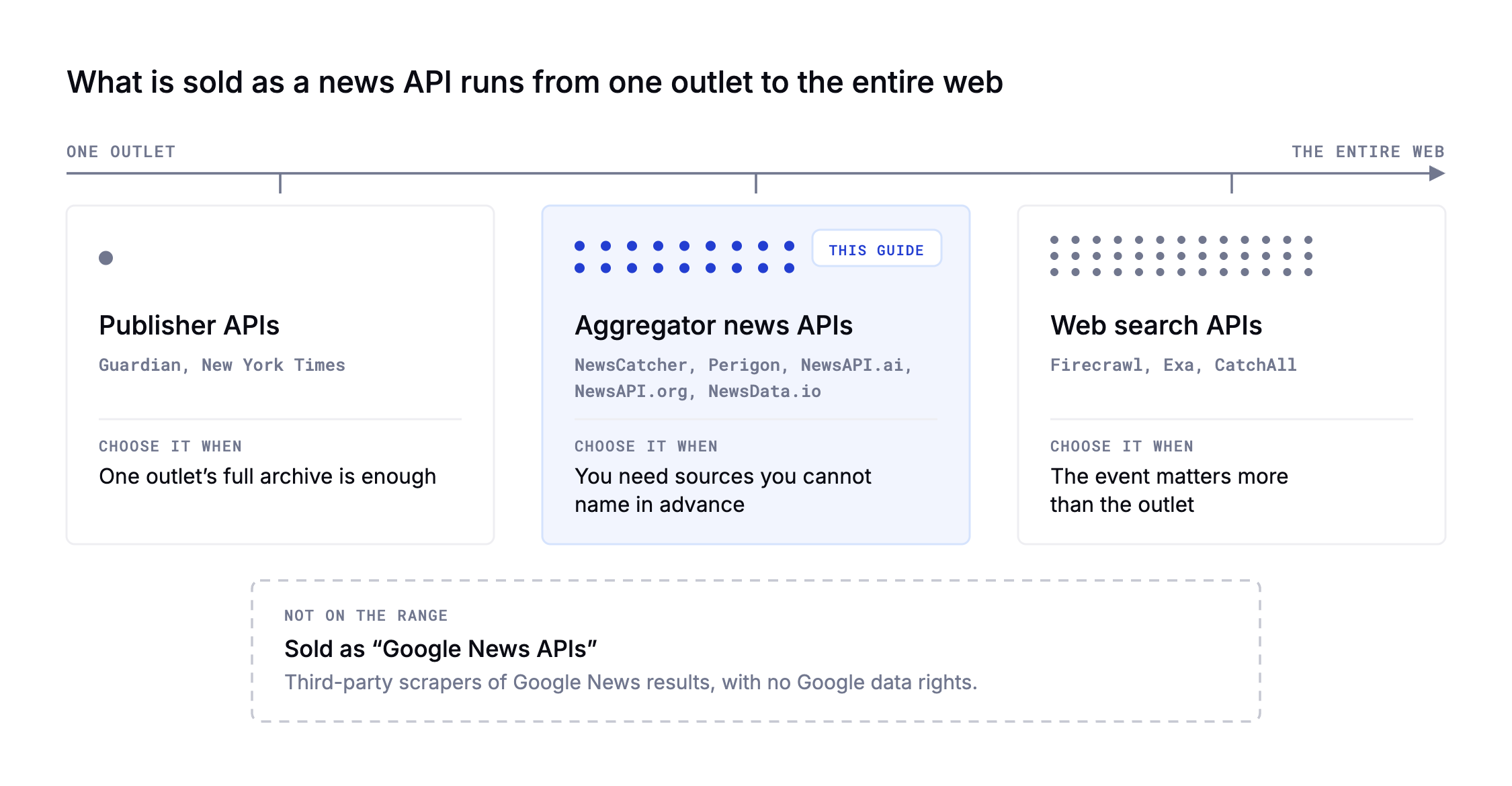
APIs that bring you news come in a very wide range, all the way from a dedicated API for a single publisher, to the entire web.
This guide covers the middle: aggregator news APIs, which let you query thousands of sources which you wouldn’t be able to name in advance. A publisher API is the better buy when one outlet’s archive is all you need, and a web search API when the event itself matters more than whether the outlet is a news publisher.
Lastly, if you are considering a third-party Google News API, the FAQ at the end of this guide explains what to check before committing to one.
What Are the Best News APIs in 2026?
The right pick depends on which of the eight dimensions are most important to you.
| # | API | Best for |
|---|---|---|
| 1 | NewsCatcher | Production pipelines needing full text, solid deduplication, and enrichments out of the box |
| 2 | Perigon | Startups that qualify for the discounted tiers |
| 3 | NewsAPI.ai | Event-level clustering and an archive that goes back to 2014 |
| 4 | NewsAPI.org | Prototypes and teaching; not ideal for production |
| 5 | WorldNews API | Cheapest route to a commercially usable full-text archive |
| 6 | NewsData.io | A full-text archive you can use commercially, with no non-commercial restriction |
| 7 | Webz.io | Usage-based pricing and coverage beyond news (blogs, forums and reviews) |
| 8 | Opoint | Multilingual media monitoring, including TV and radio |
| 9 | Exa (news search) | Semantic search over the open web, with summaries and highlights |
1. NewsCatcher
NewsCatcher is our own news API, built for teams that have outgrown a prototype. It indexes 140,000+ sources and returns the full article text alongside AI summaries, named entities, sentiment, topics and translations. A single API call gives you all the data you need.
Coverage runs well past the big outlets, which is the part that matters if what you are monitoring lives in the long tail. Full text is returned where it is publicly available, while paywalled sources may come back as headlines, summaries or preview paragraphs. It is also built for pulling big result sets rather than sampling them.
- Pricing: Custom, quoted per use case. A 7-day trial with 2,500 calls and a year of history is issued instantly so it’s easy to test. SOC 2 Type 2 certified.
2. Perigon
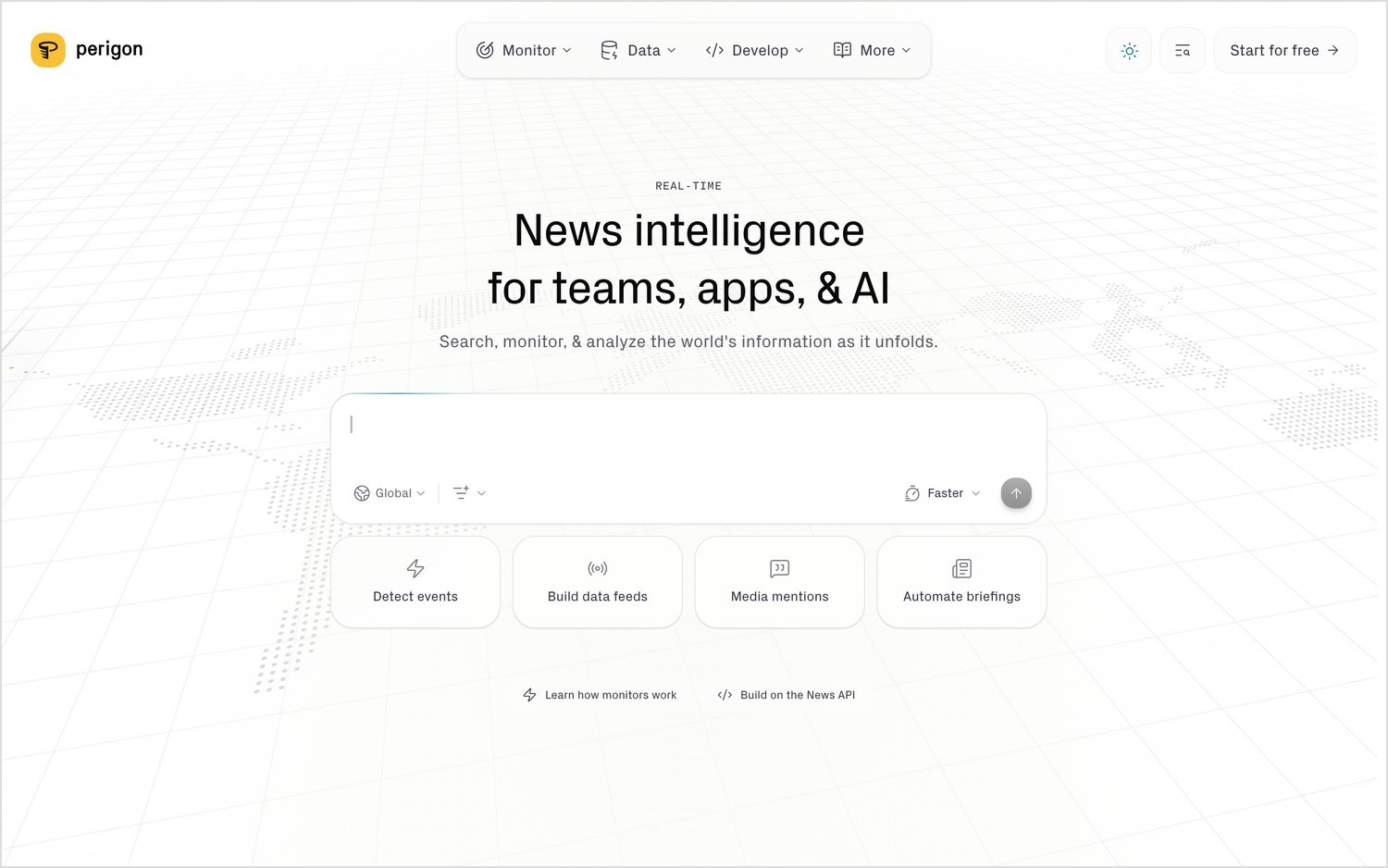
Perigon is the product on this list that’s most similar to NewsCatcher in scope. It clusters coverage into story objects and key points and resolves entities; full article text is available by licensing arrangement rather than as standard.
Its pricing page gives the impression of being self-serve, but in practice that’s not the case for most companies. The free tier is for personal use only, while the $250 and $550 tiers are restricted to eligible startups on a limited licence. Most companies will need a full commercial licence, which starts at $24,000 a year.
- Pricing: Free (150 requests per month, personal use only). $250/mo and $550/mo for eligible startups. Full commercial from $24,000/yr.
3. NewsAPI.ai (Event Registry)
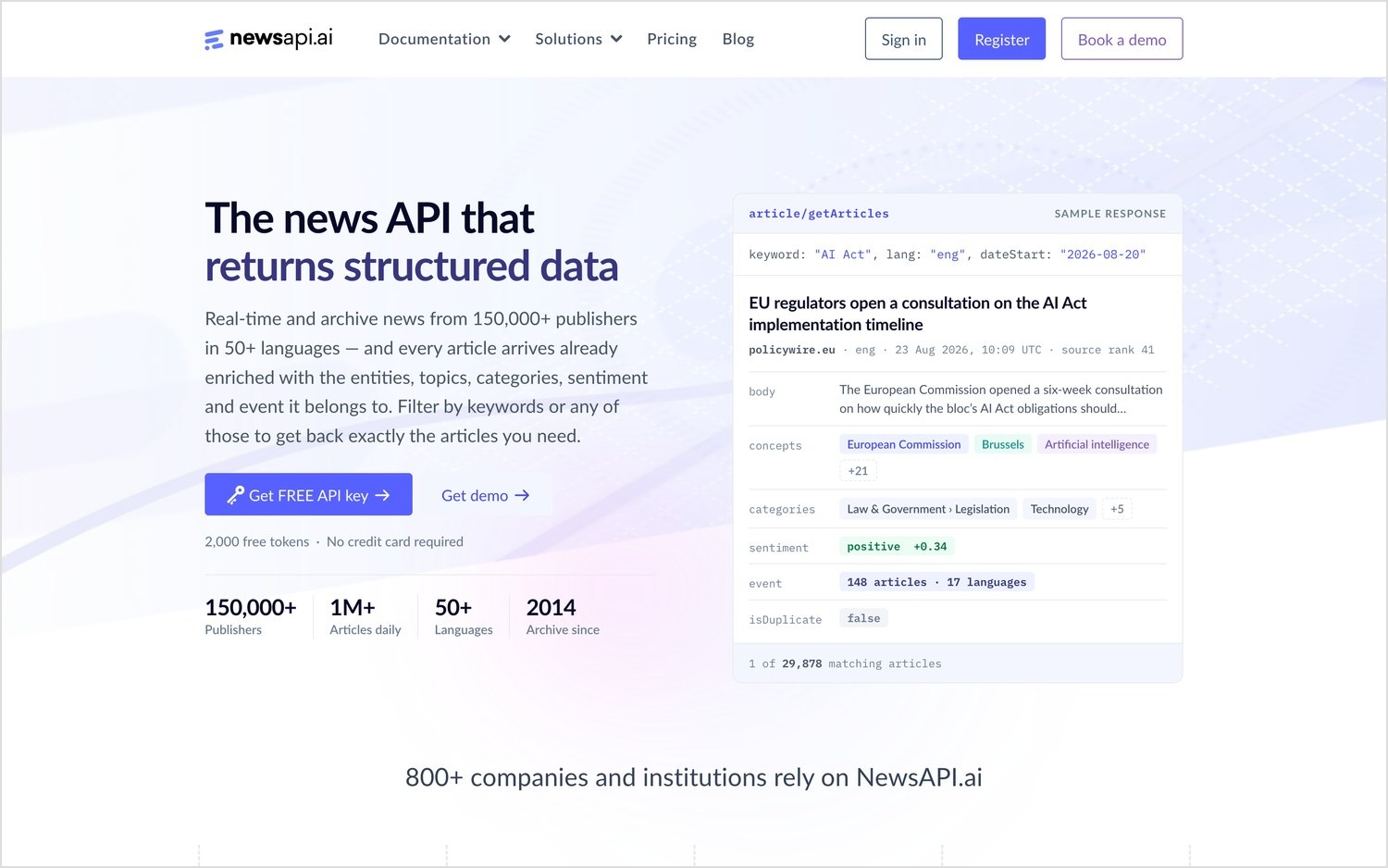
NewsAPI.ai is the front end for Event Registry, a news intelligence platform. One of its core features is clustering, grouping coverage into events across sources and languages.
It has usage-based pricing, meaning every call to their API costs tokens. In practice that makes recent news cheap and the deep archive expensive, because the cost of a search grows with the number of years it covers. For light or recent-only work the $90 entry plan goes a long way; for a team searching the full archive every day it covers only a couple of queries a day, unused allowance expires each month, and heavier use is billed on top. On the published plans, there’s a cap of 5 simultaneous requests and no published security certifications. Enterprises probably want to look elsewhere.
- Pricing: Token-based plans from $90/mo, with overage at $0.015 per token. Free non-commercial trial.
4. NewsAPI.org
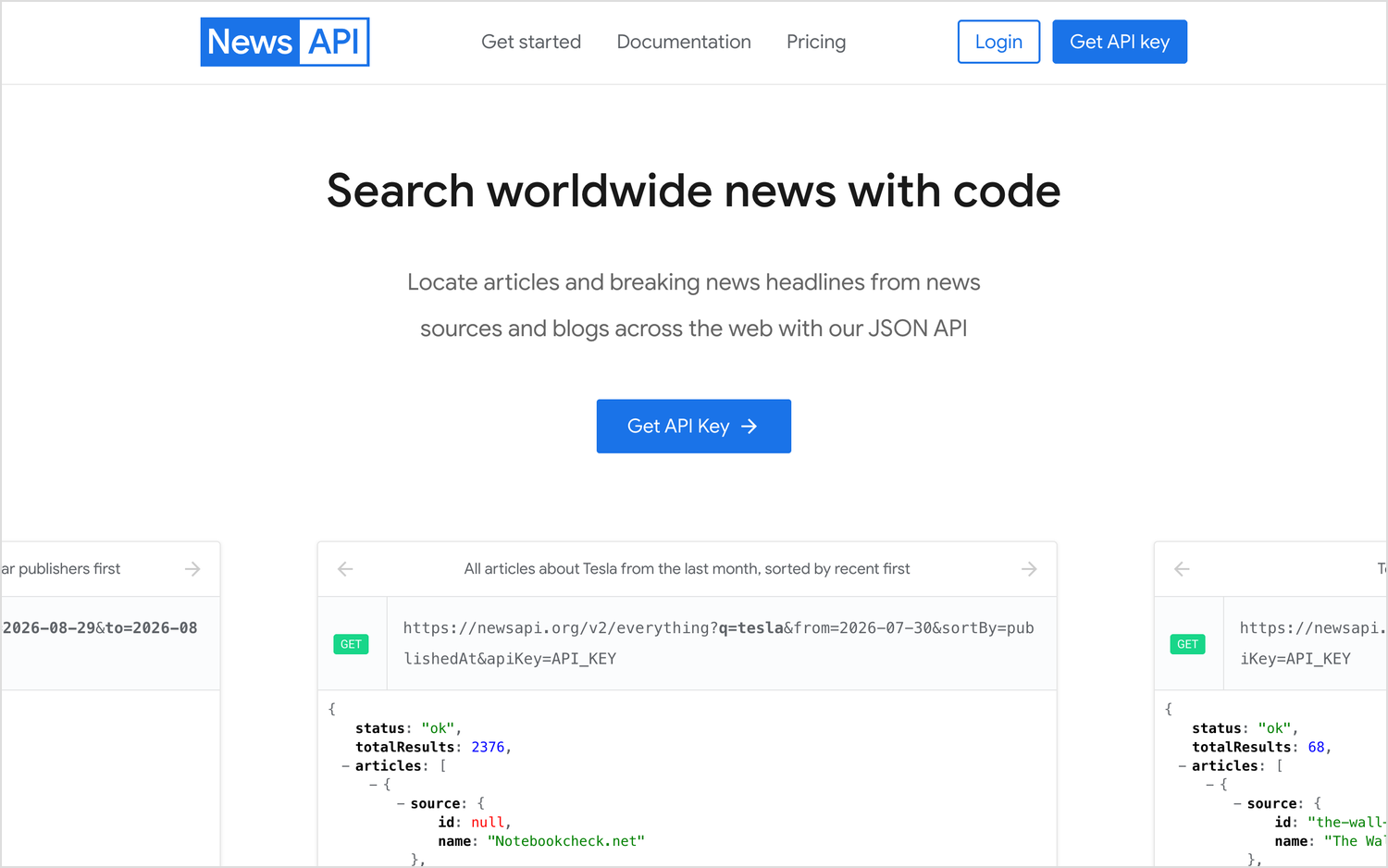
NewsAPI.org is the best-known name in the category, with over 500,000 registered developers. It’s also the one most likely to waste your time if you’re looking for full article content. Its documentation states that the content field “is truncated to 200 chars”. Their FAQ suggests that you “use the URL included with each result to scrape this yourself”.
In plain terms, the free tier is for building, not launching. The licence permits development and testing only, and the limits match. Everything runs fine while you build, and the moment you go live you are outside both the limits and the licence.
- Pricing: Free for development only. $449/mo Business. $1,749/mo Advanced.
5. WorldNews API
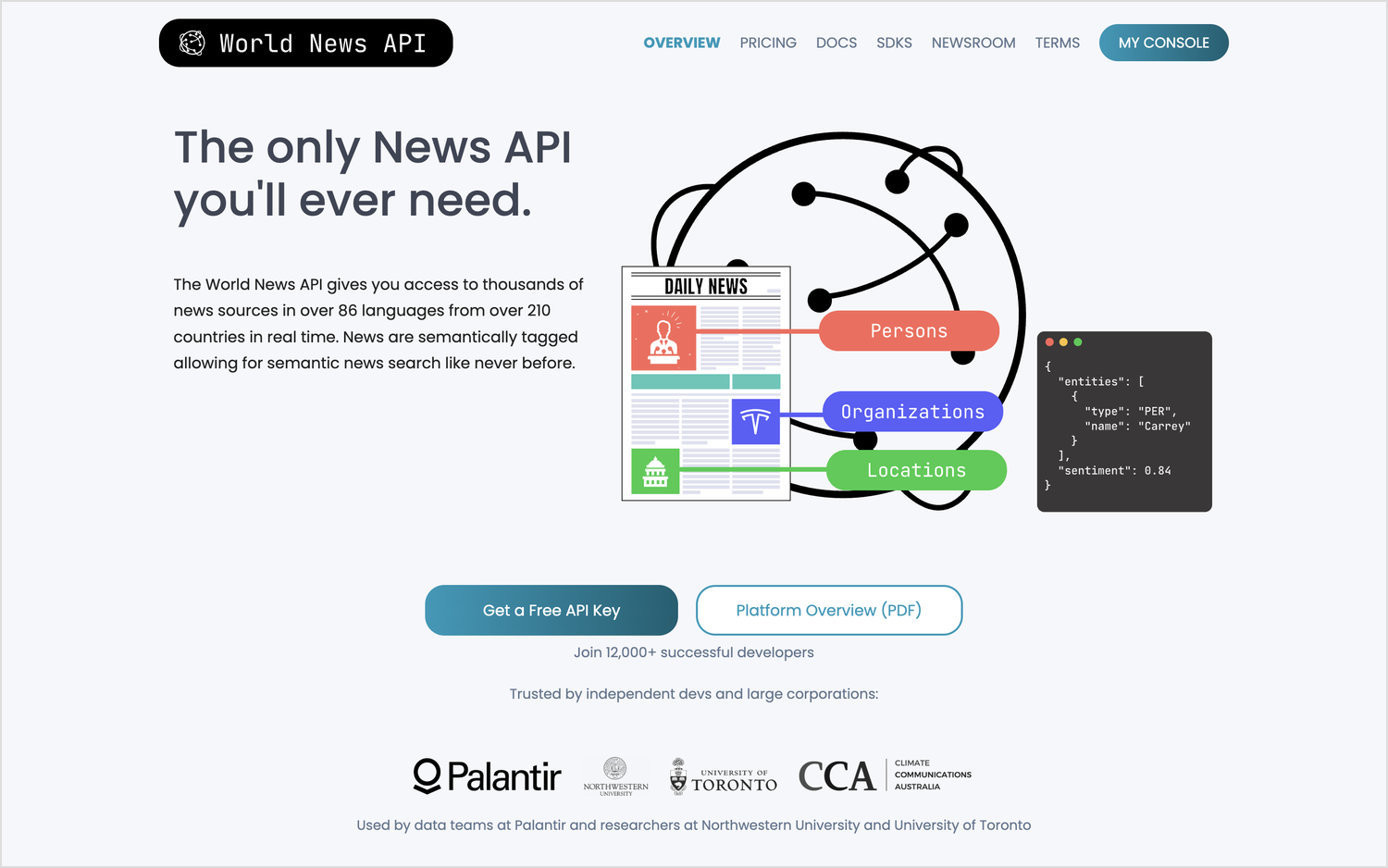
WorldNews API is the cheapest route here to a full-text archive you are permitted to use commercially. No tier carries a non-commercial restriction: the terms forbid reselling the data or cloning the service, not building on it. It also gives you an uptime guarantee from $39 a month, where most vendors here either publish nothing or reserve one for plans costing several hundred.
Where it falls short is what happens to duplicates. It does group coverage into stories, but only in its ready-made top-stories-of-the-day feed, not in search. Run your own query and near-identical copies of the same story come back ungrouped, which is the thing you were trying to avoid.
- Pricing: Free (50 points per day, 1 month of history). $39/mo Reporter. $379/mo Journalist. $1,779/mo Editor. Overage billed per point.
6. NewsData.io
NewsData.io gives you a full-text news archive that you are allowed to use commercially, and it is one of only three free tiers here that do not publish a non-commercial restriction. Its licence grants use of the data for “internal and external business purposes” with no carve-out for the free plan, which is a different position from most other providers.
What you give up is depth. In addition to a 12-hour delay on news, the free tier doesn’t give you full content to retrieve. Query strings are capped at 100 characters on lower tiers, which rules out using complex Boolean. Paying fixes most of it: the first paid tier gets you full articles in real time with a starter archive, while deeper history and longer queries are part of their higher tiers.
- Pricing: Free (200 credits per day, 12-hour delay). $199.99/mo Basic. $349.99/mo Professional. $1,299.99/mo Corporate.
7. Webz.io
Webz.io has extended well beyond their news API. News is one surface of an open, deep and dark web data business covering 350,000+ news sources, 1.2 million blogs, 11,000 forums and 150+ marketplaces. If your use case spans more than news, the breadth of sources here is hard to beat.
On the News Search API you only get a summary and a relevant excerpt, but they have a second API you can call to retrieve the article body, which is doable but makes your pipeline somewhat more complex. Their terms also bar transferring data derivatives to third parties, which is a real constraint if your product surfaces article data to end users.
- Pricing: $5 of credits monthly, no card. Then $0.001 per Search API call, $0.0005 per result.
8. Opoint

Opoint is the media monitoring specialist here, built for teams that track press coverage for a living rather than for developers wiring up a pipeline. That focus shows in the data: besides online news it monitors TV and radio, so a mention that aired in a broadcast comes back as a clip, and articles arrive with the numbers media teams report on, such as estimated readership and advertising value.
It is also the only vendor here you cannot try on your own, since there is no signup. Coverage spans most languages in the world, with more than 60% of sources publishing in something other than English, and new sources are vetted by people before they are added.
- Pricing: Not published. Trials are sales-granted.
9. Exa (news search)
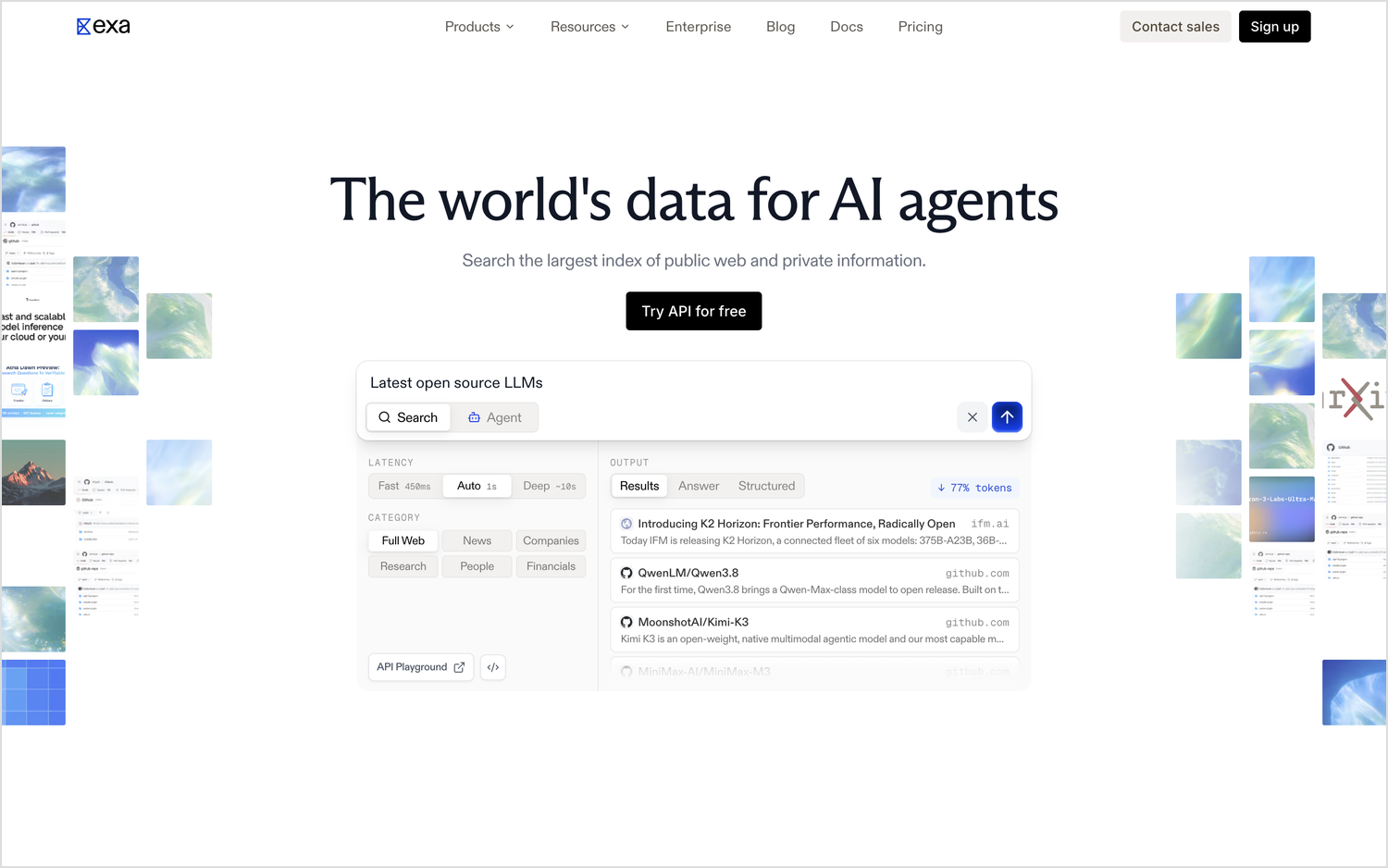
Exa is the one entry here that is not a news aggregator. It is a semantic web search engine, and news is a category value on its general search endpoint, so you are querying a web index filtered to news rather than a curated publisher index. That buys you search by meaning rather than by keyword, query-tailored LLM summaries, and highlights, which are relevant excerpts that no aggregator here returns. What you give up is everything an aggregator adds on top. For jobs where relevance matters more than completeness, it is a genuine option.
- Pricing: Usage-based, no subscription. $20 in free credits to start (around 2,800 searches), then $10 in free credits every month. Search $7 per 1,000 requests. Contents $1 per 1,000 pages. AI summaries $1 per 1,000 pages.
Single-Publisher APIs such as the Guardian and New York Times
Single-publisher APIs give you one publisher’s full archive: the Guardian Open Platform offers a free developer key with access to full article text at 500 calls a day for non-commercial use, and its commercial keys permit AI training and text and data mining. The New York Times runs a similar programme. Single-publisher APIs are the wrong tool for monitoring a topic across sources, but the right one for analysing how a specific publisher covered it.
What About Firecrawl?
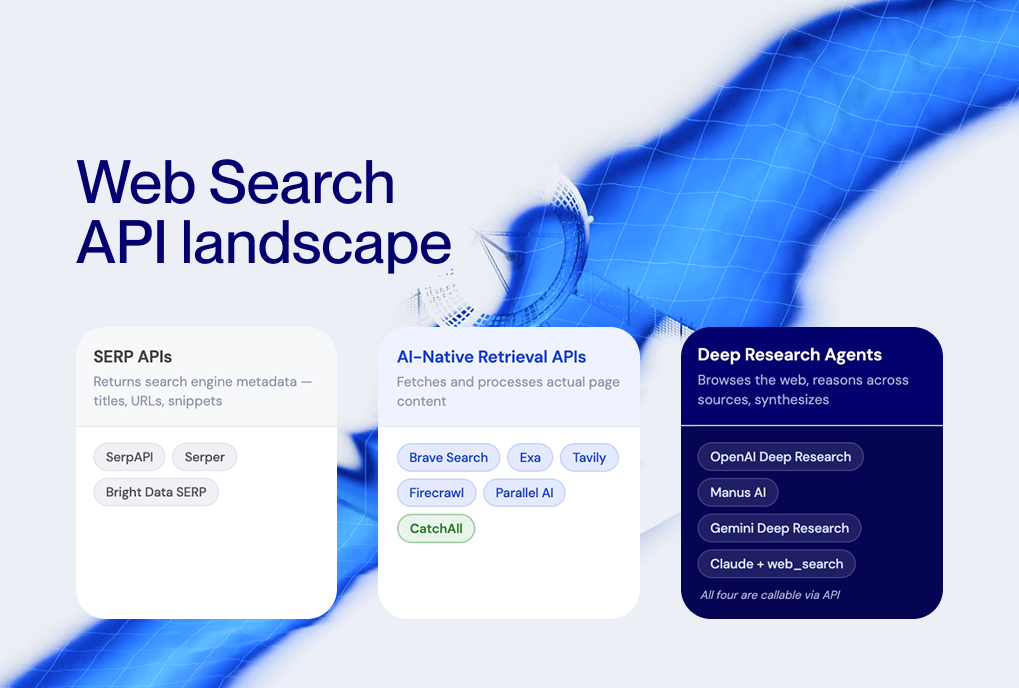
Firecrawl is a popular open-source API for web data, and a common way to give AI agents access to the web. You give it a URL and it returns the page as clean markdown or JSON, with no scraper to build or maintain, and its search can fetch the full content of every result in one call.
Next to a news API, that is both the advantage and the limitation. Firecrawl can read any page on the open web, including pages no news index carries. But it searches the live web rather than an archive you can search back through: its own docs state the date filters apply to web results only, not news, so it cannot pull coverage from a specific period. Deduplication and enrichments like entities are also yours to build. Firecrawl is the better choice when you already know which pages you want; a news API is the better one when the question is which pages exist. Our guide to web search API types places it against Exa, Tavily and the rest.
How Are News APIs Used in AI and Data Applications?
Five patterns account for most production use of news data, and each one leans on a different part of the comparison below.
| Use case | What it needs most | Why that dimension |
|---|---|---|
| Risk and threat intelligence Security, geopolitical and operational teams | Local and non-English coverage | The first report of an incident is rarely in English and rarely in a national outlet |
| Regulatory and compliance monitoring Legal and compliance teams | Archive depth | The question is usually what was knowable on a given date rather than what is true today |
| Market and competitive intelligence Strategy, product and investment teams | Deduplication | One funding round generates hundreds of near-identical write-ups, and a raw feed will report it as hundreds of events |
| Supply chain oversight Procurement and ESG teams | The long tail of sources | A factory fire or a port closure is covered locally long before it reaches the trade press |
| Grounding AI systems RAG pipelines and agents | Full article text on a single call | These systems need text that is current and attributable, which a model’s training data stops being the moment it is frozen |
Most teams end up in two of these at once, which is where the trade-offs bite. Very few vendors are good at both, and the tables below are where that shows.
How to Choose the Right News API
What You Actually Get With Each Vendor
Every cell describes the paid tiers; what the free tiers hold back has its own table below. Latency is the one column to read carefully: five vendors publish a figure, the rest describe it only as "real time", and none of them documents what is being measured.
| API | Full article text | Archive depth | Countries | Latency |
|---|---|---|---|---|
| NewsCatcher | Yes | Back to 2019; enrichments from July 2023 | 100+ | Roughly 5 to 10 minutes |
| Perigon | Via licensing | Up to 10+ years | Not published | Up to 15 minutes; 1-hour delay on the $250/mo tier |
| NewsAPI.ai | Yes | Back to 2014 | Not published | Minutes after publication |
| NewsAPI.org | No | Up to 5 years | 55 | No figure published |
| WorldNews API | Yes | Back to January 2022 | 210+ | No figure published |
| NewsData.io | Yes | Up to 10 years | 206 | No figure published |
| Webz.io | Via a second API call | Up to 10 years | 200+ | No figure published |
| Opoint | Yes | Not documented | 230 jurisdictions | Under 7 minutes on average |
| Exa (news search) | Yes | Not documented | Not published | Minutes after publication |
Source: vendor documentation and pricing pages, verified September 2026.
Retrieval Limits
The limits below are invisible while you are testing and obvious in production. Only two vendors publish a maximum query length at all, so treat the blanks as undocumented rather than unlimited.
| API | Results per request | Total results per query | Max query length |
|---|---|---|---|
| NewsCatcher | 1,000 | 10,000. Past that, the SDK splits by date range for you | Not documented |
| Perigon | 100 | 10,000. Past that, you split by date range yourself | Not documented |
| NewsAPI.ai | 100 | No limit, but every 100 articles you pull costs tokens | No character limit; 15 search terms on the free trial |
| NewsAPI.org | 100 | Not documented | 500 characters |
| WorldNews API | 100 | Not documented | Not documented |
| NewsData.io | 50 | Not documented | 100 characters on Free and Basic |
| Webz.io | 100 | Not documented | Not documented |
| Opoint | 500 | Not documented | Not documented |
| Exa (news search) | 100 | 100 self-serve; up to 1,000 on enterprise | Not documented |
Source: vendor documentation and pricing pages, verified September 2026.
None of the open-web aggregators actually serves body text from paywalled articles. Opoint sits apart because it licenses content from publishers.
The scrape-it-yourself route is a real project you take on, with paywalls, bot blocking, boilerplate and per-domain maintenance.
Deduplication and Clustering
A popular story gets covered by hundreds of newsrooms and mirrored further still, so what a vendor does about repetition shapes how much signal you get. What genuinely separates them is the last column: how much each one tells you about what it collapsed.
| API | Deduplication | Clustering | Duplicate transparency |
|---|---|---|---|
| NewsCatcher | Yes | Yes | Full group with sources |
| Perigon | Yes | Yes | Group ID to fetch the rest |
| NewsAPI.ai | Yes | Yes, the core feature | Full group with sources |
| NewsAPI.org | No | No | None |
| WorldNews API | Not documented | Top News endpoint only | Within a Top News cluster |
| NewsData.io | Yes | No | True or false flag only |
| Webz.io | Detection only, no filter parameter | No | Syndication ID and flags |
| Opoint | Yes | Not documented | None |
| Exa (news search) | Not documented | Not documented | None |
Source: vendor documentation, verified September 2026.
Enrichments
Enrichment is what you would otherwise build yourself, and it is where these vendors differ most from one another. Two columns repay a close look. Entity IDs is the difference between a name and something you can join on: a vendor that returns "Apple" as a string leaves you to work out which Apple, while one that returns a Wikidata or LEI identifier has already decided. Embeddings is the column most vendors leave empty. NewsCatcher documents 1024-dimensional semantic vectors on its Embeddings plan for similarity search and clustering, which is the layer you would otherwise generate yourself. Perigon goes the other way and offers semantic search as its own API rather than exposing the vectors.
| API | Entities | Entity IDs | Embeddings | Sentiment | Topics / IPTC | AI summary | Translation |
|---|---|---|---|---|---|---|---|
| NewsCatcher | Yes | No | Yes, 1024-dimensional (Embeddings plan) | Yes | 16 themes; IPTC and IAB on the IPTC Tags plan | Yes | Yes |
| Perigon | Yes | Wikidata, ISIN, symbol | No, but sells vector search as its own API | Yes | Google categories | Yes | Yes |
| NewsAPI.ai | Yes | Wikipedia URIs | No | English only | DMOZ, a discontinued taxonomy | Not documented | Not documented |
| NewsAPI.org | No | No | No | No | Filter only, 7 categories | No | No |
| WorldNews API | Search filter only | No | No | Yes | One category label | Yes | Not documented |
| NewsData.io | Corporate tier only | No | No | Yes | Category; AI tags on the Professional plan and up | Paid tiers only | No |
| Webz.io | Yes | Tickers only | No | Yes, also per entity | IPTC levels 2 and 3 | Yes | No |
| Opoint | Yes | LEI, FIGI, PermID, Wikidata | No | English, Swedish, Danish, Norwegian | IPTC codes | Not documented | Not documented |
| Exa (news search) | No | No | No | No | No | Yes | No |
Source: vendor documentation, verified September 2026.
Production Readiness and Tooling
Uptime is the column that matters once something real depends on the API. Not every vendor publishes a figure, and with some of them an SLA only arrives if you buy one of the top tiers. The last column is about convenience: an MCP server lets an AI assistant call the API directly, so you can explore the data or build an agent without writing an integration first.
| API | Uptime SLA | Support channel | MCP server |
|---|---|---|---|
| NewsCatcher | Not published | Email, plus contract support | Yes |
| Perigon | Commercial plan only | Email, with upgraded support on the Commercial plan | Yes |
| NewsAPI.ai | 99.99% | No direct support on the entry paid tier | Yes |
| NewsAPI.org | 99.95% only on Advanced | Basic, then email, then priority email | No |
| WorldNews API | 99%+ on paid plans | Discord, then email, then phone | Yes |
| NewsData.io | 99.99% | Dedicated support on the Professional plan and up | Yes |
| Webz.io | Not published | None below the High Volume plan | Yes |
| Opoint | Not published | Not published, sales-led | No |
| Exa (news search) | Enterprise plans only | Enterprise plans only | Yes |
Source: vendor pricing pages and documentation, verified September 2026.
Whether You Should Build It on the Free Tier
Usually not, and the reasons are often as much in the licence as in the list of features.
| API | Free tier | Commercial use | Delay | The limitation |
|---|---|---|---|---|
| NewsCatcher | 7-day trial, 2,500 calls, 1 year of history | Trial, production on Enterprise | None | It expires |
| Perigon | 150 requests per month, 3 months of history | No, personal use licence | None | The next two tiers are restricted to eligible startups. Full commercial from $24,000/yr |
| NewsAPI.ai | 2,000 searches, one time only | No | None | One-time allowance, not monthly, and archive searches burn it many times faster. Company or academic email required |
| NewsAPI.org | 100 requests a day, 1 month of history | No | 24 hours | Development environment only, and browser apps work only from your own machine |
| WorldNews API | 50 points a day, 1 month of history | No published restriction | Not documented | All endpoints share the same daily allowance, capped at one request a second. The free tier requires a backlink to worldnewsapi.com |
| NewsData.io | 200 credits a day, 10 articles per credit | No published restriction | 12 hours | Full content is paid only. Query strings capped at 100 characters |
| Webz.io | $5 of credits monthly, no card | Yes, with a redistribution limit | Not documented | $5 buys about 5,000 Search calls but only about 500 Data Feed calls, and the feeds carry full text |
| Opoint | No | Not applicable | Not applicable | Trials are sales-granted |
| Exa (news search) | $20 to start, then $10 a month | No published restriction | Not documented | Page contents and AI summaries bill on top of search, and results past the first ten in a request cost extra |
Source: vendor pricing pages and terms of service
Read the licence for the tier you intend to ship on, not the one you are testing on.
Matching an API to Your Use Case
- Prototyping or learning? NewsAPI.org, and expect to move before you launch, because its free plan is licensed for development only. Exa is the other easy start, with $10 of credits every month and no non-commercial restriction.
- Small commercial project? WorldNews API at $39 a month is the cheapest full-text archive here, with NewsData.io the step up if you need more depth.
- Funded startup? Check whether you qualify for Perigon’s startup pricing. If you do, it is the best value here, though the $250/mo startup tier delivers data on a 1-hour delay.
- Feeding an LLM, RAG pipeline or agent? Full text on a single call is the requirement. That means NewsCatcher, NewsAPI.ai or WorldNews API are your best candidates, and it rules out anything that returns only a link and a truncation marker.
- Media monitoring across languages, including TV and radio? Opoint, though getting access starts with talking to their sales team.
- Coverage beyond news, into forums, blogs and reviews? Webz.io.
- A production pipeline that needs clean, rich, ready-to-use news data? That is what NewsCatcher is built for, and you can start a trial without talking to anyone.
FAQ
Is there a Google News API?
No. Google publishes no News API and no commercial model for Google News data. Products sold as a “Google News API” are third-party scrapers of Google News search results. That matters for two reasons. Google News’s own robots.txt opens with a blanket Disallow: / and allows only a short list of paths that does not include search results or articles. And Google’s Terms of Service prohibit “using automated means to access content from any of our services in violation of the machine-readable instructions on our web pages”. A product built on scraped Google News results is doing, by construction, the thing Google’s terms tell you not to do. The free alternative people reach for is the Google News RSS feed. It works for a hobby project and stops working at scale: there is no pagination past roughly 100 items, no archive, and no support.
What is a news API?
A news API is an HTTP endpoint that returns news articles as structured data, usually JSON, so software can query thousands of publishers at once instead of a person visiting each site. Most return metadata such as title, source, date and URL, and the leading ones also return the article body along with entities, sentiment and topic classification.
Is there a free news API I can use commercially?
Yes, three of the eight free news API tiers compared publish no non-commercial restriction: NewsData.io, WorldNews API and Exa. The rest restrict it: Perigon’s free tier is personal-use only, and NewsAPI.org limits its free plan to development environments.
Which news APIs return the full article text?
NewsCatcher, NewsAPI.ai, Opoint and WorldNews API return the full article text in a single call. Perigon provides it, but only by licensing arrangement. Exa returns text it crawled rather than licensed, NewsData.io sells full text as a paid upgrade, Webz.io requires a second call to a separate API, and NewsAPI.org truncates the body at 200 characters. No open-web aggregator serves paywalled body text, and NewsCatcher is the only one that documents this openly.
How far back does news API data go?
News API archives range from 30 days to more than a decade, and the limit is almost always tied to your plan. Free tiers typically give you 30 days to three months.
What is the best news API for an LLM or RAG pipeline?
Whichever returns the article text in the same response as the search results. An API that returns only URLs turns one call into a fetch, extract and clean loop for every result. Prioritise full text on a single call, clean output, and pre-computed deduplication, clustering and entities. Only a few of the APIs here do that work for you. One caveat if you are building an agent: the search provider is only one part of the system, and the model, the prompt and the agent loop around it shape the result as much as the data source does. Test the combination on your own queries rather than trusting a comparison table, including this one.






.png)

.png)