










Asking an AI a question and having it actually research one are two different things. A standard AI prompt gets you an answer in seconds. Deep research takes longer, but it gets you a structured report, with citations, after working through dozens of sources across the web. For engineering teams building agentic pipelines, knowing the difference, and how deep research tools work behind the scenes, makes a big difference in the results you'll be able to get.
TLDR:
- Deep research AI runs multi-step agentic loops across dozens to hundreds of sources. It returns cited reports instead of just raw links.
- Standard AI search typically takes a few seconds; deep research takes anywhere from 3-30+ minutes.
- Use deep research where multi-source synthesis matters: competitive intelligence, due diligence, literature review, and more.
- Understand and test for hallucinations, access gaps, and token costs before deploying deep research in production pipelines.
What is deep research?
Deep research is the process of using AI agents to autonomously conduct multi-step investigations across large volumes of sources, synthesizing findings into cited reports. A regular AI assistant responds to a prompt in a single pass. An AI in deep research mode iterates; it queries, reads, scores, and refines until it reaches a thorough answer.
The core mechanic of deep research is an agentic loop. The AI breaks a complex question into sub-queries, retrieves relevant sources, assesses credibility and relevance, then integrates what it finds before deciding whether further queries are needed.
What defines a deep research system?
Deep research is often associated with the research mode available inside popular AI assistants (ChatGPT, Gemini, Perplexity, and more), but can also be accessed through the API. It runs on the same models that run those assistants, the difference being that the harness around them is tailored for research.
Compared to basic AI search, a few properties define deep research systems:
- They run multiple retrieval rounds, adjusting queries based on intermediate findings instead of returning the first result set.
- They're more thorough in assessing source quality, cross-referencing claims across documents before accepting them as reliable inputs.
- They produce more attribution, outputting citations alongside conclusions so users can audit the reasoning chain.
- They often read full document content beyond snippets or titles, catching context buried deep in a source that headline-only retrieval would skip over entirely.
- They can adapt their strategy in the middle of a search job, pivoting to new sub-queries when intermediate findings reveal unexpected gaps or point toward a more relevant angle.
How does deep research work?
Here is how the pipeline typically runs:
- Decomposing your query: The system breaks your high-level question into smaller sub-questions, identifying what information is needed and in what order.
- Iterative web search: The agent runs multiple searches, scores results, then adjusts queries based on what it finds.
- Source reading and extraction: Relevant documents are fetched, parsed, and filtered for signal.
- Reasoning and synthesis: The LLM connects findings across sources, resolves contradictions, and builds a coherent answer.
- Output generation: The system returns a structured report with citations.
How does deep research compare to standard AI search?
Standard AI search typically takes a few seconds. You ask a question, it fires off one or two queries, grabs the top results, and returns a short synthesized answer. For simple factual lookups, that's usually sufficient, but shallow searches like this can easily miss relevant results. This is why recall in AI search matters, even at this stage.
Deep research runs on a different axis. It takes 3 to 30+ minutes, processes dozens to hundreds of sources, can read full documents and resolve contradictions. It returns a structured report with inline citations you can click into and verify. That thoroughness is why it takes more time and uses a lot more compute than a basic AI answer.
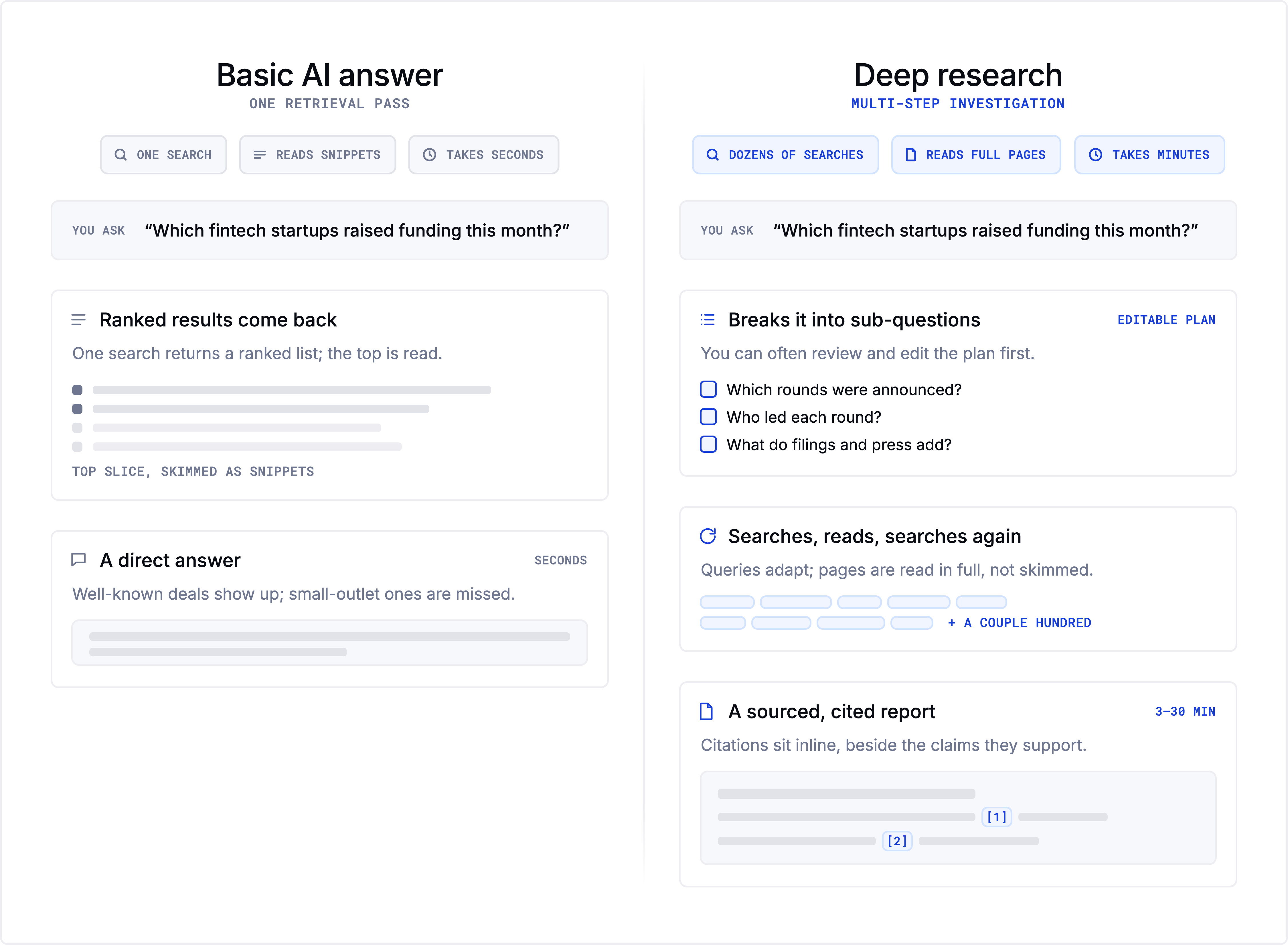
Here is how the two approaches compare across the dimensions that matter for production systems:
| Dimension | Standard AI Search | Deep Research |
|---|---|---|
| Latency | 2 to 10 seconds | 3 to 30 minutes |
| Sources processed | A handful of top-ranked results | Dozens to hundreds |
| Output format | Short synthesized answer | Structured report with citations |
| Best for | Simple factual lookups | Multi-source synthesis, gap detection |
The rule of thumb: if your question has a single, stable answer, standard search is fine. If the answer requires comparing sources or synthesizing conflicting claims across domains, running deep research is probably worthwhile.
What are the use cases for deep research AI?
Deep research AI is useful for high-value workflows where shallow, single-query search falls short.
How is deep research used for competitive intelligence?
Deep research agents can continuously scan news, filings, and other web content across multiple competitors, categorizing them by type (e.g. pricing changes, feature releases, partnerships, executive moves) and return a ranked digest. A team that previously spent days on manual competitive research can review that type of structured synthesis in far less time. Set up correctly, this makes recurring competitive monitoring easy and practical, versus relying on periodic manual efforts to get the same information.
How is deep research used for due diligence?
Deep research agents can scan SEC filings, litigation databases, and news archives in parallel across multiple acquisition targets. This compresses research that could otherwise take days of work for an analyst per target. Teams building market intelligence pipelines follow the same pattern using web search APIs for market intelligence at the retrieval layer.
How is deep research used for scientific literature review?
Researchers use AI agents to aggregate findings across published studies, flag contradictions, and summarize consensus. This makes reading much more efficient as researchers get actionable briefings, often shortening reading time from weeks to days. A typical workflow runs a research agent against a structured retrieval layer, surfacing studies not only for relevance, but also assessing contradictory findings that manual reviews often miss when working through large volumes of abstracts.
How is deep research used for real-time web monitoring?
A financial media platform building a briefing for its subscribers, for example, might run parallel deep research loops across 18 topic categories. Each loop feeds an agent that creates a summarized briefing, delivered to subscribers every four hours. Every briefing carries timestamped source citations, so subscribers can trace any claim back to its origin without relying on editorial judgment alone. Product and data teams can wire this same pattern into any pipeline that requires continuously updated, grounded context.
What are the two layers of a deep research system?
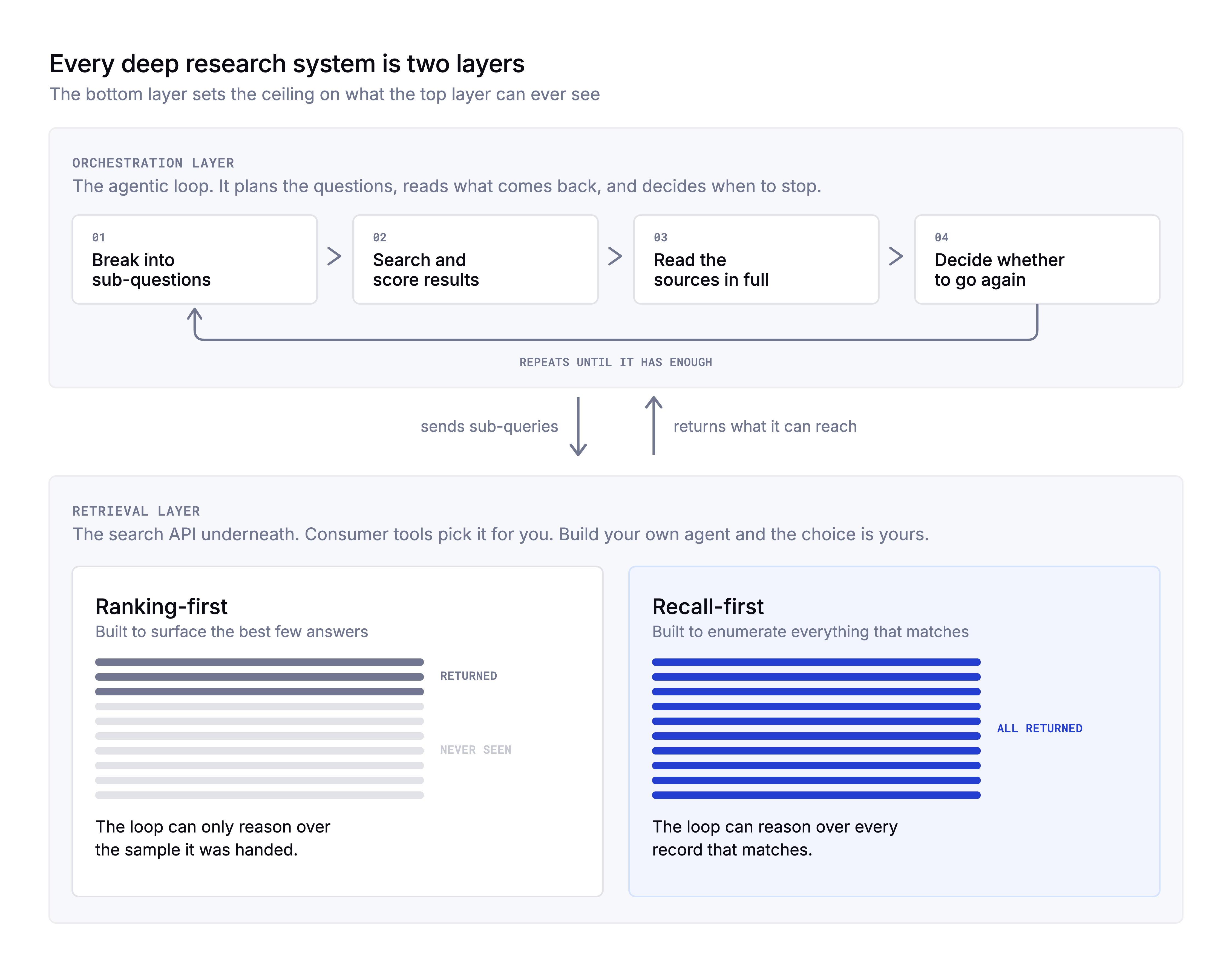
Every deep research system depends on two layers working together. The orchestration layer is the agentic loop: it breaks a question into sub-queries, reads sources, reasons across them, and decides when to stop. The retrieval layer is the search API that feeds it. Under the hood, consumer tools like ChatGPT's deep research bundle both into a single product. Engineering teams building their own agents choose each layer separately, which makes the retrieval layer a deliberate (and important) architectural decision.
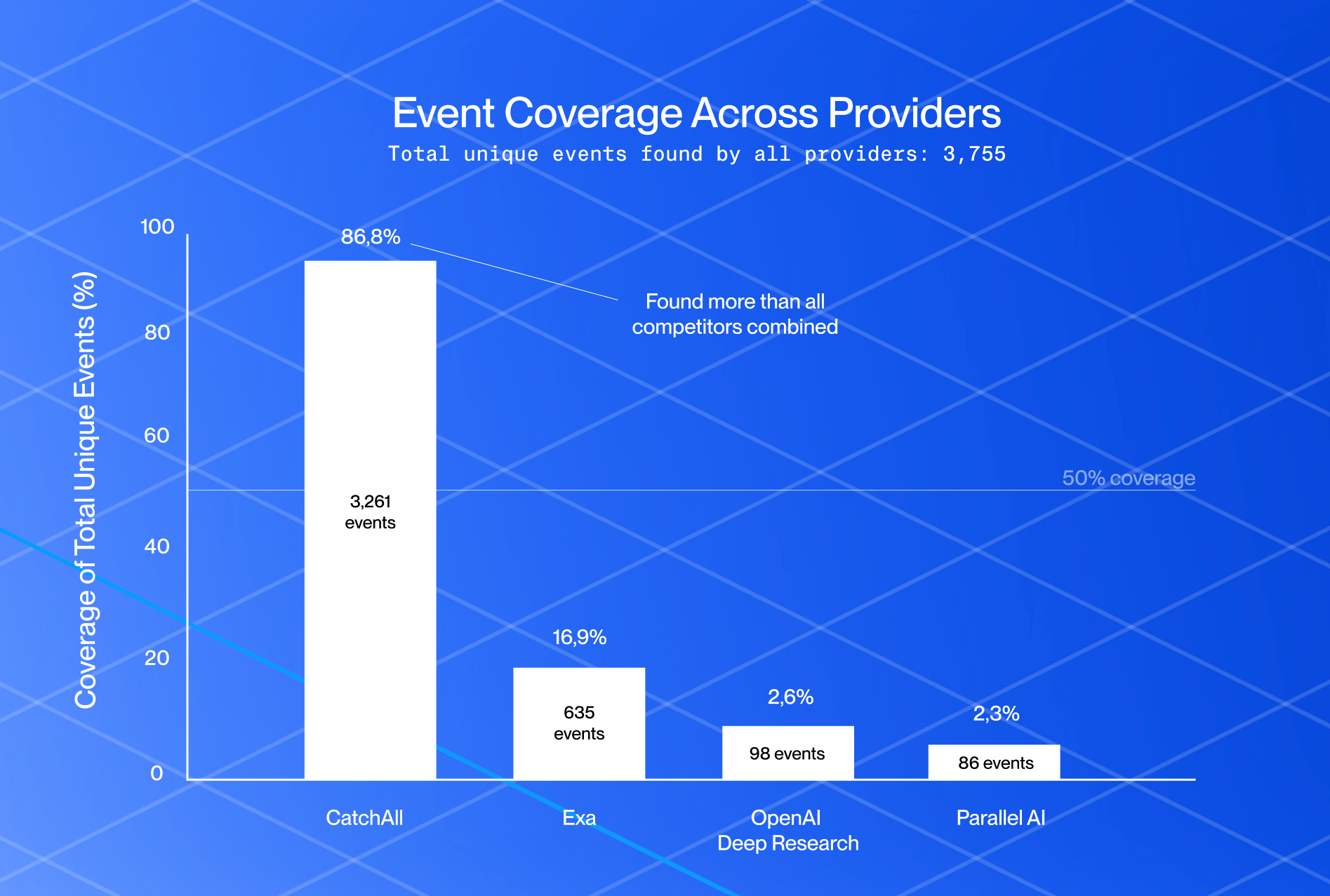
That decision usually comes down to two approaches. Ranking-first search engines, which most deep research tools for the consumer market sit on, are built to surface the best few answers to a query, so the agent only ever reasons over a ranked sample of what exists. Recall-first retrieval works the other way and enumerates every record matching your description, which matters when the answer is spread across thousands of pages rather than concentrated in the top ten. We compare seven tools on this and five other criteria in our guide to the best deep research tools in 2026.
Deep research tools available now
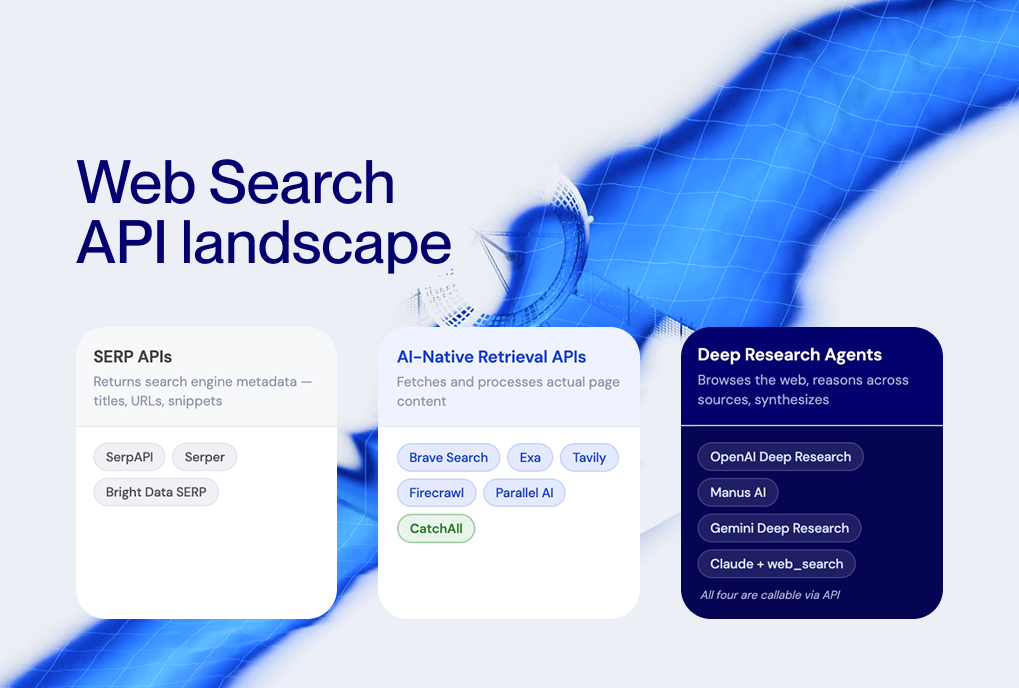
The tools below are what most people mean when they say deep research. Each of these tools bundles both the orchestration of the search and search API beneath it into a single product, so the retrieval layer is chosen for you. In every case below, that retrieval layer is ranking-first.
Consumer and general-purpose tools
| Tool | What it does | Pipeline fit |
|---|---|---|
| OpenAI Deep Research | Runs multi-step web searches in ChatGPT or via API and returns cited long-form reports | Available through the Responses API with background jobs and webhooks. Priced per token, so cost tracks report length rather than how much it actually found. |
| Google Gemini Deep Research | Synthesizes research briefs with source attribution, drawing from Google's index | Available through the Interactions API, still in preview. Priced per task, so the cost is known before you run it. |
| Perplexity AI | Provides agentic search with real-time sourcing and conversational query iteration | Available through the Sonar API with async jobs. No native scheduling or webhooks, so recurring runs have to be orchestrated on your side. |
Recall-first retrieval is a different category of tool: not a research assistant, but a search API you wire into your own agent. We compare the options in our guide to the best web search APIs in 2026.
Limitations of deep research AI
- Hallucination is a risk factor: even well-designed deep research agents can sometimes confidently cite sources that are misquoted, outdated, or subtly misrepresented. A 2026 audit found that even top agents hallucinate roughly 3 to 13% of the URLs they cite, and a 2025 audit found 97.5% of the statements in one tool's reports were unsupported by its own cited sources. Even with cited research produced by AI, verifying outputs against primary sources for important decisions is still highly recommended.
- Latency is a trade-off. Multi-step agentic workflows take minutes, not seconds. If your pipeline requires real-time responsiveness, deep research is probably the wrong tool for the job.
- Access gaps determine coverage. Most deep research tools rely on public web crawls, which means things like paywalled content, proprietary databases, and freshly published content typically fall outside their reach. We've covered this limitation in depth in our post on comparing data search pipelines.
- Cost increases with research depth. More search iterations and longer reasoning chains consume more tokens, which adds up fast in production environments with high query volume.
- Output is non-deterministic: identical queries will return different results across runs because the orchestration agent is likely to generate somewhat different sub-queries, retrieve different pages, and reason to different conclusions each time.
- Coverage quality depends on the retrieval layer beneath the agent. Coverage—particularly with ranking-first retrieval—is highly uneven: in our own analysis of 272 security incidents over three days, the top 20 incidents accounted for three quarters of all the coverage. Meanwhile, two thirds of incidents were mentioned in just one place. Single-source events like that rarely surface in a ranked result set. A well-built orchestration loop feeding from a shallow or poorly maintained index will still produce shallow results, regardless of the reasoning quality above it. That makes it a retrieval problem rather than a reasoning one, and it has to be fixed a layer down: recall-first retrieval is built to enumerate exactly the long tail that ranked search leaves behind.
Assessing deep research output quality
Assessing output quality is one of the harder problems in deep research workflows. Unlike simple Q&A, deep research produces long, multi-source reports where errors can hide in footnotes and confident-sounding claims can be completely wrong.
A few dimensions to track:
- Factual accuracy rate against verified sources, since LLMs hallucinate even when citing real URLs
- Source diversity, meaning how many distinct domains and publication types contributed to the final output
- Reasoning transparency, or whether the system shows its chain of thought so you can spot where logic breaks down
- Recency of evidence, especially for fast-moving topics
Before you rely on it for anything that matters, run it on a few questions you already know the answers to and see how the report holds up. Someone who knows the topic can often catch a thin or wrong answer quickly, though on a genuinely complex subject that check has its own limits. Treat it as a starting point rather than the whole test. Measuring the retrieval step underneath is the more systematic complement, and we cover a way to do that without hand-labeling anything in our guide to evaluating web search quality.
Integrating deep research into agentic pipelines
Deep research AI fits naturally into agentic RAG pipelines as a research sub-agent: it receives a task, fetches and synthesizes information from across the web, then passes structured findings downstream to planning or execution agents.
A few integration patterns that hold up in production:
- Trigger deep research on demand when an agent hits an information gap, not on every cycle. This keeps latency manageable without sacrificing coverage.
- Pass structured outputs (JSON summaries, ranked source lists) directly into your LLM context window to reduce hallucination risk on factual queries, which connects to why recall beats precision for real-world AI research tasks.
- Chain deep research with a retrieval-augmented generation layer so the agent can cross-reference live web findings against your internal knowledge base. We show this in practice in our post on building a supply chain risk monitor with CatchAll and CrewAI.
- Set up recurring monitors for topics you need to keep tracking, so your pipeline only receives what is new. The alternative is re-running the whole research job every time and paying again for results you already had.
- Log intermediate query steps and source citations alongside the final output to give your team an audit trail that shows where the agent focused, what it retrieved, and where the reasoning diverged.
The main friction point is freshness. Deep research tools browse the live web, but every run is a one-shot snapshot with no way to subscribe to what changes afterward. For pipelines that need continuously updated web coverage, wire CatchAll's recurring monitors into that agent node alongside the broader research layer. See how to build a deep research agent with LangChain for a concrete implementation.
Final thoughts on deep research tools and AI pipelines
Deep research AI gives your agents the ability to reason across sources, going beyond simple retrieval. Pair that with a reliable retrieval layer like CatchAll, set clear quality benchmarks for your outputs, and you have a research layer that can handle serious workloads. The tooling is there. How you wire it together is what matters.
FAQ
Why is retrieval quality critical for deep research pipelines?
Agents can only synthesize what they actually retrieved. If the retrieval layer misses relevant sources, the orchestration agent has no way to recover them. The gap disappears into the final report as if those sources never existed. This makes recall the most important metric for a research retrieval API: high precision with low recall returns a clean result set that quietly excludes the evidence your agent most needed. For production pipelines, choose a retrieval layer with broad source coverage, event clustering to deduplicate across syndicated content, and structured output your agent can reason over without additional parsing.
What are the biggest limitations of deep research tools I should account for before deploying in production?
These four constraints matter most: hallucination risk (agents can confidently misquote or misrepresent sources even when citing real URLs), latency (minutes per job, not milliseconds), access gaps (paywalled content and freshly published news often fall outside public web crawls), and token cost that scales with query depth and iteration count. Before you rely on it in production, test it on a few questions you already know the answers to.
How do I assess the output quality of a deep research AI system?
Track four dimensions: factual accuracy rate against verified primary sources, source diversity across distinct domains and publication types, reasoning transparency so you can audit where logic breaks down, and evidence recency since a six-month-old source can quietly undermine a fast-moving analysis. Before putting it in an automated pipeline, run it on a few questions where you already know what a good answer looks like.



.png)