










TL;DR: Financial databases update on reporting cycles, but the signals that move investment decisions (funding rounds, executive changes, distress indicators) appear on the open web weeks earlier. Investment teams are building web search APIs into their market intelligence platform stack to automate continuous monitoring of fragmented web sources, feed AI-powered research pipelines, and close the gap between what's knowable and what reaches analysts through traditional channels.
How Modern Investment Teams Close the Information Gap
Investment research has always been a race for information. The problem is that the sources carrying the most actionable signals, such as regional publications, niche industry blogs, company websites, and regulatory agency pages are fragmented across the open web in ways no single database reliably aggregates. By the time a funding round surfaces on Crunchbase, a leadership exit appears in a structured feed, or a distress signal reaches an analyst's dashboard, the window for acting on it has often already closed.
Modern investment teams are responding by treating the open web as a data source in its own right. Web search APIs enable programmatic, continuous retrieval of business events at scale – automating what was previously manual monitoring and feeding structured results directly into dashboards, alert systems, and AI-powered research workflows. Combined with the rise of alternative data and LLM-based investment tooling, web intelligence has become a core component of how institutional investors and venture teams stay ahead of the information curve.
Why Traditional Investment Research Workflows Are No Longer Enough
Traditional financial databases are built around mandatory disclosure events, like quarterly earnings, regulatory filings and official press releases. For public markets, this introduces lag by design: by the time a funding round surfaces on Crunchbase or an M&A deal reaches a structured database, it's been circulating in industry media for months. For earnings-related signals, the window can be even longer.
The open web compounds the problem. Relevant signals scatter across news sites, startup blogs, company IR pages, niche trade publications, regional outlets, and executive social profiles – a hiring freeze on a local business site, a partnership dissolution in a newsletter with 3,000 subscribers, a product delay on a company's own blog. No aggregator captures all of it, and no analyst team can either: tracking hundreds of companies across global markets means covering a fraction of available sources and missing the rest.
Private market intelligence is a different problem entirely. There is no disclosure infrastructure to aggregate. A Series A round may appear in one regional tech outlet and leadership changes, customer wins, and operational struggles are never mandated to be reported, so they only exist where someone chose to write about them. Tracking private market signals without automated web monitoring isn't slow, in many cases it isn't possible.
So investment teams relying on periodic analyst reviews or database alerts are systematically late to signals that are already public. Alternative data has emerged precisely because this gap is real, and open-web intelligence remains one of the most underused sources of it.
What Investment Teams Monitor with Web Search APIs
For each of the following, early discovery on the open web creates an edge that delayed databases can't provide:
| Signal | Why it matters |
|---|---|
| Funding rounds | Signals growth stage, capital availability, and investor conviction in a company or sector. Catching a round early means reaching founders before inbound overwhelms them, entering conversations ahead of competing firms, and identifying emerging categories before they become crowded. |
| M&A announcements | Reveals strategic direction, sector consolidation trends, and valuation multiples being paid. Early detection allows teams to anticipate follow-on moves, assess impact on portfolio companies in the same space, and identify targets under consideration before official processes begin. |
| Executive hires & departures | A new CRO signals a push for revenue acceleration; a CFO departure at a portfolio company may indicate financial stress or an approaching liquidity event. Early detection matters for both portfolio monitoring and deal sourcing — a departing executive is often the founder of the next investable company. |
| Layoffs & restructuring | A direct distress signal and often a leading indicator. Layoffs reported in regional media ahead of earnings calls reveal financial pressure before it's officially disclosed, giving portfolio managers and risk teams earlier warning than structured reporting cycles allow. |
| Product launches | Reveals competitive direction and R&D priorities. Early detection of a competitor entering a portfolio company's market, or an emerging startup shipping something in a white space, is actionable for both investment sourcing and portfolio strategy. |
| Regulatory developments | FDA approvals, SEC enforcement actions, new data privacy rules, and sector-specific policy changes can create or destroy value across multiple holdings simultaneously. Continuously monitoring regulatory agency sites, legal blogs, and trade press is operationally difficult without automation. |
| Partnerships | Signals strategic alignment, enterprise customer validation, and commercial traction. A startup partnering with a Fortune 500 is often reported in a press release or niche outlet weeks before it becomes a mainstream story, and it's a meaningful signal for anyone tracking that category. |
| Competitor activity | What competitors are building, buying, or exiting informs both portfolio company strategy and investor positioning. Early visibility is a competitive advantage in both deal sourcing and portfolio management. |
| Distress indicators | Cancelled partnerships, delayed product launches, accumulating customer complaints, supplier disputes. These pre-financial signals of operational problems are rarely disclosed proactively, but they leave traces across the open web that automated monitoring can surface. |
| Emerging industry trends | New technology categories, regulatory shifts, and market dynamics first appear in niche publications and early adopter communities long before they reach mainstream financial press or analyst reports. Catching a trend early allows investors to get ahead of the cycle rather than entering at consensus. |
How Web Search APIs Work in Market Intelligence Pipelines
A web search API accepts a natural-language or structured query, searches across a large web index, and returns structured results, typically JSON, rather than a rendered webpage. The workflow is straightforward: a query defines the signal to watch (e.g., "cybersecurity startup Series A North America 2026"), the API retrieves and processes matching web content, and the output, including entity-extracted, deduplicated and source-attributed records flows into dashboards, CRMs, alert systems, or AI research workflows. No HTML parsing, no scraper maintenance, no manual URL triage.
Built for machines rather than human readers, it handles the full request-processing-response cycle programmatically, returns structured data at scale, and supports the filtering and scheduling that production monitoring pipelines require. Integration into existing tooling, whether a portfolio monitoring dashboard, a CRM alert workflow, or an LLM-based research system, is a matter of API calls rather than custom engineering. That's what makes it viable as a market intelligence platform infrastructure layer rather than a research shortcut.
Real-Time Funding Round and M&A Intelligence
A funding round at a seed-stage AI startup may be covered by two regional publications and a founder announcement before it appears on any aggregator. An acquisition in enterprise SaaS may surface in an industry newsletter three weeks before the official press release.
Catching these early changes the nature of the opportunity. Faster deal sourcing means earlier conversations with founders. Spotting underreported rounds in cybersecurity or climate tech means identifying categories attracting capital before those categories become consensus. Tracking private market movement before databases update means operating on current information rather than historical aggregations.
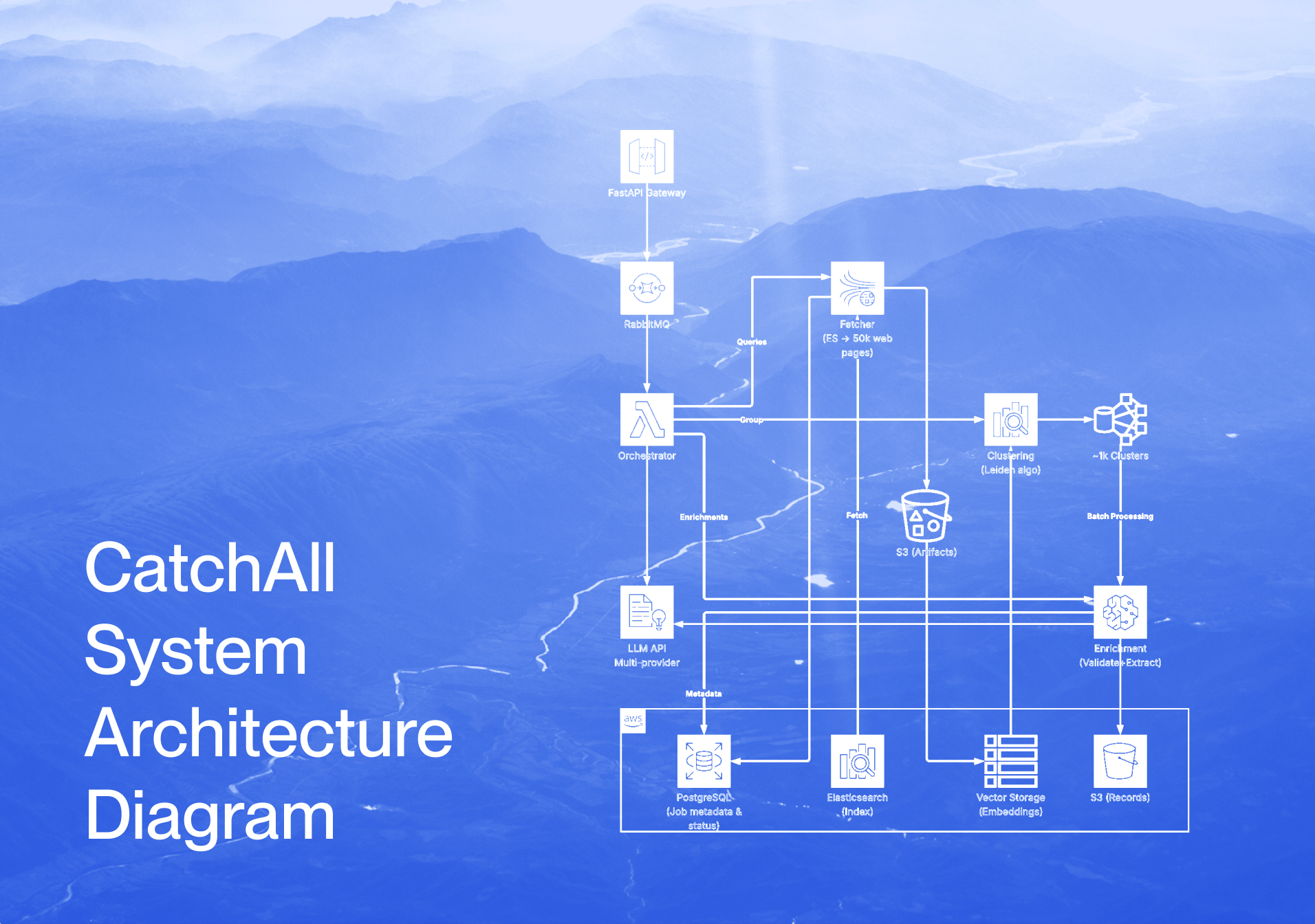
CatchAll is built to address this problem. NewsCatcher's web search API is built for enumeration tasks, scanning 2B+ web pages to return every matching event, not just the most prominent results. Investment teams use it to automate tracking of funding announcements, acquisitions, investor activity, and startup growth signals across fragmented web sources, replacing delayed database monitoring with comprehensive, structured retrieval that feeds directly into their research pipelines.
Sample CatchAll output:
{
  "record_title": "Terra Security Announces Series A Funding and Rising in Cyber 2026 Inclusion",
  "enrichment": {
    "company_name": "Terra Security",
    "domain": "terra.security",
    "funding_round": "Series A",
    "funding_amount": 30000000,
    "company_location": "United States",
    "investor_names": "Felicis, Dell Technologies Capital, SVCI"
  },
  "citations": [
    {
      "source": "Business Wire",
      "url": "https://www.businesswire.com/news/home/20260512285750/en/Terra-Security-Named-to-Rising-in-Cyber-2026-List-of-Top-Cybersecurity-Startups",
      "published_at": "2026-05-12"
    },
    {
      "source": "PR Newswire",
      "url": "https://www.prnewswire.com/news-releases/notable-capital-unveils-rising-in-cyber-2026-302769101.html",
      "published_at": "2026-05-12"
    }
  ]
}
50k pages analysed from NewsCatcher’s index, 910 candidate events found, 37 valid results found after validation.
Detecting Risk and Distress Signals Earlier
Risk signals rarely arrive through official channels first:
- A portfolio company losing a key customer appears in a trade publication or a supplier's press release before any internal disclosure.
- A regulatory investigation surfaces in legal filings before financial news coverage. A leadership crisis begins with a local industry outlet announcement.
- PR crises, whether from a product failure, a data breach, or an executive controversy, erupt on social platforms and niche media before they reach structured feeds.
- Supplier disruptions appear in logistics trade press.
- Restructuring announcements often surface in regional business news before they become official company statements.
Early warning indicators are often unstructured, distributed across the open web, and don't wait for reporting cycles. A hiring freeze shows up in job posting patterns and a blog post before it appears in any database. Operational issues, such as delayed launches, cancelled events and scaled-back roadmaps are announced quietly on company blogs or mentioned in passing by journalists covering adjacent topics. By the time a risk appears in a structured source, it's already news.
Teams relying on periodic reviews like quarterly check-ins and weekly analyst summaries are operating on a lag that's increasingly hard to justify. Markets move faster than reporting cycles. Risk signals are distributed across sources no analyst team can manually track in full. Always-on monitoring pipelines, running the same queries against new web content on a schedule, are the only operationally viable response.
CatchAll's web search API enables this kind of continuous monitoring at scale, delivering structured results as signals emerge across news, blogs, and company updates, not after they've been aggregated elsewhere. Risk and compliance teams use it to watch for early distress indicators without manually tracking every source, turning periodic manual reviews into automated, always-on intelligence pipelines.
Web Search APIs vs Traditional Financial Intelligence Platforms
|
Financial terminals
Bloomberg, FactSet, Refinitiv
|
Manual workflows & scrapers
Analyst teams + custom-built scrapers
|
Web search API
CatchAll, Exa, and others
|
|
|---|---|---|---|
| Best for | Structured financial data — prices, filings, company records | Deep reading of a curated source list | Continuous, automated monitoring across fragmented web sources at scale |
| Coverage gap | Early-stage private companies, regional press, weak distress signals on niche web sources | Cannot monitor thousands of sources simultaneously; scrapers break on site changes and require ongoing engineering | Does not replace structured financial data (prices, filings) — complements terminals |
| Cost | ~$25k/user/year | High maintenance overhead | Lower than terminal |
| Open-web intelligence | Not covered | Partial, fragile | Structured, scalable |
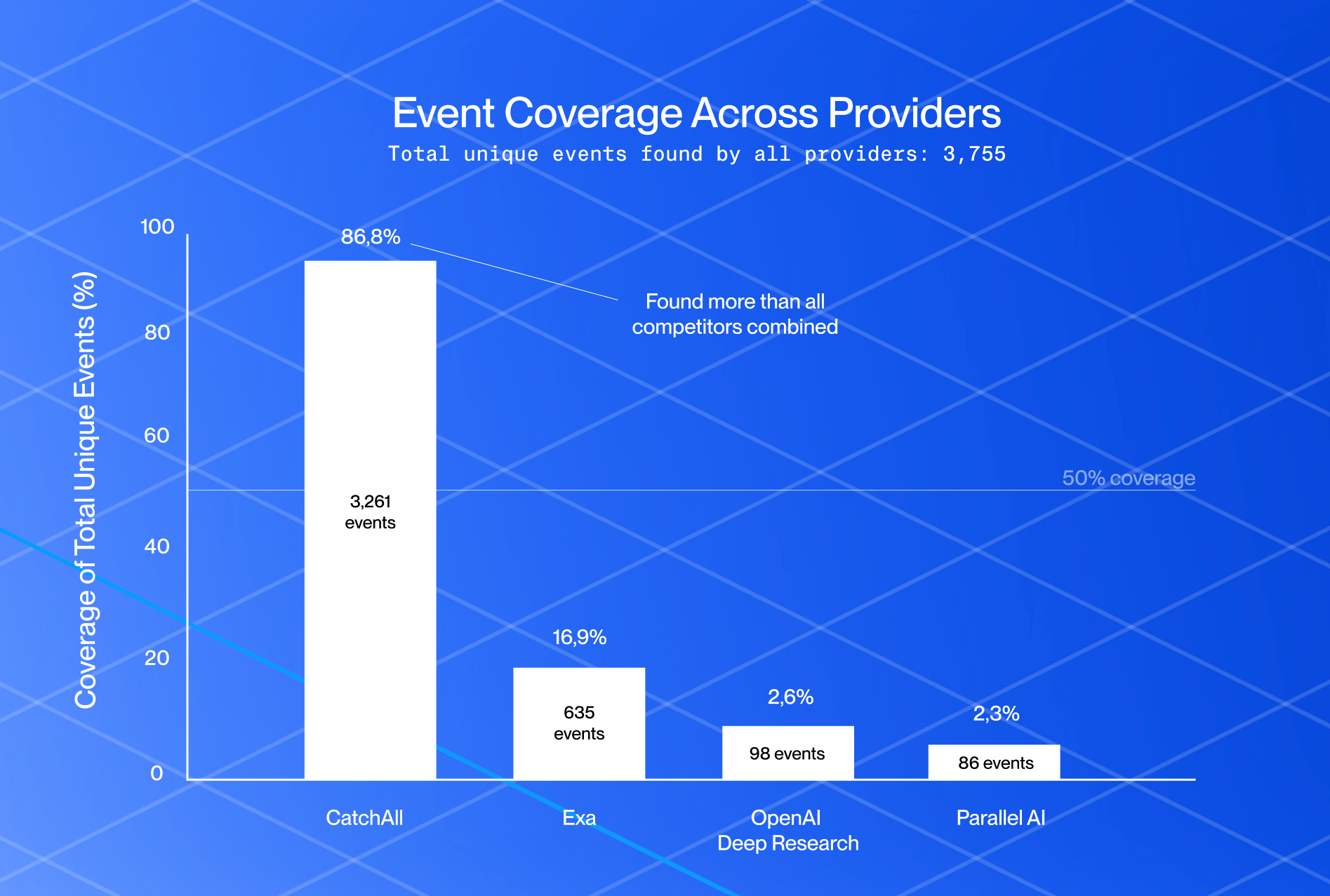
AI workflows note: LLM-based research tools (memo generation, portfolio monitoring, natural language search) depend on the data layer underneath them. If retrieval misses 80% of relevant events, the AI output is built on incomplete information — making the web search API layer foundational, not optional.
CatchAll is built specifically for this layer: customisable, automation-friendly, and scalable across the query types investment teams run, from broad sector monitoring to named-entity tracking across thousands of companies. Its API-first design makes it straightforward to integrate into AI research workflows, portfolio monitoring dashboards, and alert pipelines.
Web Search APIs vs Web Scraping for Investment Research
| Web scraping | Web search API | |
|---|---|---|
| How it works | Custom parsers written for each target site, extracting data from HTML elements | Submit a query; receive structured results — crawling, indexing, and extraction handled by the service |
| Setup | New parser required per source; significant upfront engineering for each site | API integration — no per-source setup |
| Maintenance | High: site redesigns, CAPTCHA changes, and proxy rotation all break scrapers and require rebuilds | Low: infrastructure maintained by the provider |
| Scalability | Poor at scale: each new source multiplies maintenance burden; inconsistent HTML produces inconsistent output | Scales freely: broader coverage than any scraper fleet a team could maintain |
| Output quality | Inconsistent across sites; downstream cleaning required | Deduplicated, structured JSON — entity extraction and source attribution built in |
| Proxy management | Required: rotating IP pools to avoid blocks; ongoing operational cost | Not required |
| Best for | Narrow, high-value targets where a specific site's structure is stable | Production monitoring across dozens of markets without constant maintenance overhead |
For a full breakdown, see our guide on web scraping API vs web search API.
How to Choose the Right Web Search API for Market Intelligence
Not all web search APIs are suited to investment intelligence workflows. The following criteria matter and each has direct operational implications:
- Real-time indexing speed. How quickly does new web content appear in the index? For investment monitoring, a funding round announced this morning needs to be retrievable today, not next week. Indexing lag is the difference between actionable intelligence and historical record.
- Breadth of web coverage. Does the index span regional publications, non-English sources, niche industry sites, and company blogs? Private market signals and early-stage events rarely appear in mainstream press first. An index optimised for popular sources will systematically miss the early signals that create investment edge.
- Structured output quality. Raw text isn't usable in pipelines. Look for entity extraction, event classification, sentiment scoring, source attribution, and deduplication built into the response. The less post-processing your team needs to do, the faster structured data reaches the workflows that consume it.
- API scalability and rate limits. Investment teams monitoring large company universes run high query volumes. Understand the rate limits, concurrent job capacity, and cost structure at scale before committing to infrastructure that becomes a bottleneck as monitoring scope grows.
- Filtering and search capabilities. Can you filter by geography, date range, source type, or entity? Broad queries produce noise; precise filtering produces signals. The more control you have over retrieval parameters, the more targeted your monitoring pipelines can be.
- AI integration support. If the API output feeds into LLMs or internal AI research systems, it needs to return clean, consistent JSON schemas those systems can reliably consume. Variable output formats create fragile pipelines.
- Reliability and uptime. A market intelligence pipeline that goes dark during earnings season or a market event is worse than no pipeline at all. Evaluate SLAs, historical uptime, and support response times before integrating into production workflows.
- Cost efficiency vs enterprise terminals. The economic case for web search APIs over traditional financial intelligence platforms rests partly on cost. Evaluate total cost at your query volume against the specific coverage you need – open-web intelligence is the gap, not a replacement for structured financial data.
- Support for monitoring and alert workflows. One-off queries aren't enough for investment surveillance. The API needs to support recurring jobs that run on a schedule and deliver structured updates as new events match your criteria, without requiring manual re-querying.
For a side-by-side tool comparison, see our best web search APIs overview.
Summary
Traditional financial databases and manual analyst workflows operate on reporting cycles: open-web signals appear weeks earlier, and no team can monitor the full source landscape manually. Private market intelligence is the sharpest gap: with no disclosure obligations, signals only exist where someone chose to report them, scattered across regional press and niche industry media.
Web search APIs address this by replacing manual monitoring with a programmatic pipeline layer covering ten categories of market signal, from funding rounds and M&A to distress indicators and emerging industry trends.
Compared to traditional financial platforms, the advantage is open-web coverage and cost efficiency; compared to custom scraping, it has reliability, scalability, and lower operational overhead. When evaluating a market intelligence platform, prioritise indexing speed, coverage breadth, output quality, scalability, AI integration, and monitoring support.
Start automating your market intelligence workflows with 2,000 free credits at platform.newscatcherapi.com. For enterprise use cases, reach us at sales@newscatcherapi.com.






.png)

.png)