









The best competitive intelligence tools in 2026 answer different questions. A practical overview for anyone putting a competitive intelligence programme together, comparing eight leading tools on coverage, monitoring, accuracy and price.
Staying on top of what competitors are doing is a strategic advantage for most companies. Most of the moves your competition makes surface publicly, somewhere on the web, before anyone inside your company hears about them. A pricing change, job postings, a new partnership. Being the first to notice lets you act early and proactively, instead of reacting to the news once it goes mainstream.
Manually checking competitor updates is both time consuming and doesn't scale. At the pace things change, that isn't feasible for most companies. Visualping found that around 60-70% of changelog, blog, press release and pricing pages changed at least once within 30 days. Even a weekly manual check misses most of what's happening.
TL;DR: The best competitive intelligence tools in 2026 answer different questions, and a working setup usually combines two or three of them rather than crowning one winner. Crayon and Klue go deep on the competitors you name, Similarweb and Semrush estimate a rival’s traffic, AlphaSense holds research you cannot get anywhere else, and prices run from free page watchers to five-figure enterprise contracts. What almost none of them can do is surface the competitor or deal nobody thought to put on a list. That discovery job is what CatchAll, our own web search API, is built for.
This guide compares leading competitive intelligence platforms across a buyer's checklist of six criteria. Our own product, CatchAll web search API, sits at the collection layer.
What Features Should the Best Competitive Intelligence Tools Include?
The best competitive intelligence tools cover six main areas. Use this as a checklist when going into product demos, and ask for answers in concrete numbers on the areas that matter most to you.
- Competitor monitoring. Which surfaces does the platform cover per competitor: website, pricing page, job postings, reviews, ads, filings? Can you add competitors to track freely, or does it cost extra?
- Real-time alerts. How often does the tool scan for updates? Consider how it differs between tiers. Can you get alerts directly to the channels your team uses: Slack, Teams, CRM?
- Search coverage. How many sources does the tool scan, how are these defined, and what are they measured against? Most vendors can give you a source count, but few will tell you what share of the relevant stories a search actually finds.
- Data accuracy. Which numbers come directly from the source, and which are enriched or modelled? And at what point does a modelled number stop being reliable?
- Historical tracking. How far back does the archive go, is it exportable, and is it still accessible to you after you stop paying?
- Reporting and collaboration. Output only counts if it reaches whoever is making the decision. Ask where the report is available, how it stays up to date and who can contribute to it.
Two considerations sit outside the feature list. Budget for an internal owner, because the enterprise platforms in this comparison assume somebody runs the programme day to day. And treat the category labels with suspicion: competitive analysis tools, competitive intelligence platforms and competitor tracking tools are largely marketing terms, and the same product often shows up under all three. What matters is which of the questions in the next section a tool actually answers.
What Are the Best Competitive Intelligence Tools in 2026?
The best competitive intelligence tool depends on which question you are asking.
The category is established enough that Gartner published its first Magic Quadrant for competitive and market intelligence platforms in April 2026, and several of the tools in this guide are on it. Similarweb, Semrush and Visualping are not, because Gartner scopes that market narrowly and those three answer a different question: how much online traffic a company is getting, or what changed on their pricing page overnight. Most teams end up running two or three of these together rather than picking one. Here are the top competitive intelligence tools in 2026, grouped by the question each one answers.
| Tool | What it is | What it covers | How soon you find out | Price |
|---|---|---|---|---|
| CatchAll | Web search API | The open web, searched by event description instead of by company name | Daily to hourly, by plan | 2,000 free credits, then $0.10 per validated record |
| Crayon | Competitor monitoring | Competitor sites, pricing pages, job posts, reviews and ads, plus your own sales calls and win-loss notes | Continuously | Quote only. Median $30,000/yr (n=93) |
| Klue | Sales enablement | The same public sources plus your CRM and call recordings, packaged into battlecards for reps | Every 24 hours | Quote only. Median $30,000/yr (n=106) |
| Similarweb | Traffic and audience data | Estimated traffic, audience and channel mix for any website or app | Monthly, daily on enterprise | $99/month |
| Semrush | Search and ads data | Organic and paid search, keywords, backlinks and competitor ad copy | Daily to weekly | $139/month, CI tools extra |
| AlphaSense | Research library | Filings and earnings transcripts anyone can get, plus broker research and an expert-interview library you cannot | Within hours of publication | Quote only. ~$20,000 per seat |
| Contify | Curated news feed | News and company sites filtered against a taxonomy you define, in 117 languages, checked by analysts | Continuously | Quote only, 7-day trial |
| Visualping | Page change alerts | Any page you add, and nothing you have not | Every 2 minutes to hourly, by plan | Free, then $14 to $350/month |
Source: vendor pricing pages, August 2026, quote-only vendors show Vendr contract data
Which tools track what my named competitors are doing?
These are the dedicated competitive intelligence platforms, and where most buyers start.
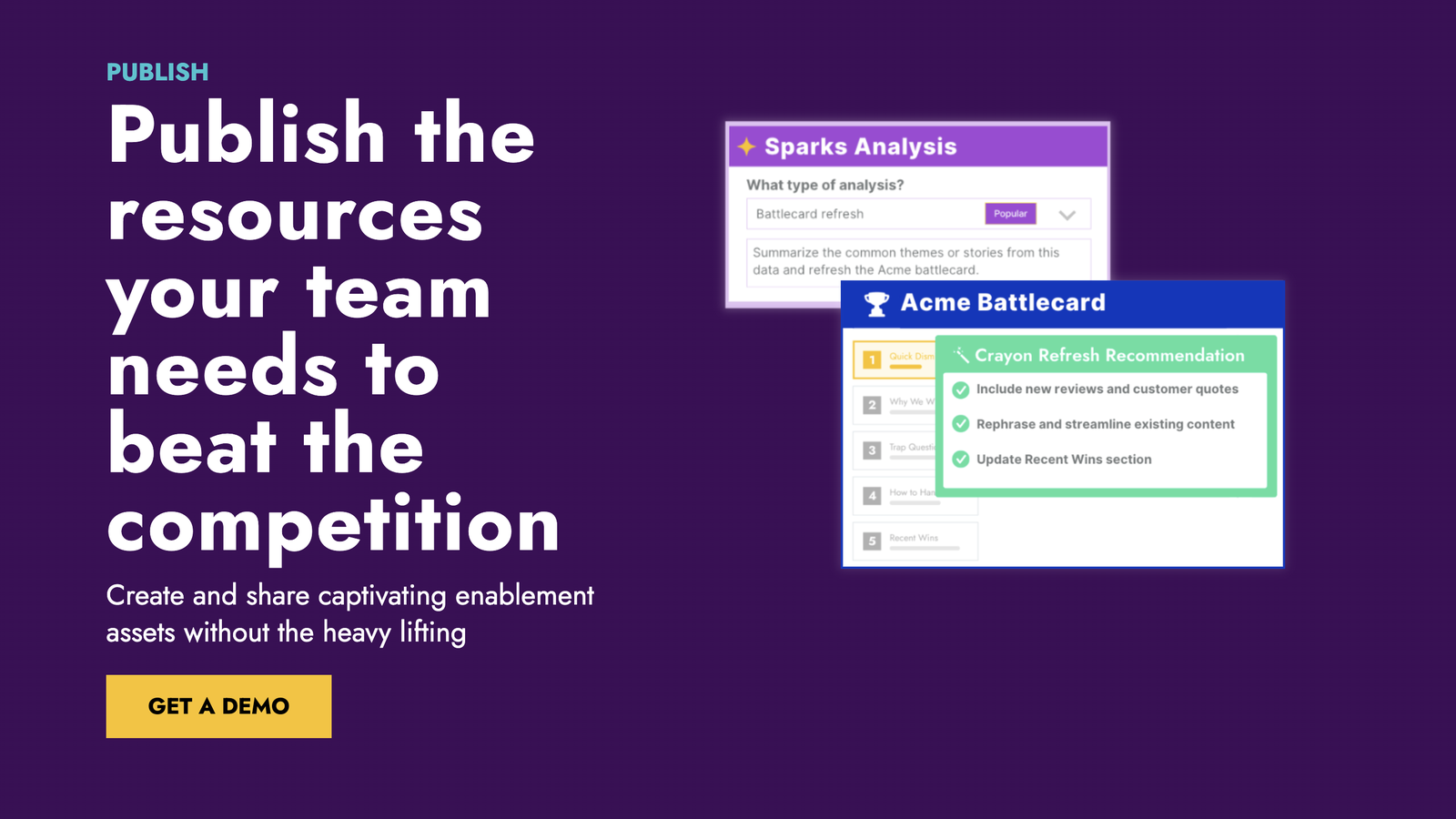
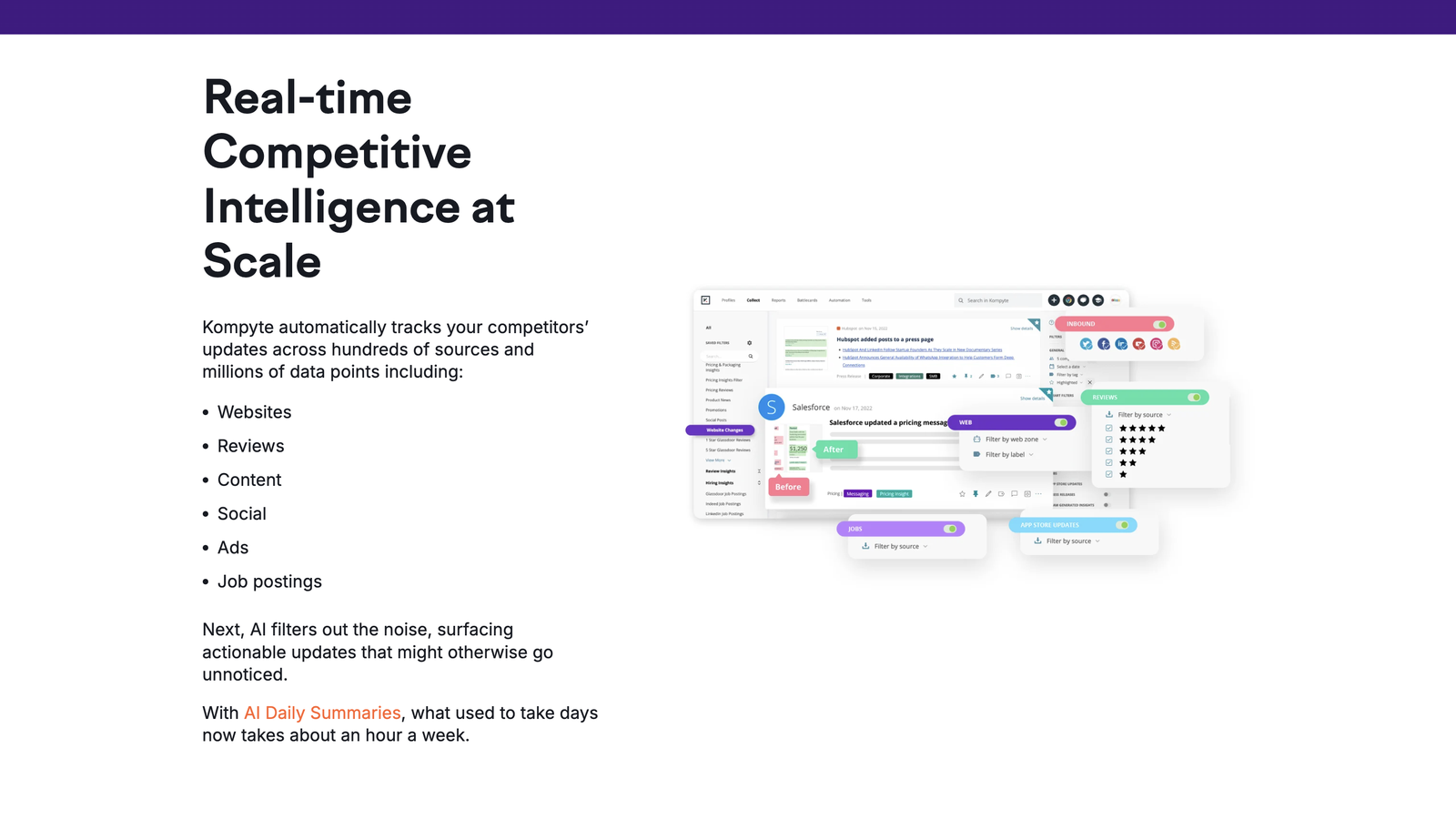
Crayon scans the widest set of surfaces and goes deepest on each competitor: their website, pricing pages, job postings, reviews and ads. It is also the only platform here that takes in your own material, so sales calls, win-loss interviews and rep notes sit alongside the public signal. That gives it more raw material than anything else in this comparison, and the usual complaint follows straight from it: volume. History runs to roughly three months and costs extra beyond that. This is enterprise software. The companies buying it already run a competitive intelligence function.
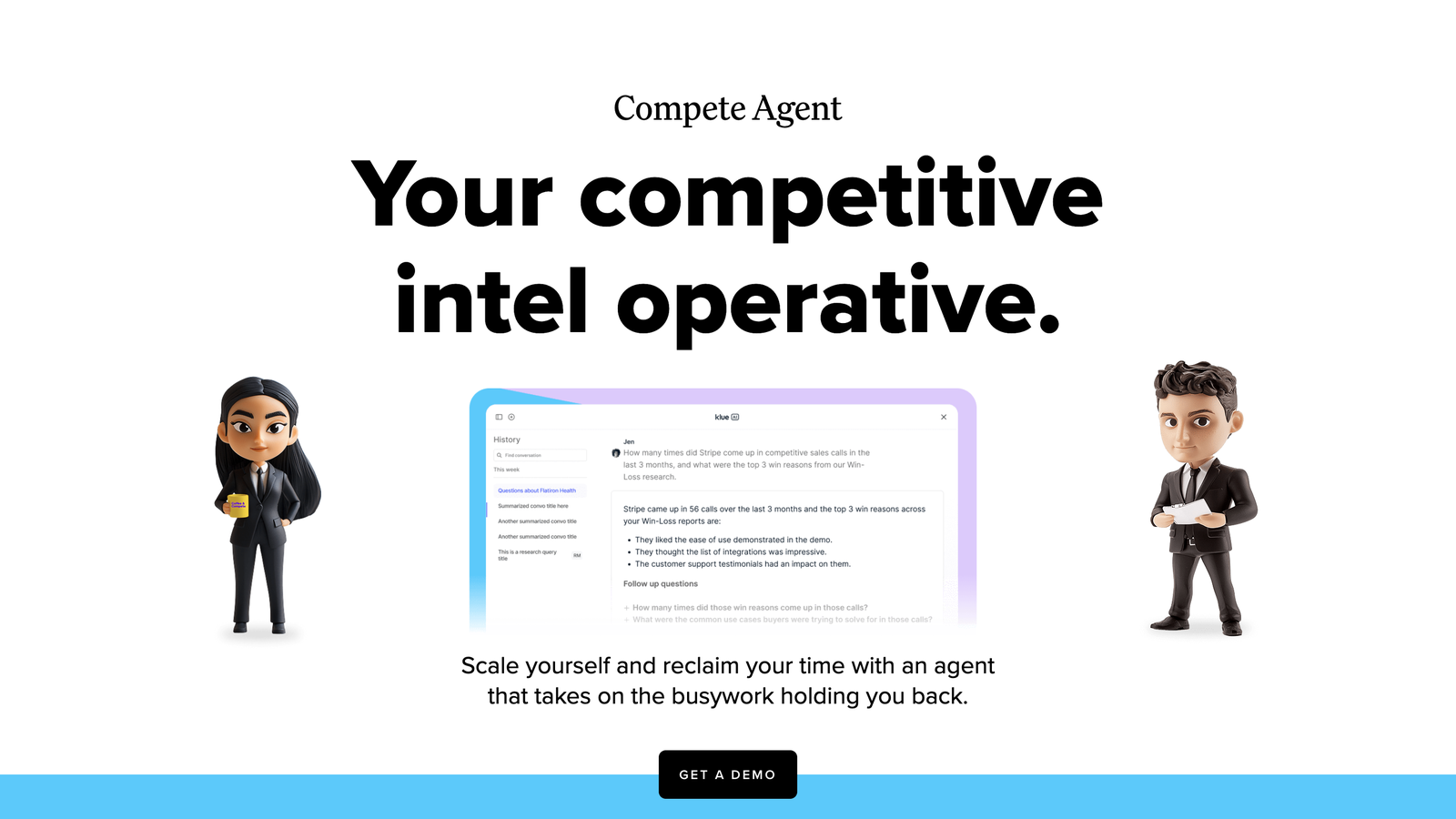
Klue puts its effort into the moment intel gets used. Its Compete Agent watches live deals in your CRM and your call recordings, notices when a competitor comes up, and pushes a tip to the rep while the deal is still open. Gartner ranked it first for revenue enablement on the strength of that. It reads much the same public sources as Crayon. The difference is what reaches the seller, and when. It is a programme you have to staff, with a four to eight week rollout, and it sits in the same enterprise price bracket.
Which tools show where a competitor's traffic comes from?
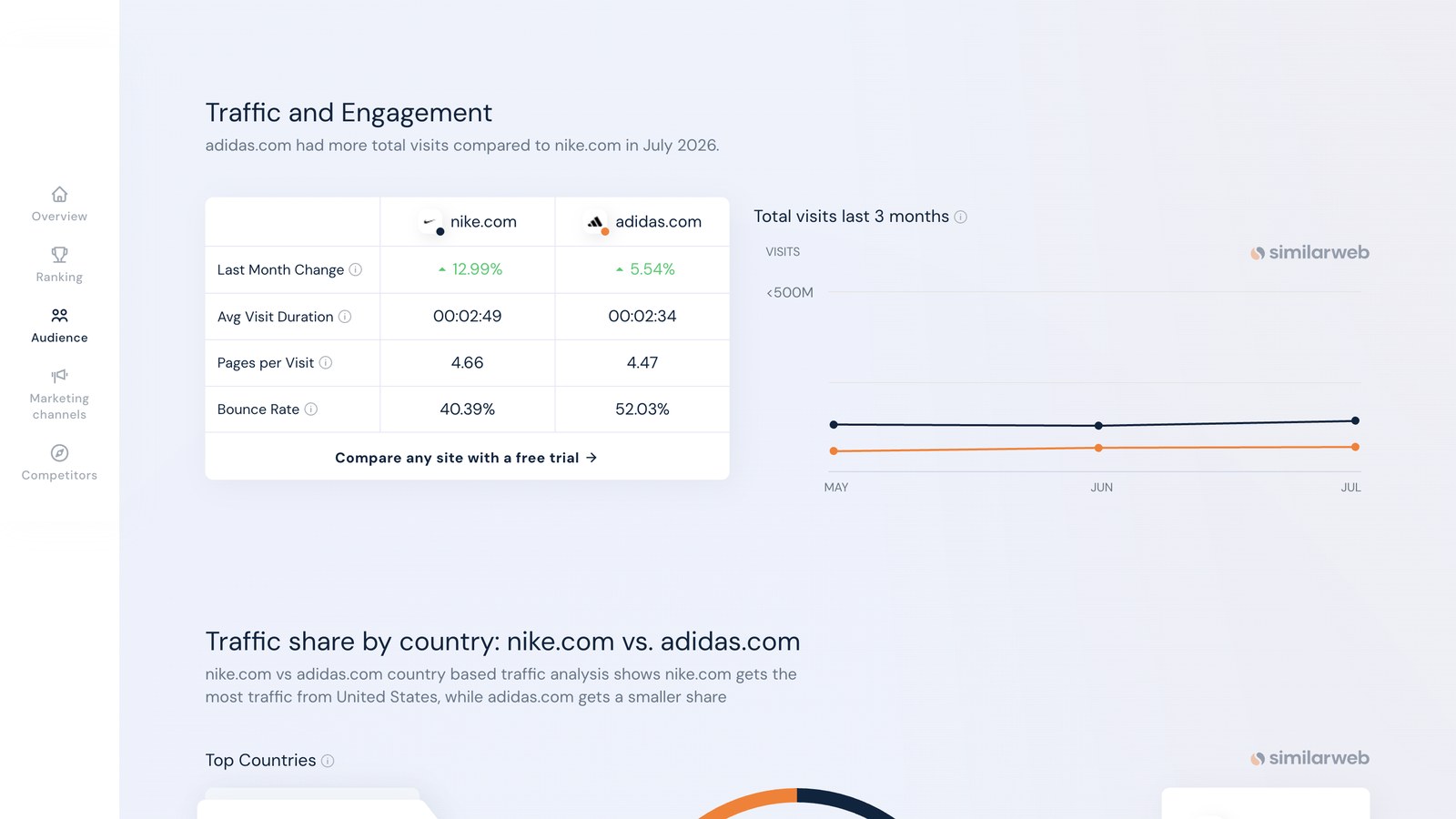
Similarweb and Semrush, the pair most often sold as competitor analysis software, tell you where a competitor's traction comes from. Similarweb gives the high-level picture: estimated traffic, audience, and the mix of channels bringing people in, for any website or app. Semrush goes further down: which keywords a competitor ranks for, what they are bidding on, which topics they cover, where their backlinks come from. The two overlap more than their marketing suggests. Treat every number from either as a modelled estimate. SparkToro's study of 641 sites found none of the major estimators reliable at the level of an individual figure. Similarweb at least publishes a floor: below 5,000 monthly visits it returns nothing. Semrush has no floor, so a small competitor comes back with a confident number and no warning attached. Adobe acquired Semrush in 2026 for nearly $2 billion.
Which tools search filings, transcripts and analyst research?
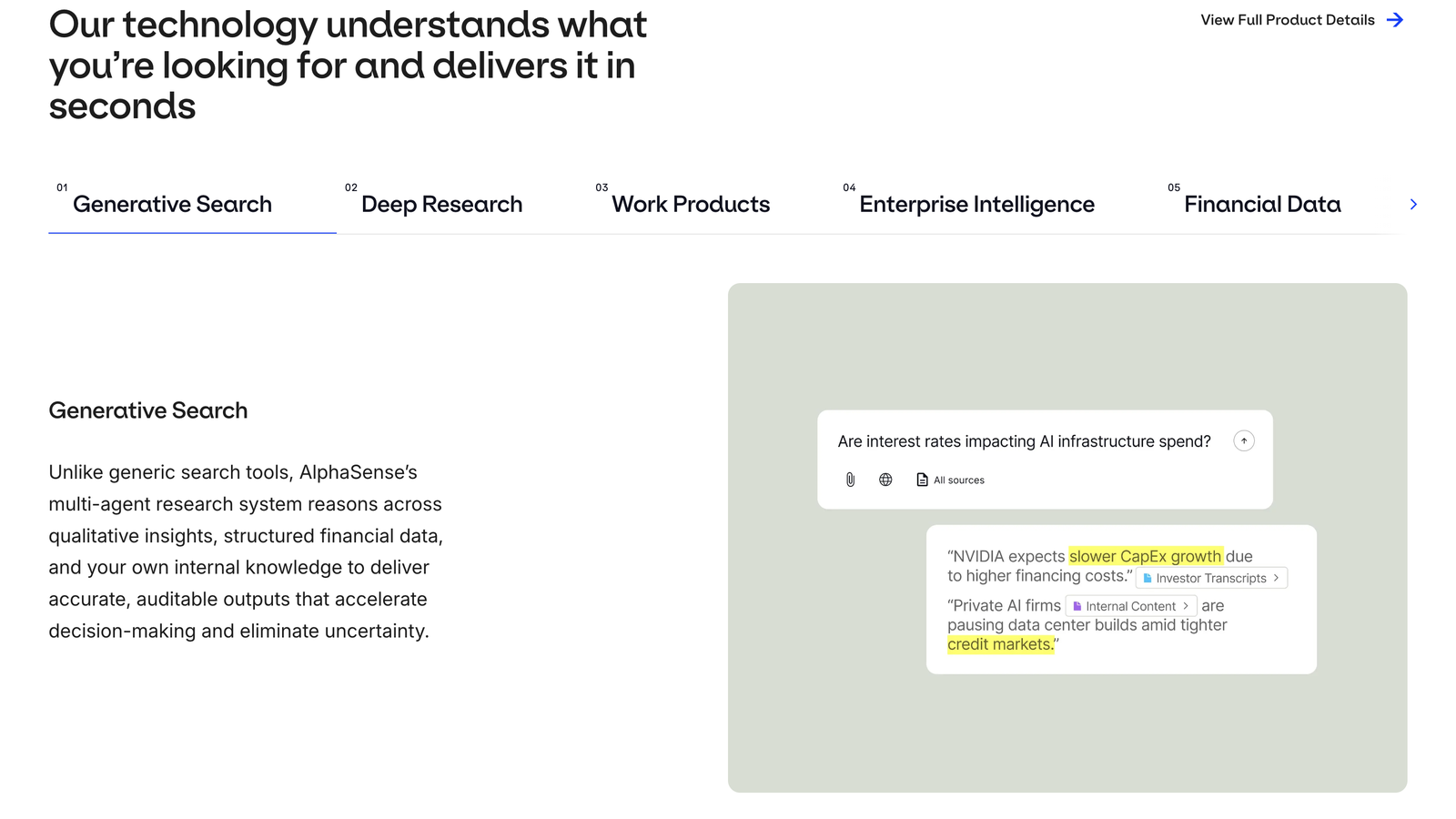
AlphaSense is closer to a research desk than to anything else in this table. It brings together four things: company filings, earnings call transcripts, equity research licensed from more than 1,500 providers, and its own library of expert interviews, which arrived with the $930 million Tegus acquisition in 2024. An AI layer searches across all of it and ties every answer back to the sentence it came from. That suits strategy, corporate development and investor-facing work more than day-to-day sales enablement. What it does not do is crawl the open web. Competitor websites, pricing pages and job postings sit outside it entirely. None of that is a complaint. It is the reason teams usually run AlphaSense next to something that does watch the web.
Which tools monitor news and web changes for you?
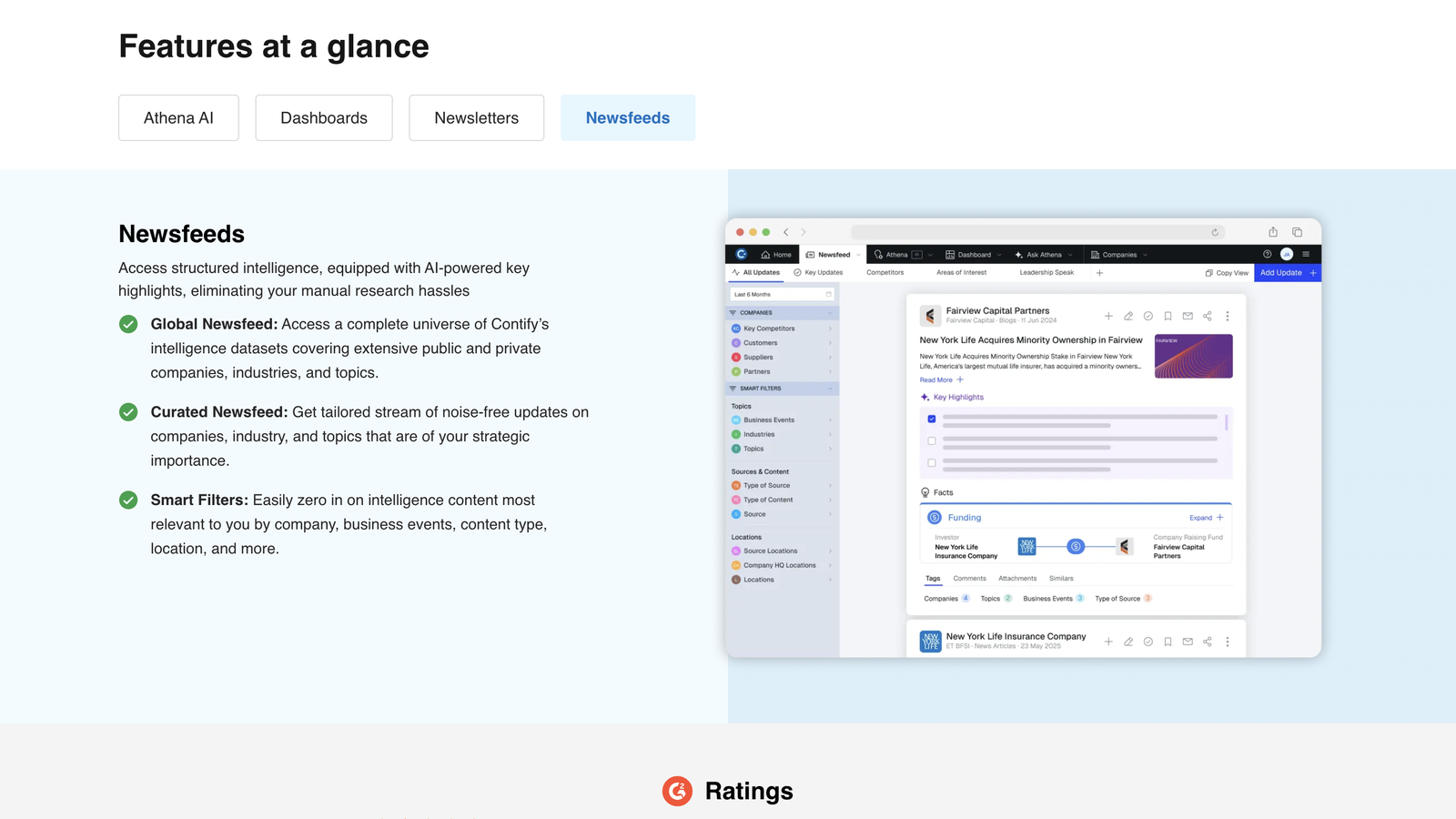
Contify is what you point at a whole market. You build a taxonomy of the companies, topics and events you care about, and it scans news and company websites against it. Two things separate it from Crayon and Klue. It reaches a much larger and more international pool of sources, with real depth in over a hundred languages, where most tools manage English plus a few. And you can add sources it does not already carry, so a trade publication or a national regulator's site that matters in your market goes into the feed. Contify's own analysts review what comes back before it reaches you. It also excludes anything that is not business news by design.
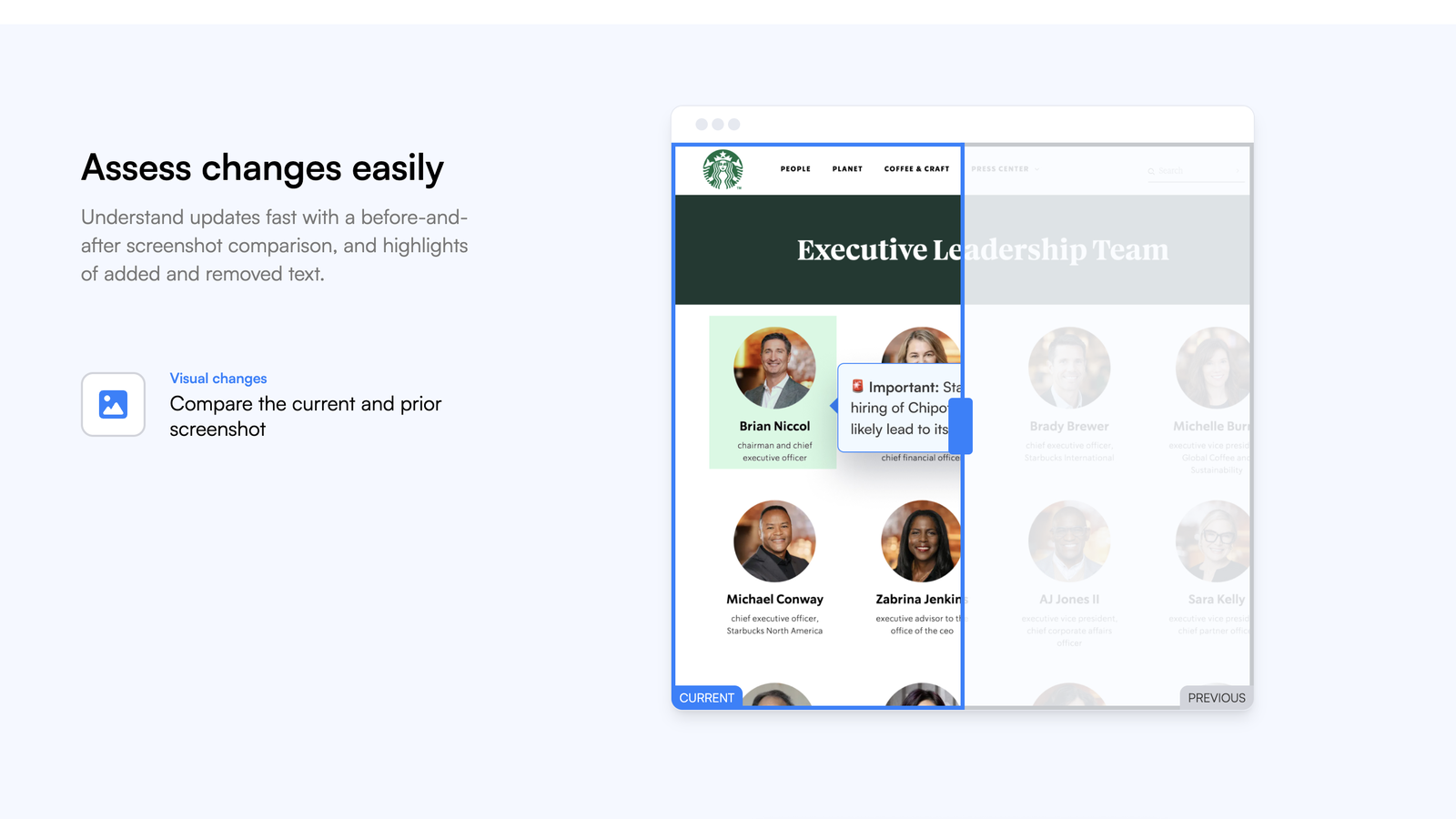
Visualping is the simplest of the competitive monitoring tools in this list. It watches specific pages you choose and tells you when they change. Paste in a URL, set how often it should check, and it alerts you on any difference: a price, a headline, a new job listing, a line in the terms of service. That is the whole product, which is also the point, because you can aim it at anything and it costs almost nothing to start. Its limit is the same as its design. It only ever sees the pages you already thought to add.
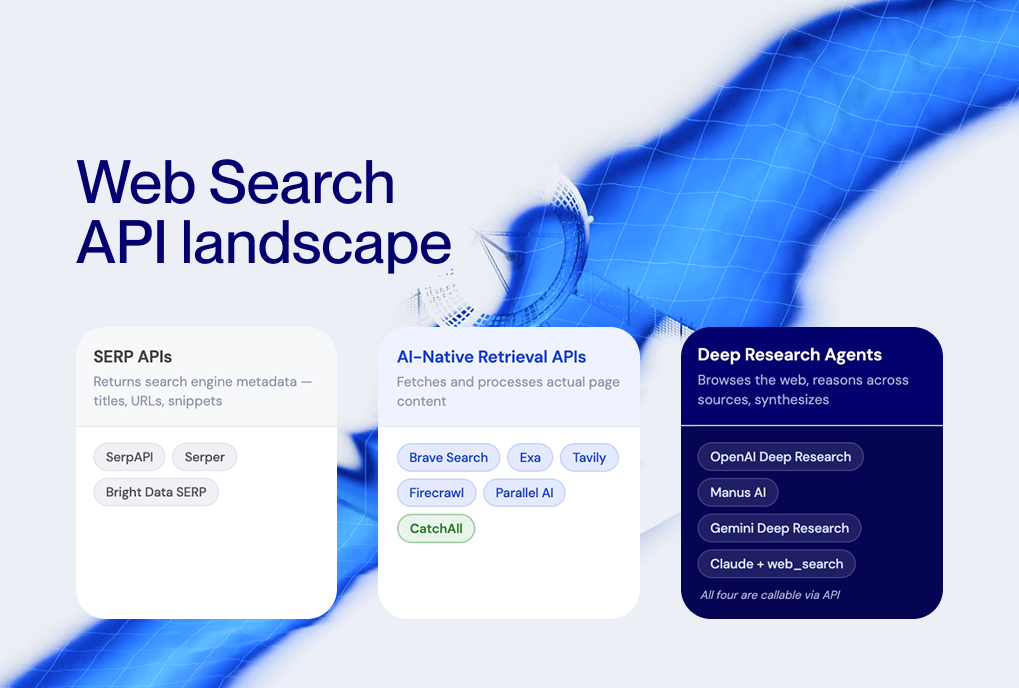
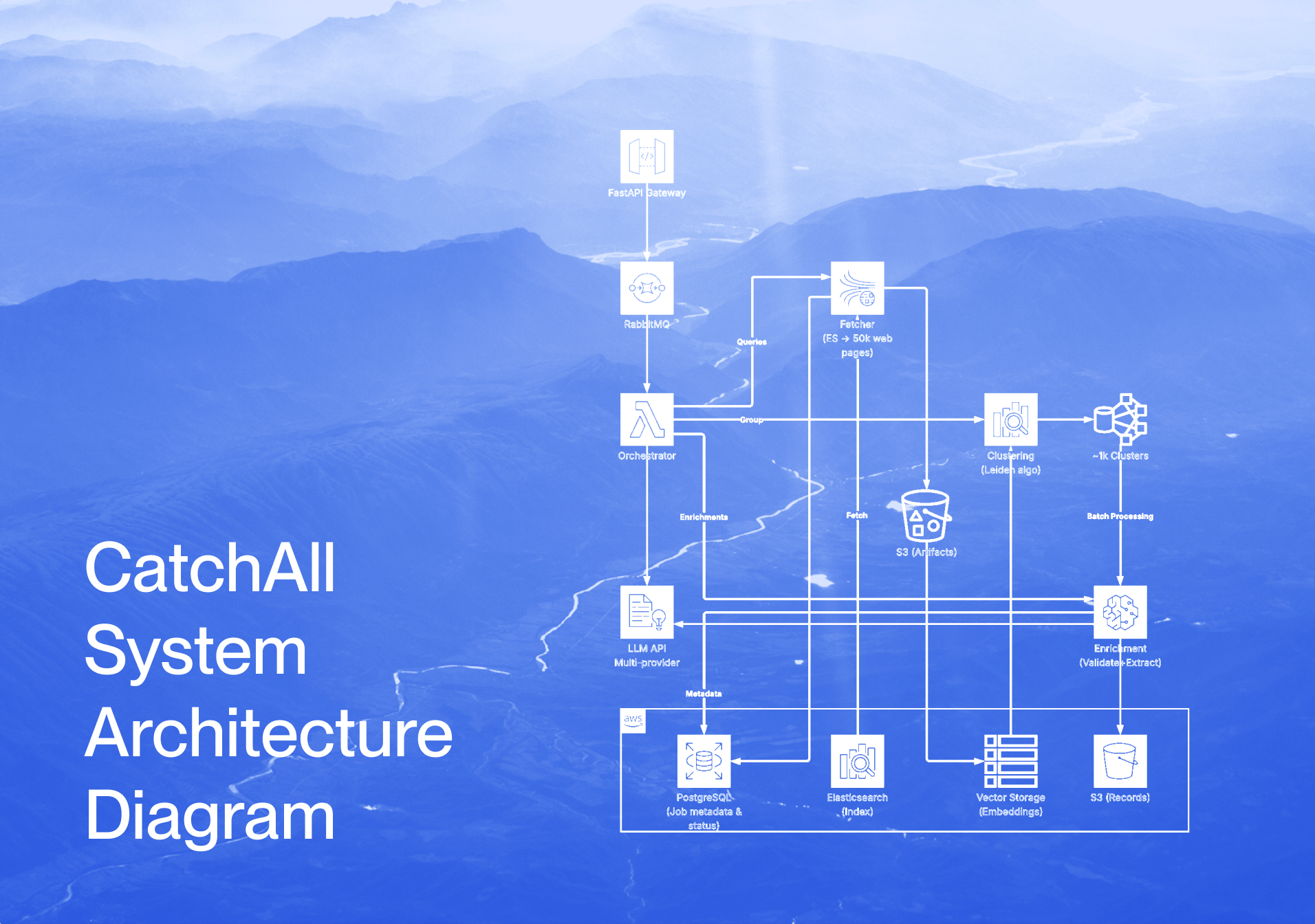
CatchAll is our own Deep Web Search API product. Give it a company watchlist or describe an event, and it works through an index of more than two billion pages, returning everything it finds as structured records with sources attached. No ranked page of links to read through. That includes the things nobody thought to put on the list. It ships as an API for anything you want to build on top, and also has a platform UI for running searches without writing code. A thorough run takes around fifteen minutes.
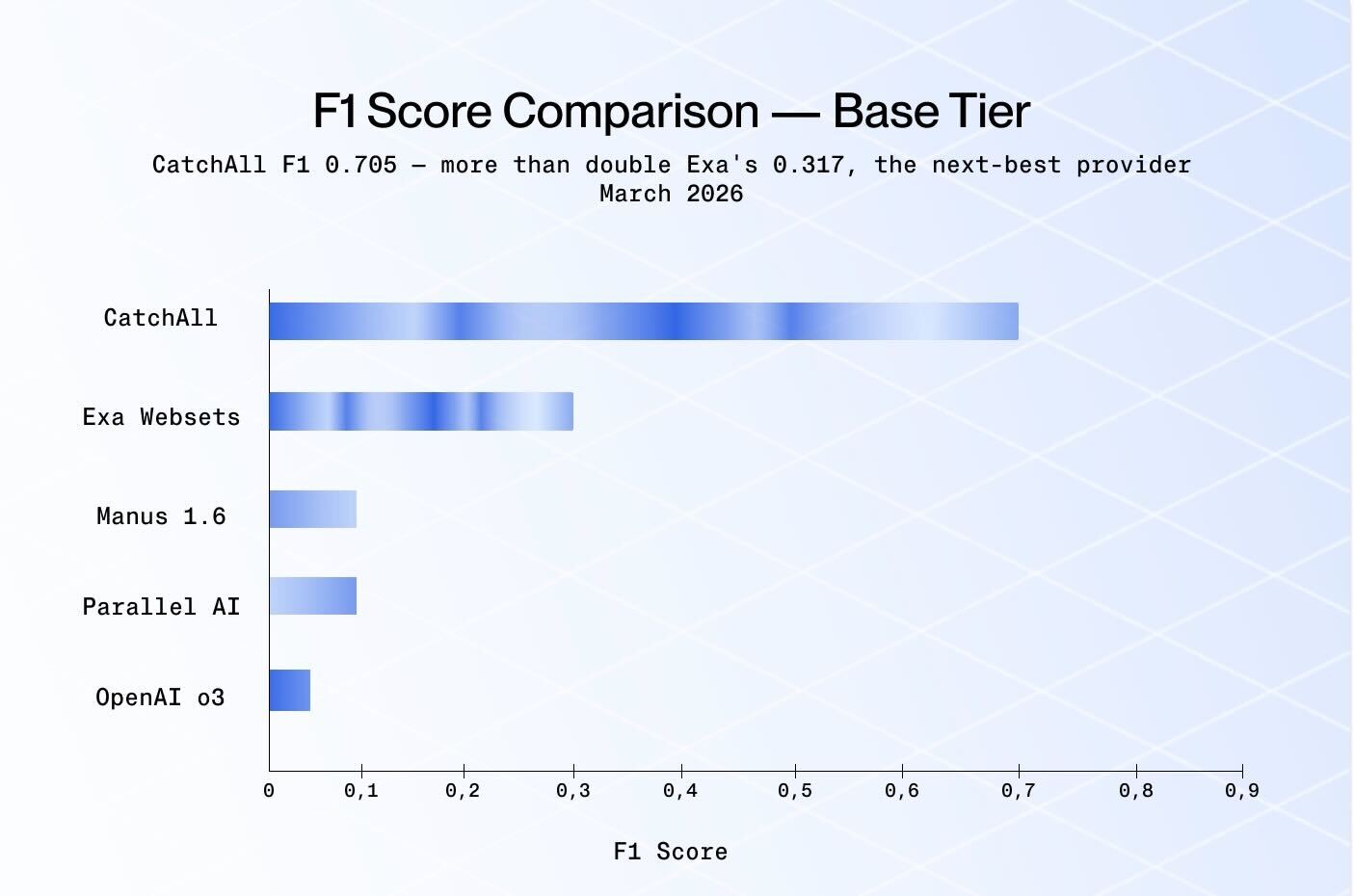
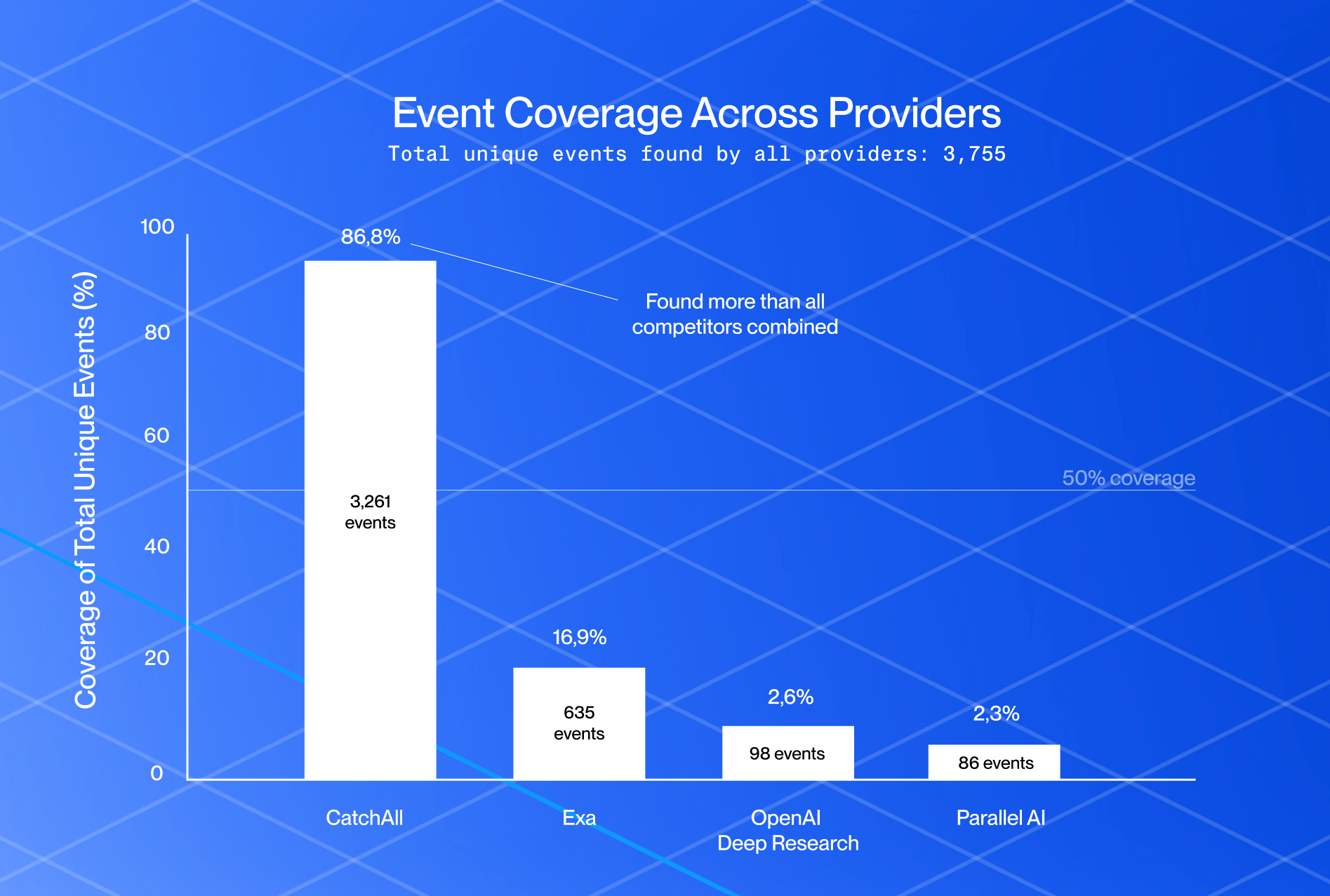
AI competitive intelligence tools are less a category now than a feature every tool above ships. The more interesting question is whether ChatGPT or Claude with browsing replaces any of it. For a one-off lookup, honestly, they are fine. But they return a small ranked sample and never tell you what they did not find, and they cannot sit there running, day after day, across hundreds of entities. We measured that gap across four AI search tools: a system built to surface the best few results was never built to enumerate all of them.
Why Does Real-Time Web Data Matter for Competitive Intelligence?
Fresh web data matters because most competitive signals appear publicly before they reach any database.
A product launch shows up on a changelog or a release note before anyone writes it up. A funding round, a partnership or an executive hire goes out as a press release, sometimes only to a regional outlet, and reaches a structured database weeks later. That lag is exactly why investment teams monitor the open web directly. You either find it in the week it happened, or you find it in the quarterly review.
Market changes are harder, because they are not attached to anyone on your list. A regulation, a pricing shift across a category, an entrant nobody had heard of a year ago. Industry trends are the slow version of the same problem, visible only if you have kept enough history to see a direction rather than a single data point.
All of it lands on whatever you build next: a market map, a board deck, an AI agent answering questions about a category. Those are only as good as the inputs, and stale data does not announce itself. It produces a confident answer that happens to be wrong. Which makes freshness a collection problem before it is an analysis one.
Should you use a web scraping API instead?
Sometimes, and it turns on one question: can you name your sources in advance? A scraping API fetches pages you already know about. A search API finds pages you do not. Teams searching for the best web scraping API for real-time data are usually solving that collection problem, and we compared the two approaches in web scraping API vs web search API.
Where many web search tools merely scratch the surface, CatchAll's web search API is built specifically to find all events for your search query. Describe an event, and it returns deduplicated records with their sources attached. It's also easy to scope searches to a list of companies. Read about our approach and its trade-offs in recall-first web search.
Why Are Companies Investing in Competitive Intelligence Software in 2026?
Companies invest in competitive intelligence to make decisions fast and early. Five drivers are behind it.
- Market volatility. Conditions change faster than planning cycles do. Almost three in four executives told McKinsey that geopolitical uncertainty had a notable impact on their organisation. When the ground shifts that often, a quarterly read on a competitor is stale before it circulates.
- Faster product cycles. Ship dates used to be quarterly. Now a feature lands on a changelog page on a Tuesday, the pricing page is quietly updated to match, and nobody sends you a note about it. An annual competitor deck cannot keep up with that.
- Competitive pressure. Buyers turn up to a sales conversation having already compared you against alternatives you did not know you had. Competitive questions land in more deals, from better informed people, and the rep needs an answer that is current rather than remembered.
- Data-driven decision-making. Most organisations now run some part of their work on AI. McKinsey puts it at 88% reporting use in at least one business function. Those systems are only ever as current as whatever feeds them, which turns “where does our competitive data come from, and how old is it” into a question with budget attached.
- AI keeps changing who the competitors are. The cost, time and headcount needed to build a product, test it and ship a better version have all collapsed. Harvard Business Review calls it the second great compression of entrepreneurship. For anyone running competitive intelligence, that means the threat is as likely to come from a company you have never heard of as from the three on your battlecard, which is why staying on top of the competitive landscape matters more than ever.
Summary
- Competitive intelligence tools answer different questions. Compare tools that answer the same one.
- Crayon and Klue are the two big competitive intelligence platforms, both at a $30,000 median contract, and Gartner named them Leaders alongside AlphaSense in April 2026.
- Similarweb and Semrush produce modelled estimates: useful for direction, unreliable per number.
- Visualping is the cheapest credible entry point and has the fastest published check interval here.
- Almost every platform starts from a competitor list you supply. Discovering what was never put on a list is a separate job, and it is the one broad web search covers.
FAQ
What are competitive intelligence tools?
Competitive intelligence tools collect, filter and distribute information about competitors, markets and customers from public sources such as news, websites, review sites and filings, then turn it into alerts, dashboards and briefings that sales, product and strategy teams act on. Most monitor a defined set of competitors and sources that you configure.
What are leading competitive intelligence tools?
As of 2026, the most frequently shortlisted are Crayon for competitor monitoring, Klue for sales enablement, AlphaSense for financial and expert research, Contify for curated market feeds, Similarweb and Semrush for traffic and search data, and Kompyte, now part of Semrush, for digital competitor tracking.
How much do competitive intelligence tools cost in 2026?
Published entry prices run from free to roughly $550 a month for digital suites. Enterprise CI platforms are quote-only, and Vendr's contract data puts the median for both Crayon and Klue at $30,000 a year. Third-party estimates vary widely, so treat any single figure as directional.
Are there free competitive intelligence tools?
Yes, and each covers one job. Google Alerts, the Meta Ad Library, G2 review pages and Visualping's free tier all work. Free stacks break down on coverage and deduplication rather than on features.
Do competitive intelligence tools cover the whole web?
No. Most monitor a defined competitor list and a curated source set, which makes them good at what changed at a named company and weak at what happened that nobody flagged. Broad web search and a news API cover the second job.





.png)

.png)