










If your media aggregator covers local news, retrieval gets complicated fast. A search for "Portland news" returns Oregon and Maine. Small local publishers rarely carry consistent source labels, and deduplication has to separate wire syndications from original reporting. Each problem is solvable, and the approach holds whether you cover two cities or two hundred.
TLDR:
- General news APIs favor high-authority publishers; hyperlocal coverage needs different retrieval architecture to avoid mixed-geography noise and source fragmentation.
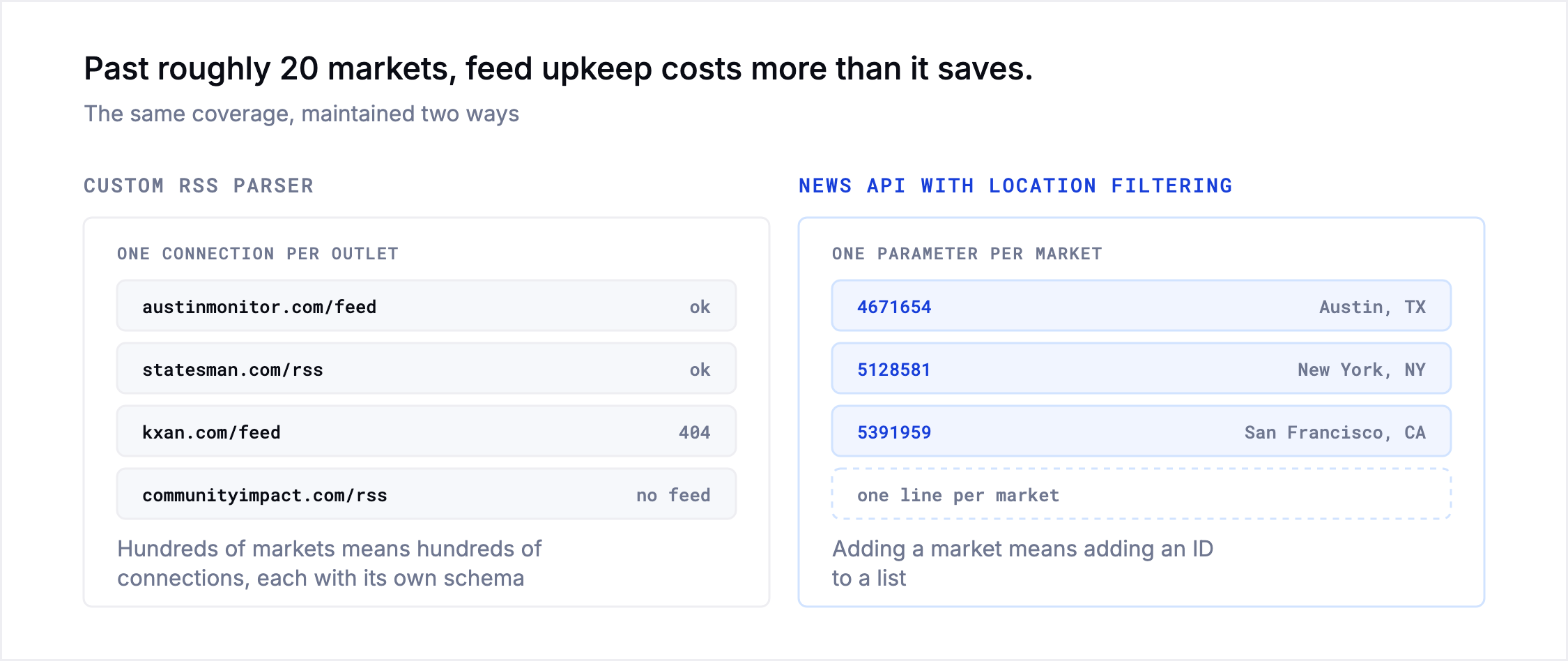
- RSS feeds work for fewer than roughly 20 markets; past that, broken feed URLs and dropped feeds cost more than a news API's setup, and GeoNames hierarchy queries cover hundreds of markets with a single query shape.
- Use GeoNames IDs, not city name strings: IDs avoid collisions between same-named cities such as Springfield, and county and state boundaries resolve automatically.
- Deduplication needs two passes: MinHash hashing (Jaccard threshold around 0.8) catches syndicated copies, then embedding clustering groups independent articles on the same event, which the API can return directly.
What makes hyperlocal news retrieval harder than general news retrieval?
Hyperlocal retrieval fails where general news retrieval works because the scale assumptions are inverted. General news APIs favor high-authority, high-frequency publishers, while local coverage lives in the long tail of small-city papers, county portals, university papers, and community sites that publish rarely and carry little domain authority.
Three distinct problems compound this:
- Location ambiguity: city names collide ("Springfield," "Franklin," "Columbia"), and a query for "Portland news" returns Portland, Oregon and Portland, Maine alike. Keyword searches without structured disambiguation produce mixed-geography results.
- Source fragmentation: a metro area can have a dozen active local publishers that a general news index ranks poorly, and a single event may be reported by several outlets that a general index labels and ranks inconsistently.
- Volume mismatch: national outlets cover local events only when a story escalates, so an aggregator needs local primary coverage and national follow-up, linked to the same event.
The hyperlocal news app market was valued at $4.8 billion in 2025 and is projected to reach $14.2 billion by 2034, a 12.8% CAGR, according to Dataintelo's hyperlocal news app market report. General-purpose news APIs were not built for that long tail, which is the gap a dedicated local news API covers.
Which methods are used for finding hyperlocal news programmatically?
Three methods cover most hyperlocal retrieval: RSS/Atom feed parsing, Google News RSS with geo-parameters, and a dedicated news API with location filtering. The right one depends on how many geographic areas the aggregator covers: RSS fits fewer than roughly 20 markets, Google News RSS fits prototypes and free monitoring, and a news API fits 20+ markets and production aggregators. The sections below detail each method.
RSS/Atom feed parsing gives the highest fidelity for a small set of locations
You subscribe to each outlet's feed and receive headlines, summaries, and publish times as the publisher issues them. Feeds carry no location data, so you maintain your own feed-to-location table, and each feed has its own field names and date formats. Feed URLs change without notice and some publishers drop RSS entirely, so covering hundreds of markets means managing hundreds of separate connections with no unified schema.
Google News RSS approximates location filtering but skips small local publishers
Google News RSS approximates geographic filtering through a location path segment, news.google.com/rss/headlines/section/geo/Austin?hl=en&gl=US&ceid=US:en, or by folding the place name into a keyword search. It returns recent matches with no API key and no cost, which makes it the fastest way to prototype a location feed. Each item carries only a headline, link, and timestamp, so body text, author, and entities require fetching the article yourself, and the geo behavior depends on undocumented search parameters that Google can change or remove without notice.
Dedicated news APIs filter hyperlocal news by location at query time
The provider crawls and indexes local publishers, normalizes every article into one schema, and tags each with a resolved location, so one request with a GeoNames ID or coordinates returns articles from every indexed outlet in that area. Setup takes more work than subscribing to a feed: choose a plan, map your markets to location IDs, and accept the provider's source coverage. After that, adding a market means adding an ID to a list.
How does location detection work in news APIs?
Each method carries a different precision-recall trade-off, and knowing which one your API relies on determines how far you can push geographic specificity.
Dedicated source assignment is the most reliable method in the US: if a source exclusively covers one city or county, every article it publishes inherits that location with high confidence, no text analysis needed. Other methods, ranging from named entity extraction to proximity mention and AI-based content analysis, trade off confidence and coverage of implicit geographic context, as shown below.
GeoNames administrative hierarchy mapping translates detected location strings into structured IDs tied to a standardized geographic taxonomy. This is what lets a query for "Washington County" return only Oregon's results when you're targeting Oregon, even though Washington County exists in many other US states.
Accuracy degrades sharply at sub-city granularity. Neighborhood-level detection is unreliable with any method except dedicated source assignment, which is available for US sources only. Outside the US, local section is the highest-confidence method, so neighborhood precision there depends on how finely each publisher divides its local sections, and most local articles don't name the neighborhood explicitly.
How to query multiple geographic areas with one query structure?
Build the query code once against a location-abstracted interface, then drive geography as an input variable instead of hardcoding city names into query strings for each market.
Coordinate-based or administrative-hierarchy queries outperform city-name strings for a specific reason: "Austin" is ambiguous, GeoNames ID 4671654 is not. Pass the GeoNames ID as a parameter, and the API resolves administrative hierarchy for you, including county and state boundaries. Your application maps each user's location to the appropriate ID once, then reuses that ID across every subsequent request.
For aggregators covering state or national scope, group markets into regional batches and paginate within each using time-windowed requests. This matters because page-number pagination drifts when new articles arrive mid-query. Pin each request to a fixed from_ and to_ window on the search endpoint and page within it, or use the latest headlines endpoint with a when window sized to your poll interval.
The parameter changes with scope. A single city takes a city filter or GeoNames ID, polled every 5 to 15 minutes. A metro area takes a GeoNames admin2 (county) ID or a lat/lon bounding box, polled on a publish event or interval. A state takes a GeoNames admin level 1 ID with batched polling over fixed time windows. A national local rollup takes a list of GeoNames IDs per region, run as a scheduled batch, each market advancing its own time window.
Store the last-seen article timestamp per geographic unit, not per API call. When a regional batch covers 12 cities, per-city freshness tracking prevents a slow news day in one market from delaying retrieval for the others.
How to deduplicate and cluster hyperlocal news articles about the same event?
A local zoning vote gets reported by six outlets the same afternoon, three as wire syndications with near-identical text and two as independent rewrites, with one adding a quote from a council member nobody else caught. Showing all six as separate items looks broken; showing only one risks dropping the unique reporting.
The first pass is text-similarity hashing. Shingling the article body into overlapping n-grams, then comparing MinHash signatures, catches exact duplicates and near-exact syndicated copies in constant time per article. A Jaccard similarity threshold around 0.8 reliably merges the same AP paragraph republished across regional outlets.
Embedding-based clustering picks up where hashing stops. Two independently written articles about the same school board vote score low on Jaccard similarity while landing close together in semantic vector space, so generating a vector embedding per article at index time and grouping by high cosine similarity catches what hashing misses. Too tight a threshold splits the same story; too loose and adjacent stories like the vote and the subsequent protest merge into one.
The second pass is also available as a parameter. Enable clustering on a request and the API groups the result set by cosine similarity over article embeddings, using Leiden community detection to form the groups, and returns a cluster ID and cluster count alongside the articles. That covers the semantic pass. Wire-copy hashing and the feed-card metadata rollup stay on your side.
At cluster time, aggregate metadata across member articles before building the feed card:
- Source count across outlets
- First-seen and last-seen timestamps
- Highest-confidence location result among member articles
- Citation count as a prominence proxy
- Whether any member article has unique sourcing, like a quote or document, missing elsewhere
High-precision clustering leaves near-duplicates in the feed and inflates apparent story count, while high-recall clustering occasionally collapses distinct stories into one and buries unique angles. For a media aggregator, precision matters more at the feed level; recall matters more at search, where completeness is expected.
How to filter and curate local news sources by quality?
Four signals are practical to assess programmatically when judging whether a local source is trustworthy:
- Whether a domain covers only one geographic area (a dedicated local source scores higher confidence than a regional news outlet with local coverage mixed in)
- Whether publication cadence is consistent over the trailing 90 days
- Domain authority as a rough proxy for editorial standards
- Whether the domain is behind a paywall or primarily syndicates wire content
No single signal is sufficient: a solo hyperlocal site may have low domain authority but high geographic fidelity, while a mid-authority regional paper may cover your target city only incidentally.
A curated source allowlist at the API query level front-loads the cost: build and validate the list once, then get clean output with no post-processing filter needed. Post-hoc filtering is faster to set up, but every retrieval job returns the full index and your filtering logic runs on every response, a cost that adds up at high query volumes across many markets.
Micro-local outlets, solo practitioner sites, and community business portals generally fall outside what indexed news APIs cover. Content from a neighborhood blog or a local business association's news page requires custom scraping, not an API parameter change.
What are the components of a hyperlocal news aggregator?
A production hyperlocal news aggregator runs on five components: ingestion, normalization, enrichment, storage, and serving. The build-vs-buy decision differs at each one.

- Ingestion: The ingestion step polls the news API on a schedule tied to location scope: every 5 to 15 minutes for active markets and hourly for low-volume ones, with webhooks reducing polling overhead where push delivery is supported.
- Normalization: This step standardizes the article schema across sources before anything touches storage: canonical fields, a consistent timestamp format, and a resolved GeoNames ID per article.
- Enrichment: Enrichment applied at index time by an enterprise news API, covering sentiment, entity extraction, and topic tags, delivers structured JSON without running your own models. Enrichment deferred to query time instead adds per-request latency and per-response compute cost that scales badly across 50+ markets.
- Storage: Index by discovery date, not publish date. Publishers backdate corrections, and a time-series index by discovery date keeps freshness logic consistent.
- Serving: The serving step applies cluster deduplication before response, so the feed card a user sees reflects a resolved event, not several separate article rows.
Build a component yourself for custom scraping of unlisted sources, a proprietary schema, domain-specific entity models, custom retention or compliance rules, or a sub-second SLA with custom ranking. Buy it when standard sources via a news API, normalized JSON, general enrichment, a managed time-series store, and API-side filtering with time-windowed retrieval cover the requirement.
Is there an API to get local news?
Yes. NewsCatcher's Local News API indexes thousands of unique local sources across nine countries: the United States, Germany, Canada, France, Great Britain, Italy, China, Thailand, and Switzerland. Coverage includes small-city publishers, regional outlets, university newspapers, and local government news portals, with dedicated endpoints for both simple location filtering and structured GeoNames administrative hierarchy queries down to district and city level.
The API supports six location detection methods, from dedicated source assignment at the highest confidence tier (US only; local section is the top tier in the other eight countries) down to AI-based content analysis for implicit geographic context. Coordinate filtering is supported natively through latitude and longitude ranges, so a real estate zoning and development or retail use case can scope retrieval to a bounding box without maintaining a custom geocoding service.
Named entity extraction, sentiment scoring, topic tagging, and AI-generated summaries arrive in the JSON response for every indexed local article. One practical application is building an automated local business tracker that monitors new openings across markets, with normalization reduced to schema mapping against a consistent JSON contract. Historical coverage begins September 2025, so teams needing multi-year local archives should factor that boundary into data requirements before integrating.
Why does a hyperlocal news aggregator need parameterized geography?
Location disambiguation, source fragmentation, and deduplication need to be designed in from the start, not added once a hyperlocal aggregator breaks under load. Parameterized GeoNames IDs and per-market timestamp tracking keep query logic unchanged as coverage grows from one city to 50 or more.
FAQ
How to find hyperlocal news programmatically across 20+ geographic markets?
Treat geography as an input variable, not part of the query string: map each market to a GeoNames ID once and reuse it on every request, batched into regional groups, each polling its own time window. Before building, audit coverage with the sources endpoint, which lists the local outlets indexed for a region, so thin coverage in a given market shows up before you write a query for it. From there, latest headlines handles the recurring poll per market and full-text search covers backfills. A market with little indexed coverage is a candidate for a custom scraper instead of a standard query.
NewsCatcher Local News API vs. building a custom RSS parser: which scales better for a hyperlocal news aggregator?
Custom RSS parsing stays practical up to roughly 20 markets, after which broken feed URLs and publishers dropping RSS cost more than the simple setup saves. The Local News API normalizes metadata across indexed local sources in nine countries and filters by GeoNames hierarchy, so query logic does not grow with source count.
How to handle a corrected or updated article that already belongs to a cluster?
Re-hash the article when its body changes and leave it in the existing cluster unless its cosine similarity to that cluster drops below your threshold. Indexing by discovery date means a correction arrives as a new discovery instead of disappearing behind the original publish date. Show the latest version on the feed card and keep earlier versions on hand for audit.
How to get neighborhood-level news when location detection is unreliable below city level?
Filter on admin3 or admin4 where the neighborhood exists as an administrative unit, and fall back to a tight lat/lon bounding box with a keyword filter where it doesn't. Then set confidence_score.min to 8 or higher. The advanced endpoints return a confidence score and a localization score with each result, which means AI-extracted matches below city level can be dropped while dedicated-source matches stay in the feed.









.png)



.png)