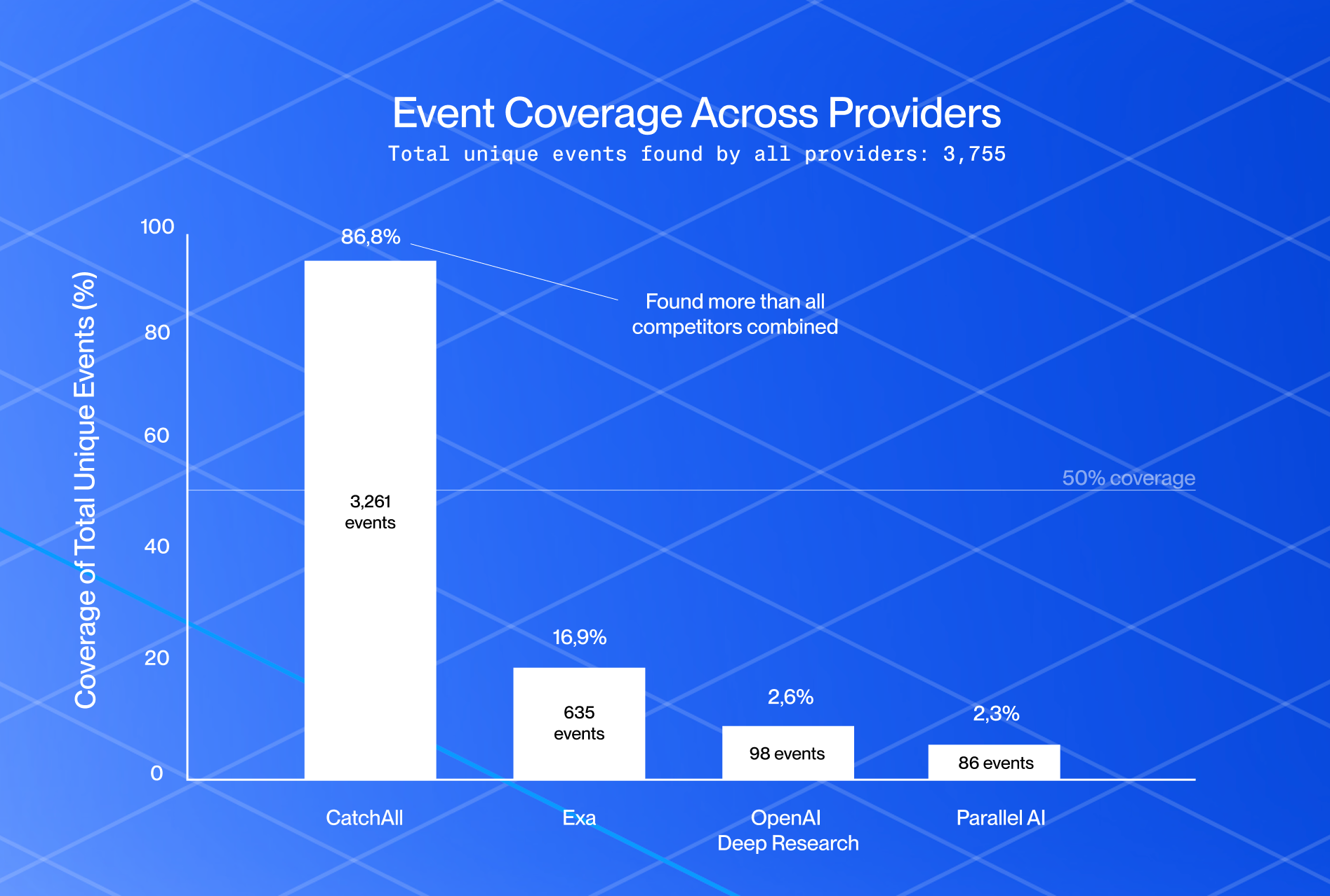








News is spread across thousands of sites, each with its own layout and its own copy of the same wire story. A news API brings those articles into one index that one request can search. Results come back in a standardized shape, with the headline, source, publish date and link.
Enriched news APIs go further when they index each article. They merge copies of the same story and record the named entities each article mentions, so you can filter on those as well.
What is a news API?
A news API is a web service that returns news articles as data. You send an HTTP request, add a few filters to narrow it down to the news you're interested in, and JSON comes back, so your code doesn't have to interact with the web pages themselves.
If you search online, you'll see some providers also use the term "news data API", which means the same thing.
What types of news APIs are available?
News APIs typically come in two kinds: simple and enriched. The difference is how much data cleaning each one leaves to your code.
A simple news API indexes articles and hands them back much as it found them. Search for a story that dozens of local sites reprinted and you'll get dozens of results back, one per reprint.
An enriched news API does more before anything reaches you. Reprints of the same news story are grouped. Each article also gets tags for who and what it mentions, how positive or negative it reads, and its topic. You can also filter on any of those in the query, so you get only what you need.
| Feature | Simple news API | Enriched news API |
|---|---|---|
| What each result contains | Headline, snippet, link, source and date | The same, plus entities, sentiment, topic labels and often a summary |
| Syndicated copies | Each copy is a separate result | Grouped, or filtered out on request |
| Filters | Keyword, source, language, country and date | All of those, plus entity, sentiment and topic |
| Left to your code | Deduplicating, tagging and filtering the results | Querying the labels |
| Typical fit | Prototypes, headline widgets and low-volume apps | Monitoring, analytics, AI agents and RAG |
How does a news API ingest and process content?
To build its index, a news API crawls news sites, RSS feeds and wire services (some also crawl social channels), and runs every article it picks up through the same four-step pipeline.
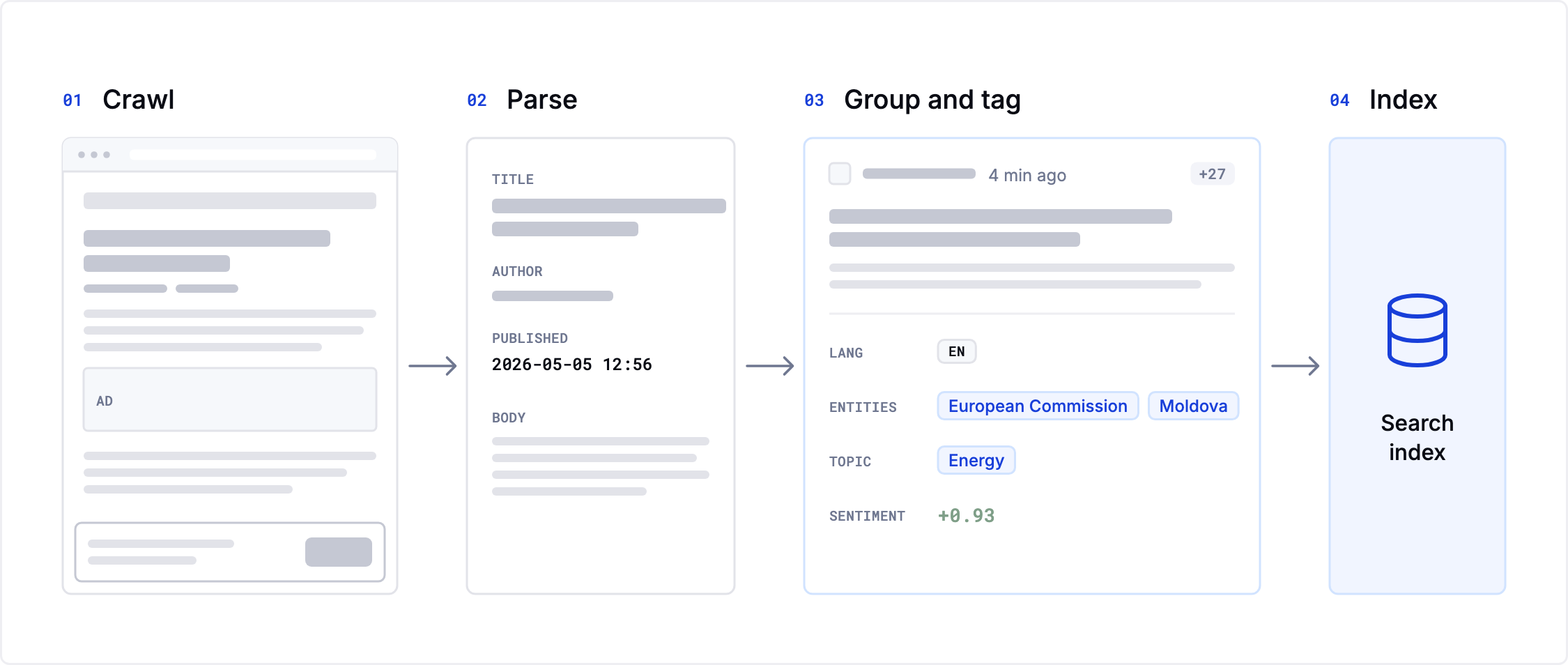
- Crawling. This step finds new articles. Crawlers check each site and feed for fresh links and download the pages. They also adjust crawling frequency based on how often each source publishes; for example, they visit a busy national daily far more often than a monthly trade journal.
- Parsing cleans the data. Menus, ads and cookie banners are stripped out, and the headline, author, publish time and article text are kept in the same fields for every site.
- Deduplication and tagging. Copies of one story are merged into one record, so an AI agent reads it once and spends less context, and money, on repeats. Models then tag named entities, sentiment and topic.
- Indexing. This makes millions of articles fast to search. Each one is filed by its words, date, source and tags, like a book's index, which is where your query looks.
How quickly does indexed content become available?
Most articles reach a news API's index within minutes of publication, though a slow minority of sources can take hours, and some free tiers hold articles back for up to a day.
If your app needs news fast, say for breaking-news alerts, test that in a trial. Note when a few new stories go live on the publisher's site and when the API first returns them.
What does a news API response contain?
You get JSON back from most news APIs. At the top, there are usually a few meta fields that describe the search (e.g. status, total hits, current page). After that comes the array of articles.
Say you want one English-language article about renewable energy from NewsCatcher's News API. The request looks like this:
curl -X POST "https://v3-api.newscatcherapi.com/api/search" \ -H "x-api-token: YOUR_API_KEY" \ -H "Content-Type: application/json" \ -d '{ "q": "renewable energy", "lang": "en", "page_size": 1 }'Here's what comes back, with a few fields left out to keep it short:
{ "status": "ok", "total_hits": 10000, "page": 1, "total_pages": 10000, "page_size": 1, "articles": [ { "id": "93b554adf9bf7feb5fc70be8209f8fc9", "title": "EU-Moldova High-Level Energy Dialogue: Renewed commitment to closer energy cooperation", "link": "https://energy.ec.europa.eu/news/eu-moldova-high-level-energy-dialogue-2026-05-05_en", "domain_url": "europa.eu", "name_source": "European Union", "published_date": "2026-05-05 12:56:15", "language": "en", "description": "The European Commission and the Republic of Moldova held today the 7th High-Level Energy Dialogue in Brussels...", "word_count": 254, "rank": 40, "score": 5.787511 } ]
}
Other providers return much the same information under slightly different names. The table compares the fields above with NewsAPI.org's.
| What it holds | NewsCatcher field | NewsAPI.org field |
|---|---|---|
| Headline | title | title |
| Article URL | link | url |
| Publisher | domain_url, name_source | source.name |
| Author | author, authors | author |
| Publish time | published_date | publishedAt |
| Short description | description | description |
| Article ID | id | Not returned |
| Relevance score | score | Not returned |
Enriched APIs can also return what they extract. In NewsCatcher's, setting include_nlp_data to true adds an nlp object to each article with a summary, a theme and sentiment scores, plus lists of the named entities.
What query parameters does a news API support?
Most news APIs accept a search query, filters for source, language, country and date, and a sort order. Enriched APIs add filters on what they extract from each article.
| Common filter | What it controls |
|---|---|
| Keyword | Words, phrases or a boolean expression with AND, OR and NOT |
| Search fields | Whether to match the title, the description or the body |
| Sources | Publishers to include or exclude |
| Language | ISO 639-1 codes such as en, fr or de |
| Country | Where the publisher is based |
| Date range | Earliest and latest publish time |
| Sort order | Relevance, publish date, or source rank or popularity |
| Pagination | Page number and results per page |
On top of these, most providers offer their own extras, such as filters for article length, opinion pieces or paywalled content, so check each API's documentation for its full list.
What does enrichment add to each article?
An enriched news API labels every article as it enters the index. Natural language processing (NLP) models do this work, from small task-specific ones up to LLMs, and everything they add becomes a filter.
- Entities. Named entity recognition tags the people, companies and places an article mentions. Ask for one company with
ORG_entity_nameand you get the articles that mention it. - Sentiment. Each article's tone gets a sentiment score, often separate ones for the headline and the body, and setting
title_sentiment_maxbelow zero leaves only negative headlines. - Topic. A classifier files the article under a topic, usually one from the IPTC Media Topics list. Those topic codes work as filters as well (
iptc_tags).
Duplicates are handled too. Turning on exclude_duplicates makes each news story show up only once. Some APIs also write a short summary of each article. The names in brackets are NewsCatcher's parameters.
All of it runs on the provider's side. The alternative, pulling hundreds of loose matches and sorting them in your own code, costs more requests and more compute than one precise query. Our guide to NLP enrichment in a news API covers each field in detail.
What is a news API used for?
Products that need to follow the news as it happens get their articles from a news API. They tend to look like this:
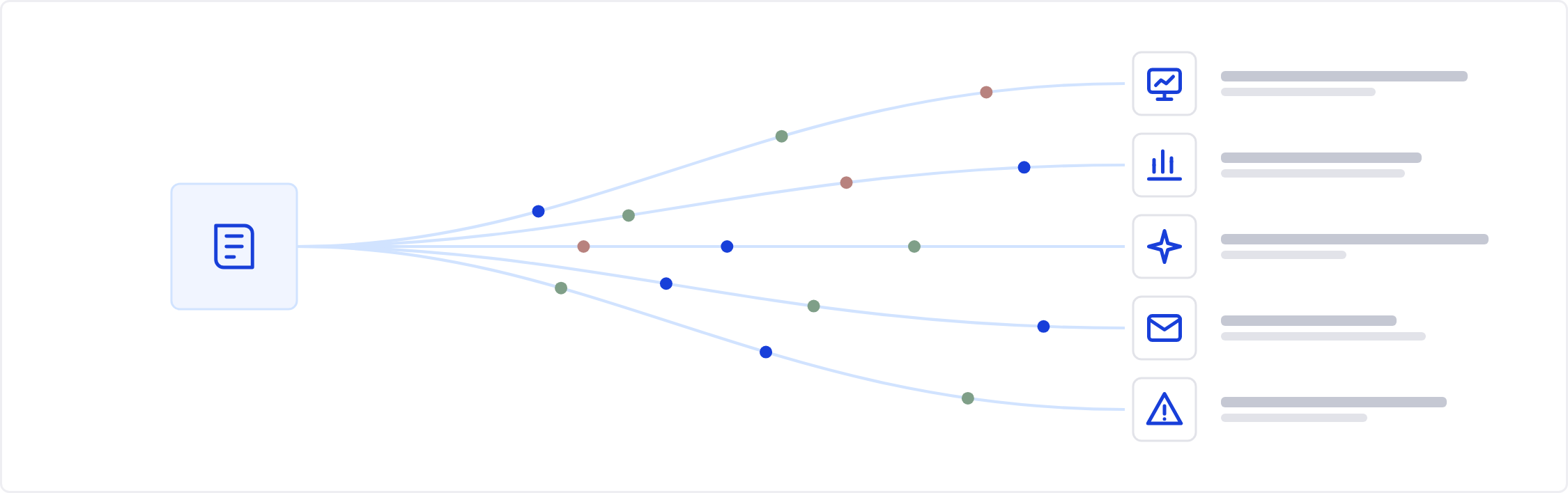
- Media monitoring dashboards. A PR team follows its brand, its rivals or a breaking story across thousands of outlets.
- Portfolio monitoring and financial research, where an analyst wants earnings news, regulatory filings and anything else that might move a holding.
- AI agents and RAG systems. A model's training data stops at some date, so questions about anything later need recent articles, with sources attached.
- Daily briefings and newsletters that pick the day's relevant stories without anyone curating them by hand.
- Risk and compliance alerts. Sanctions, geopolitical events and supply chain disruptions get flagged as soon as they're reported.
How to assess a news API for production use?
The best way to assess a news API is to try it before you commit to a paid plan or a contract. Decide what kind of news you need and run those searches during the trial, adjusting them until they fit your use case. Then check the results themselves for relevance, coverage and quality. They can look quite different from what a provider's website promises, and from what your use case needs.
| Check | What to look for |
|---|---|
| Latency | Minutes between publication and an article's first appearance in your results |
| Coverage | Whether your test searches find the outlets, languages and countries your topic needs. Source counts can't settle it, since providers don't define what counts as a source |
| Duplicates | Whether a popular story comes back as one grouped result or as dozens of near-identical copies, republished or reworded across the web |
| Enrichment accuracy | Whether the entity and sentiment labels look right when you spot-check a few articles |
| History | How far back the archive goes, and whether older articles cost extra |
| Rate limits | Quota per day or month and requests per second, set against your real polling volume |
| Licensing | Whether the terms allow commercial use, including inside AI products |
What rate limits do news APIs set?
As of October 2026, news API free tiers usually allow 100 to 250 requests a day, and paid self-serve plans go up to tens of thousands. Check that against how often you'll query. Fifty saved searches, each checked once a minute, add up to 72,000 requests a day.
To compare providers, see our guide to the best news APIs and our Q4 2026 news API benchmark.
FAQ
Is a news API the same as NewsAPI.org?
No. NewsAPI.org is one provider, and its name happens to match the generic term, which is why it often comes up first in searches for "news api". Like other news APIs, it searches articles from many sources and returns them as JSON, with a free plan for development and paid plans for production.
Is a news API better than an RSS feed?
Once you follow more than a handful of sites, a news API is better than RSS. A feed covers one site, or one section of it, and only keeps the latest items. Searching across publishers, going back in time and dropping repeats are all on you. A news API does that work across its whole index. RSS still suits a few known sites, as long as each feed's terms allow your use. Google News RSS, for instance, allows personal, non-commercial use only.
How is a news API different from a web search API?
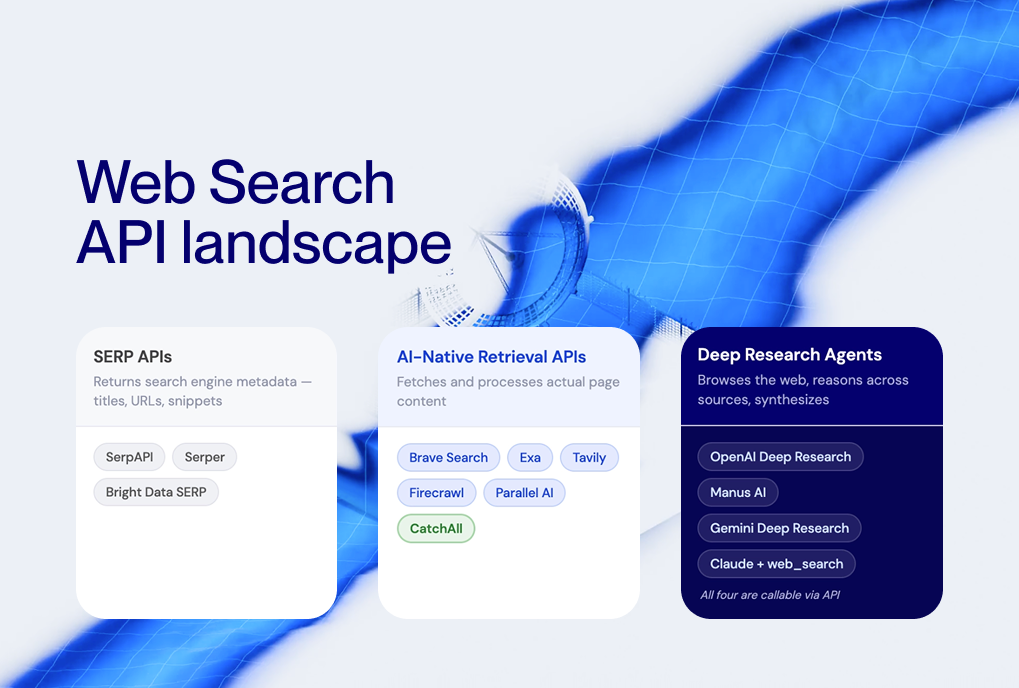
A news API searches an index of articles from news publishers, with publish dates, sources and filters built around them. A web search API searches the open web, forums, product pages and papers included, and returns ranked pages or extracted content for a query. Our comparison of news APIs and web search APIs covers when each one fits.