









Introduction
Imagine asking an AI agent to research a company, monitor competitors, or summarize an industry trend. The answer may look complete and confident. However, the system may have examined only the top 50-100 search results out of 1000 potentially relevant sources. That is not a reasoning failure. It is a recall problem in which retrieval coverage is too narrow to support a reliable conclusion.
Many AI systems optimize for ranking and relevance while overlooking coverage. Hence, AI agents prioritize precision over completeness and routinely miss long-tail, niche, or recently published sources. This can lead to gaps, bias toward popular sources, and inaccurate conclusions.
That gap between available information and retrieved information is a recall in search problem in modern AI agent search systems. Understanding recall is essential for building reliable AI agents, RAG systems, and research workflows.
Why Do AI Agents Miss 80% of Relevant Results?
AI agents often miss relevant information because retrieval systems fail to discover all relevant sources before answer generation begins. This is a core limitation in AI agent search systems. Retrieval failures happen long before an LLM hallucination because the agent can only reason over what the search layer returns.
Here are some of the factors that contribute to this problem:
- Search coverage limitations: Search systems may miss relevant information from niche websites, forums, research papers, PDFs, and other long-tail sources that are harder to discover.
- Ranking limitations: Algorithms often favor popular or high-ranked results. This can push useful but lower-ranked content further down.
- Query formulation issues: AI-generated queries may be overly narrow or poorly phrased, leading to relevant information being missed.
- Incomplete indexing: Some pages are not properly indexed or updated regularly. This can make them invisible to retrieval systems.
This is why retrieval failures often occur before hallucinations. An AI model cannot reason over information it never retrieved. If key facts are missing from the search results, the model may fill the gaps with outdated knowledge or incomplete context.
%20(1).jpg)
What Is Recall in AI Search?
Recall is a metric which measures how many of the relevant results a search system successfully retrieves from the total set of relevant information that actually exists.
Recall in information retrieval is measured through recall in search which is defined as:
Recall = (Number of relevant documents retrieved) ÷ (Total number of relevant documents available)
For example, there are 100 documents on the web relevant to your query. Your search system returns 30 and 20 of them are genuinely relevant. Your recall is 20/100 = 20%. You missed 80% of the relevant information that existed.
Recall is an important evaluation metric for modern search systems and AI data retrieval systems because missing information cannot be recovered later in the AI pipeline. Once relevant sources are not retrieved during the search phase, no model can reconstruct or infer them accurately, no matter how strong the reasoning capability is.
For a deeper look at how search infrastructure works in practice, see our guide on web search APIs.
%20(1).jpg)
What Is the Difference Between Recall Vs Precision?
Recall measures completeness, while precision measures relevance. These two metrics work together to evaluate how well a search system retrieves and filters information.
Here’s how precision vs recall compare side by side:
How Can You Measure Recall in Search?
The evaluation should compare results against a known set of relevant documents. Without this reference set, recall in information retrieval cannot be reliably measured. This is often done through ground truth datasets that define which documents are relevant for each query. They act as the “answer key” for evaluating retrieval quality.
A common metric is Recall@K, which measures how many relevant documents appear in the top K results. For example, Recall@10 checks how many relevant items are found within the first 10 results.
In broader evaluation setups, coverage testing is used to understand whether a system can retrieve information across different types of sources. This includes blogs, PDFs, forums, and research papers. It helps identify missing source types in retrieval.
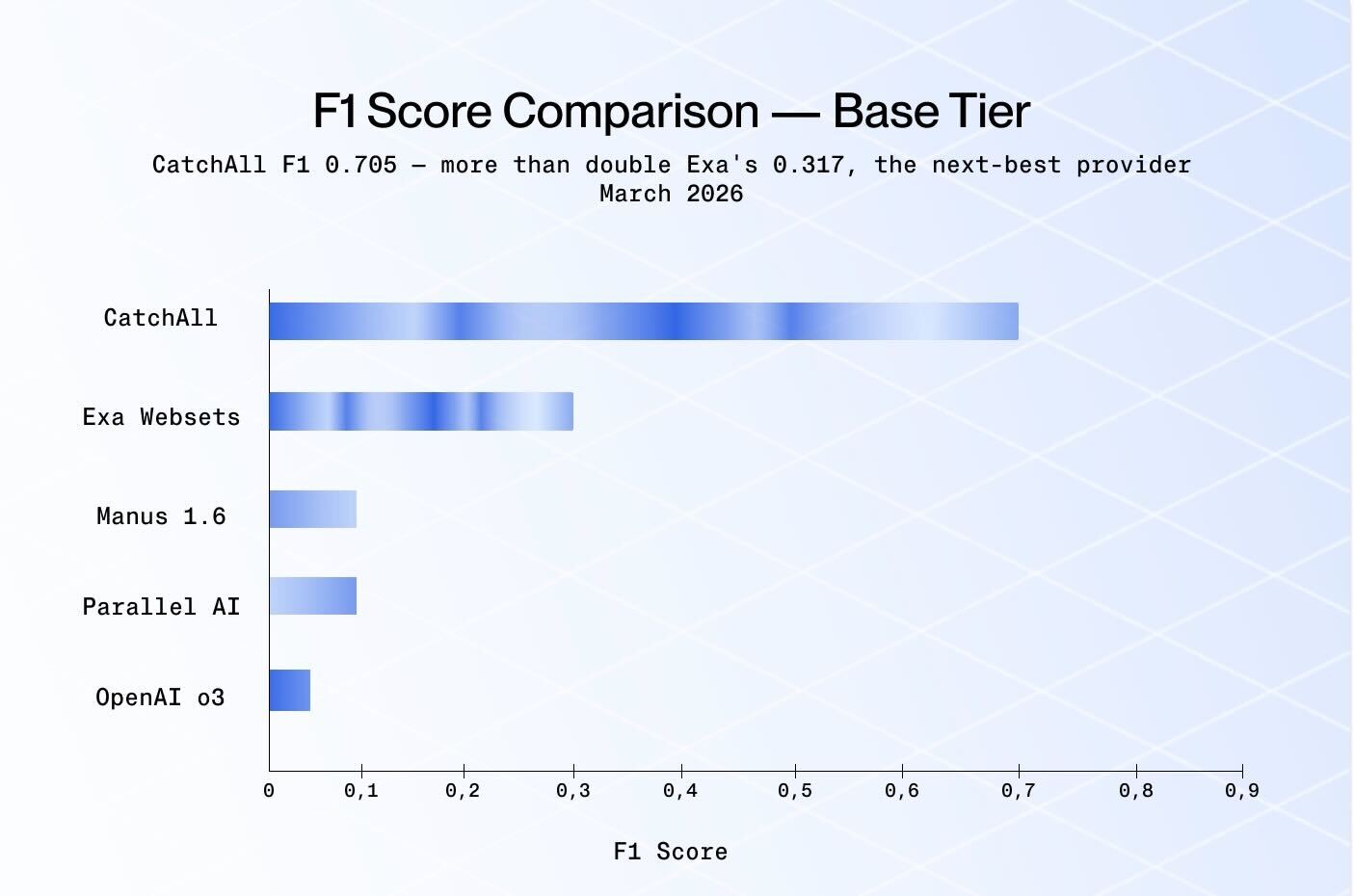
More structured comparisons are done through benchmarking methodologies, where multiple systems are evaluated using standardized datasets or domain-specific test sets. They help measure how completely the systems retrieve relevant information under consistent conditions. In March 2026, such a benchmark across 32 queries showed CatchAll achieved 79.8% recall and won 84% of queries with an F1 score of 0.705, more than double Exa's 0.317.
However, measuring recall is difficult in open-web systems because there is no fixed list of all relevant documents. This is why recall is usually estimated using benchmarks and proxy datasets.
For teams building AI agent search systems, RAG pipelines, or monitoring workflows, managed solutions like CatchAll Web Search API can help handle recall-first retrieval, monitoring, and large-scale web data collection. It removes the need to manage proxies, browser clusters, and parser maintenance manually.
How Can You Improve Recall in AI Search Systems?
Improving recall requires broadening the set of sources your retrieval system can discover before generation begins. Ranking better within a small pool of documents doesn't fix a coverage problem. Practical strategies include:
- Query expansion: Use synonyms and alternative phrasings so more relevant documents can match the search.
- Multi-query retrieval: Break complex questions into smaller sub-queries to capture different angles of the same topic.
- Hybrid search: Combine keyword search and semantic search to catch both exact matches and related concepts.
- Broader source indexing: Include long-tail sources like niche blogs, government sites, and regional publications, not just top-ranked domains.
- Multiple data sources: Use more than one search provider to improve overall coverage and reduce missed information.
What Is a Recall-First Search API?
A recall-first search API is designed to retrieve as many relevant results as possible before applying strict ranking or filtering.
Traditional search focuses on showing the best results early using ranking algorithms. This works for browsing but fails in AI systems where missing information is more costly than extra noise.
Recall-first retrieval prioritizes coverage over early ranking, ensuring long-tail and less-visible sources are included. AI systems need this broader retrieval because limited input leads to incomplete outputs, regardless of model quality.
If you are evaluating what is the best web search api for AI agents, recall-first design is a key differentiator.
How Does CatchAll Help AI Agents Retrieve More Relevant Information?
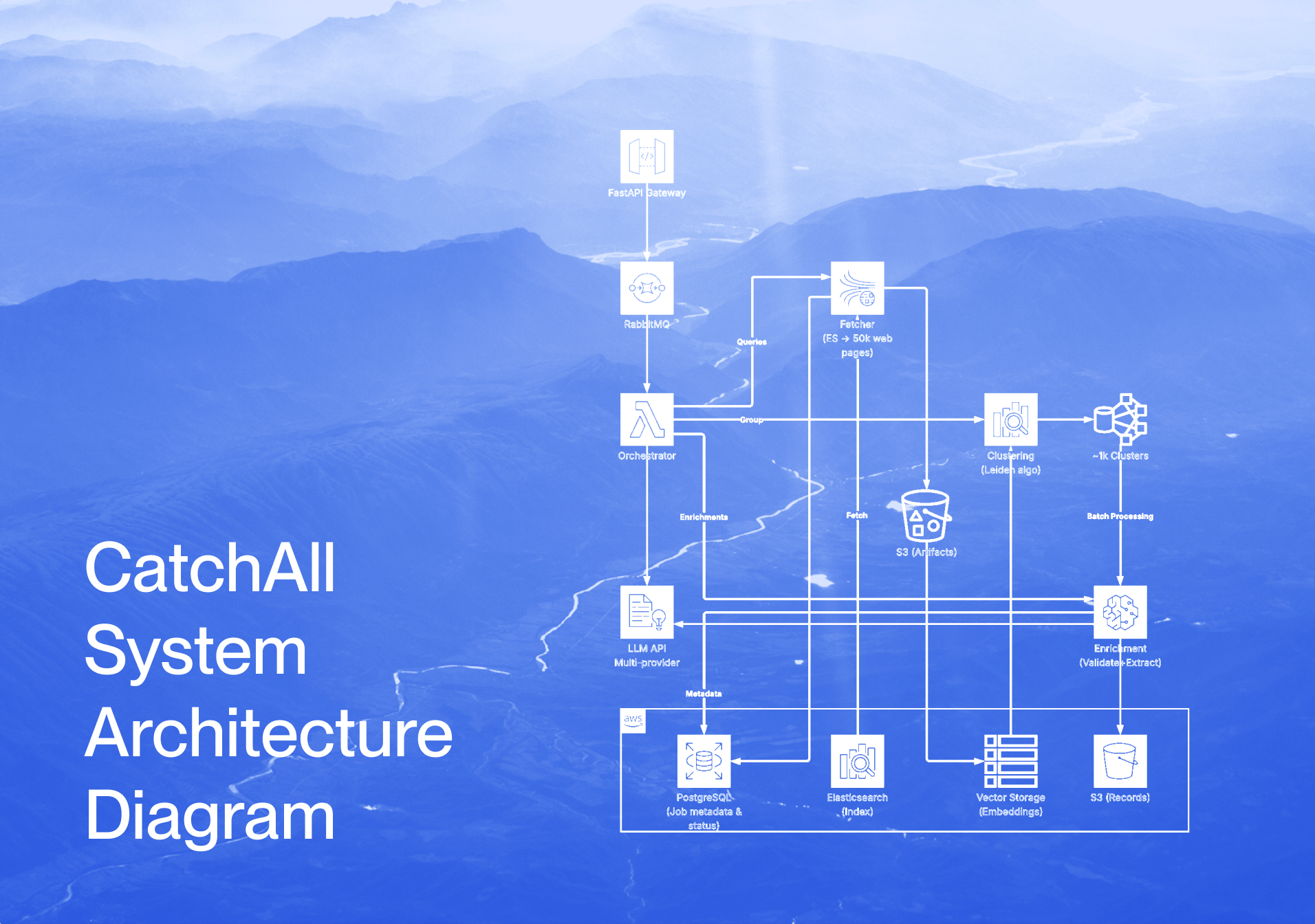
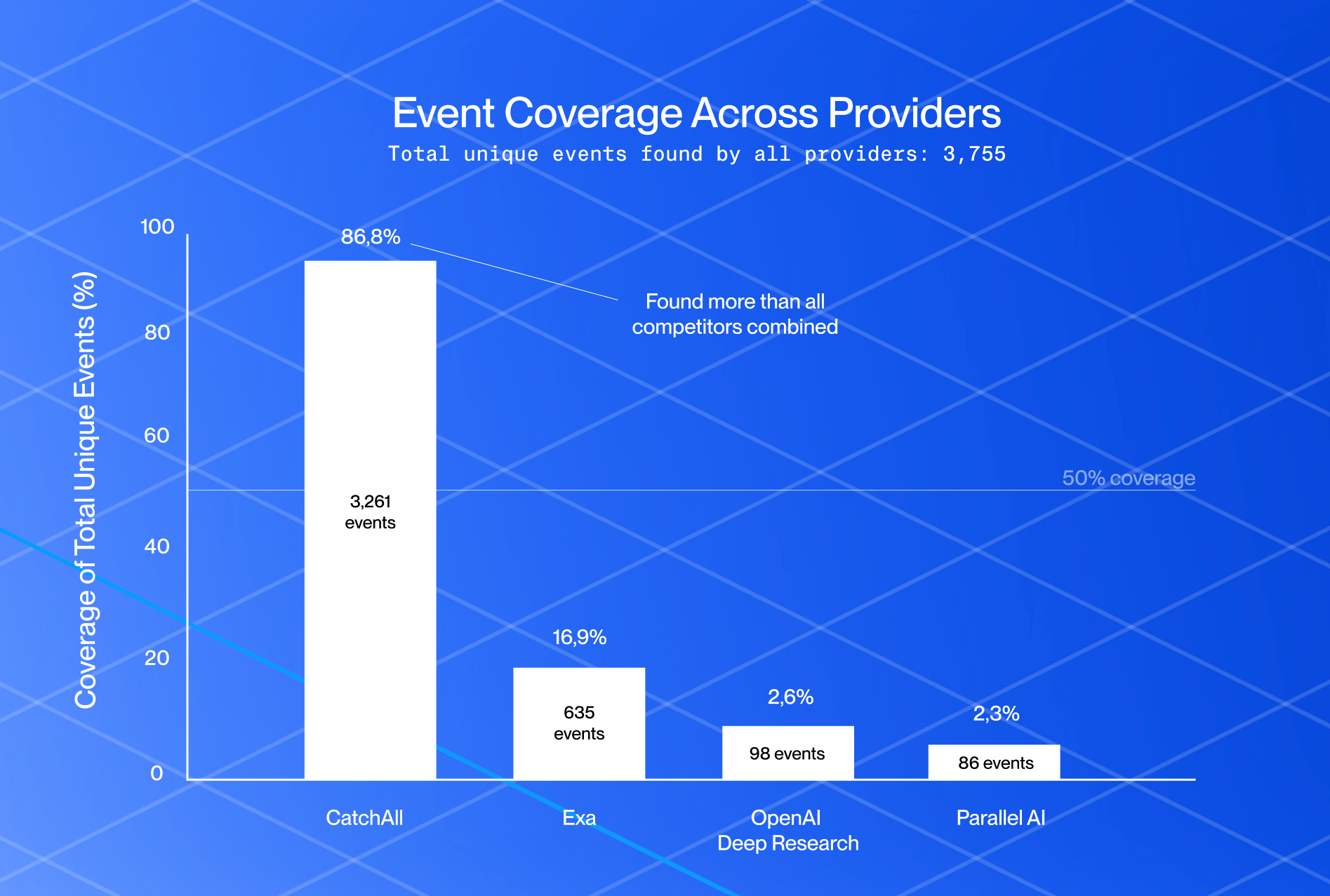
CatchAll is built around a recall-first architecture that prioritizes search coverage before ranking. As of 2026, CatchAll delivers 86% recall across more than 2 billion web pages (5x more than OpenAI Deep Research), scans 10,000+ pages per minute, and achieved the highest F1 score in internal benchmark testing. This helps AI agents and RAG systems retrieve more complete context before generating answers.
Unlike traditional retrieval systems that focus on returning a small set of top results, CatchAll is designed to surface a broader range of relevant sources.This includes long-tail content such as niche blogs, regional news sites, industry publications, forums, and newly published pages that often receive less visibility in conventional search results. These sources can contain valuable information that AI systems would otherwise miss.
Its advantages include:
- Wider search coverage across diverse web sources
- Discovery of long-tail content and niche publications
- More comprehensive retrieval for RAG applications
- Better context for AI research and knowledge assistants
- Reduced risk of missing critical information
Summary
Recall in search measures how much relevant information a system retrieves before generating an answer. Low recall means the system works with incomplete context, leading to missing insights and less reliable outputs. While precision focuses on relevance, recall focuses on coverage, and both are needed for trustworthy AI systems.
If your AI system is missing key sources, the issue is often retrieval, not reasoning. NewsCatcher’s Web Search API is designed for recall-first search, helping AI agents surface broader, long-tail, and diverse web content for more complete context.
Get started with CatchAll for recall-first web search. Start with 2,000 free credits at platform.newscatcherapi.com that are enough for 20 Lite queries.
Documentation: https://www.newscatcherapi.com/docs/web-search-api/get-started/introduction.
Questions? Contact us at support@newscatcherapi.com.
FAQs
1. Is high recall always better for AI search?
Not always. High recall improves coverage, but if too many irrelevant results are included, answer quality can suffer. The best systems balance recall and precision.
2. Why is recall important for enterprise knowledge search?
Enterprise search systems need to surface documents across multiple repositories. Low recall can cause employees and AI assistants to miss critical internal information.
3. Does vector search automatically provide high recall?
No. Vector search can improve semantic matching, but recall still depends on indexing quality, embedding models, query design, and retrieval settings.




.png)
.png)