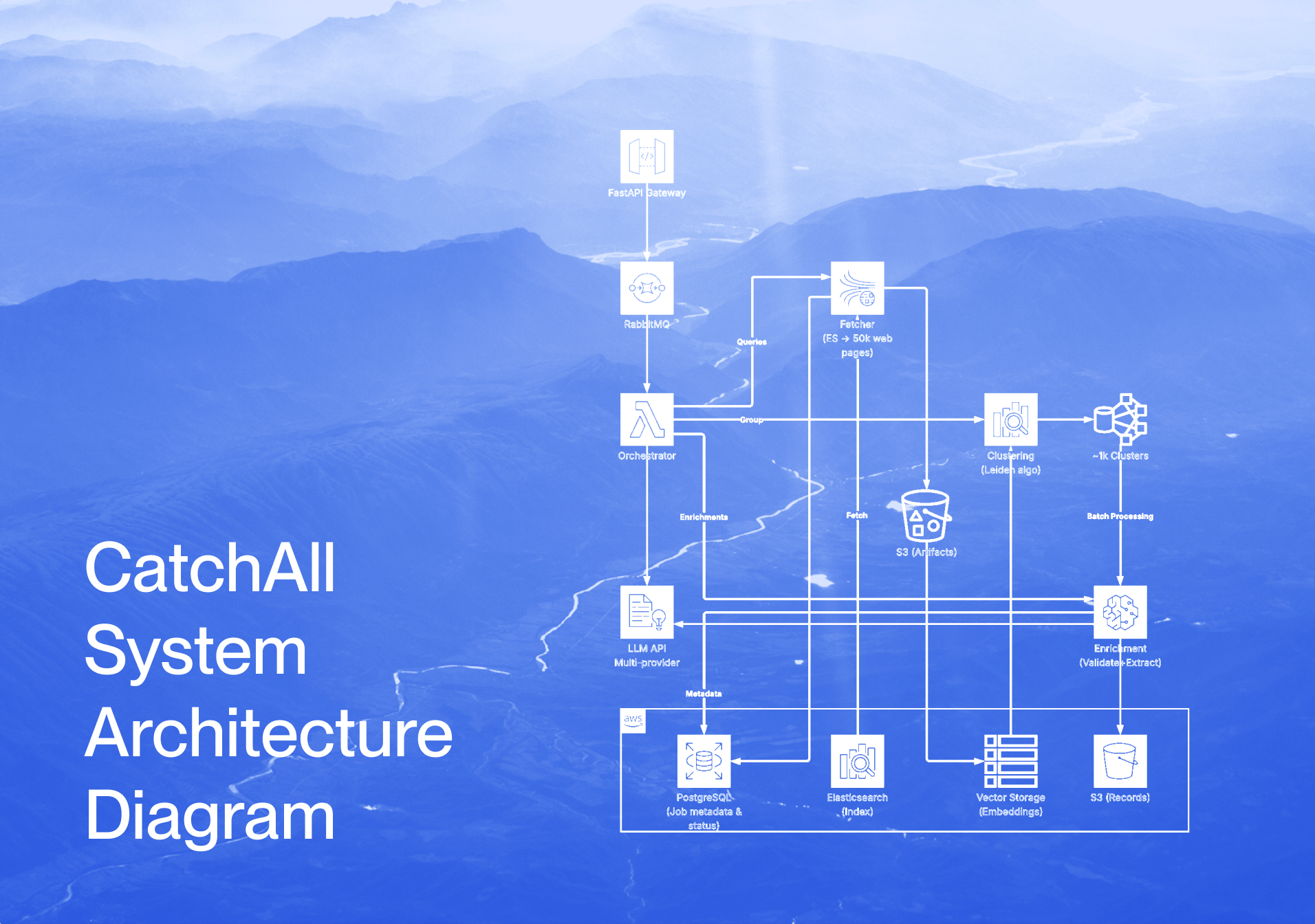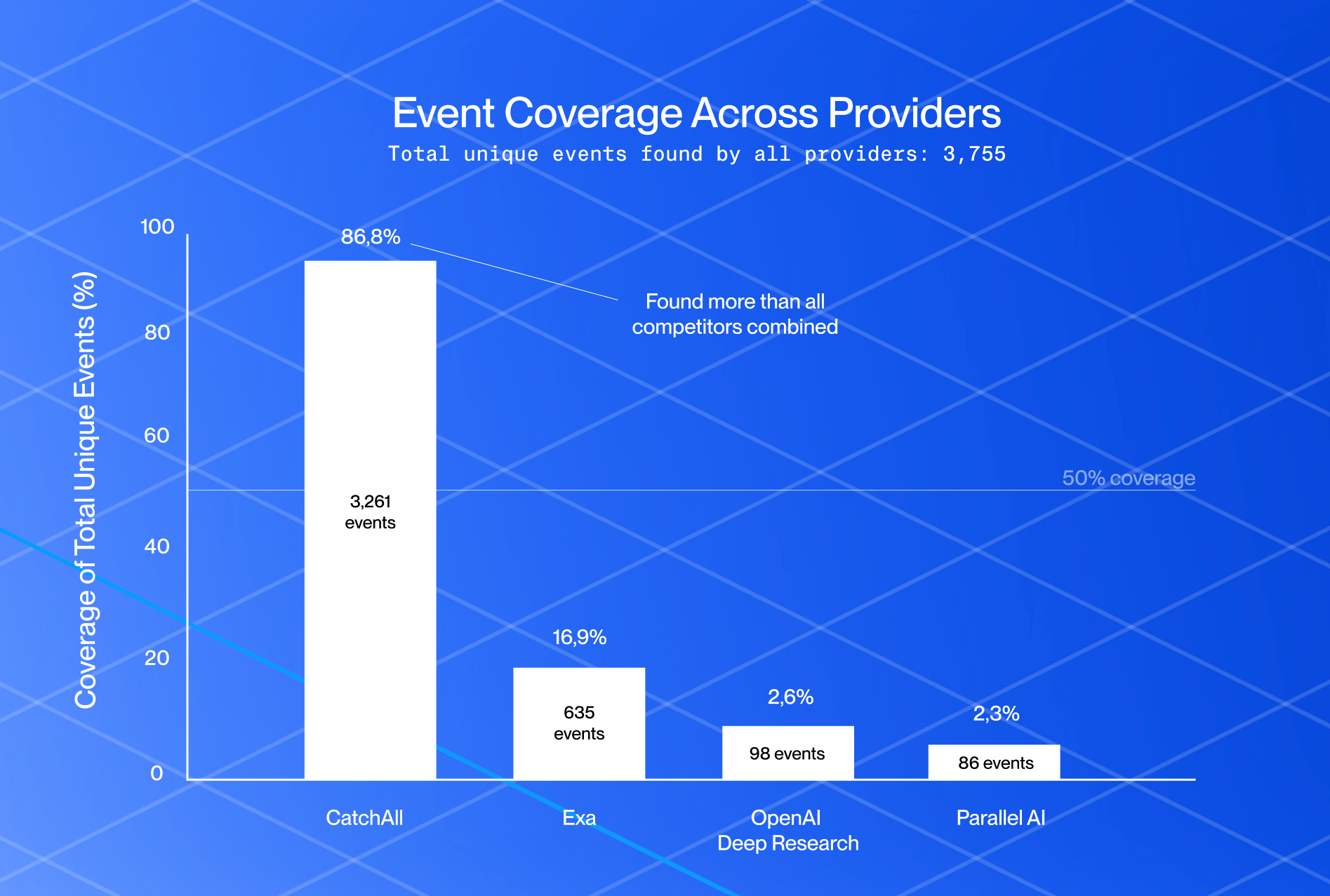











Architecture Overview
The system uses a three-stage agent pipeline where each agent processes and enriches the data:

Why this architecture?
- Separation of concerns — each agent has a focused role
- Context passing — later stages build on earlier analysis
- Consistent output — structured reports regardless of input volume
- Domain expertise — agent backstories encode industry knowledge
Prerequisites
- Python 3.10+
- NewsCatcher CatchAll API key
- Google Gemini API key
Project Setup
1. Create project structure
mkdir risk_management_agent && cd risk_management_agent2. Define dependencies
Create pyproject.toml:
[project]
name = "risk_management_agent"
version = "1.0.0"
requires-python = ">=3.10"
dependencies = [
    "crewai[tools]>=0.86.0",
    "newscatcher-catchall-sdk>=0.2.0",
    "python-dotenv>=1.0.0",
]

[project.scripts]
run_crew = "risk_management_agent.main:run"

[tool.crewai]
type = "crew"

[build-system]
requires = ["hatchling"]
build-backend = "hatchling.build"

[tool.hatch.build.targets.wheel]
packages = ["src/risk_management_agent"]
3. Install
crewai install4. Configure environment
Create .env in the project root:
NEWSCATCHER_API_KEY=your_catchall_key
GEMINI_API_KEY=your_gemini_key
Data Ingestion
CatchAll provides three ways to get data:
- Monitor — Continuous monitoring with periodic pulls
- Job — One-time search with structured extraction
- New Job — Create and wait for completion
Create src/risk_management_agent/main.py:
import os
import time
from datetime import datetime

def get_client():
    from newscatcher_catchall import CatchAllApi
    return CatchAllApi(api_key=os.getenv("NEWSCATCHER_API_KEY"))


def fetch_from_monitor(monitor_id: str) -> dict:
    """Pull latest results from a running monitor."""
    client = get_client()
    results = client.monitors.pull_monitor_results(monitor_id)
    return to_dict(results)


def fetch_from_job(job_id: str) -> dict:
    """Get results from a completed job."""
    client = get_client()
    results = client.jobs.get_job_results(job_id)
    return to_dict(results)


def create_job(query: str, context: str, schema: str) -> dict:
    """Create a new job and wait for completion."""
    client = get_client()

    job = client.jobs.create_job(
        query=query,
        context=context,
        schema=schema
    )

    # Poll until complete
    while True:
        status = client.jobs.get_job_status(job.job_id)

        if any(s.status == "completed" and s.completed for s in status.steps):
            break

        current = next((s for s in status.steps if not s.completed), None)
        if current:
            print(f"Step {current.order}/7: {current.status}")

        time.sleep(30)

    return to_dict(client.jobs.get_job_results(job.job_id))


def to_dict(obj):
    """Recursively convert API objects to dicts."""
    if obj is None or isinstance(obj, (str, int, float, bool)):
        return obj
    if isinstance(obj, datetime):
        return obj.isoformat()
    if isinstance(obj, dict):
        return {k: to_dict(v) for k, v in obj.items()}
    if isinstance(obj, (list, tuple)):
        return [to_dict(i) for i in obj]
    if hasattr(obj, 'model_dump'):
        return to_dict(obj.model_dump())
    if hasattr(obj, '__dict__'):
        return {k: to_dict(v) for k, v in obj.__dict__.items()
                if not k.startswith('_')}
    return str(obj)
Usage examples
# From a monitor (for continuous use cases)
data = fetch_from_monitor("50e6a6bc-bb49-4968-8f3c-1f984359cf62")

# From a previous job
data = fetch_from_job("ab2b9609-aa5f-41c4-a894-87fcfa1cbe04")

# Create new job with custom query
data = create_job(
    query="Supply chain disruptions at German car manufacturers",
    context="Focus on semiconductor shortages, logistics delays, labor strikes",
    schema="Supplier [NAME] Event [TYPE] Impact [DESCRIPTION] Severity [High/Medium/Low]"
)
Building the Processing Tool
The tool formats raw API results for agent consumption. Agents work better with structured text than raw JSON.
Create src/risk_management_agent/tools/risk_tool.py:
import json
import re
from typing import Type, Dict, Any
from crewai.tools import BaseTool
from pydantic import BaseModel, Field


class RiskDataInput(BaseModel):
    results_json: str = Field(..., description = "JSON string of API results")


class RiskDataTool(BaseTool):
    """Formats CatchAll results for risk analysis."""

    name: str = "process_risk_data"
    description: str = "Processes news data to extract supply chain risks"
    args_schema: Type[BaseModel] = RiskDataInput

    def _run(self, results_json: str) -> str:
        try:
            data = json.loads(results_json)
            return self._format(data)
        except json.JSONDecodeError as e:
            return self._extract_partial(results_json, str(e))

    def _format(self, data: Dict[str, Any]) -> str:
        lines = [
            "## Risk Intelligence Data",
            f"**Records:** {data.get('valid_records', 0)}",
            ""
        ]

        for i, record in enumerate(data.get('all_records', []), 1):
            lines.append(f"### {i}. {record.get('record_title', 'Untitled')}")

            enrichment = record.get('enrichment', {})
            if enrichment:
                if enrichment.get('schema_based_summary'):
                    lines.append(f"**Summary:** {enrichment['schema_based_summary']}")

                if enrichment.get('affected_manufacturers'):
                    lines.append(f"**Manufacturers:** {enrichment['affected_manufacturers']}")

                if enrichment.get('disruption_causes'):
                    lines.append(f"**Causes:** {enrichment['disruption_causes']}")

                impact = enrichment.get('impact_details')
                if impact and isinstance(impact, dict):
                    lines.append("**Impact:**")
                    for k, v in impact.items():
                        if v:
                            lines.append(f"  - {k}: {v}")

            citations = record.get('citations', [])[:3]
            if citations:
                lines.append("**Sources:**")
                for c in citations:
                    lines.append(f"  - [{c.get('title', '')}]({c.get('link', '')})")

            lines.append("")

        return "\\n".join(lines)

    def _extract_partial(self, raw: str, error: str) -> str:
        """Fallback extraction when JSON is malformed."""
        lines = [f"## Partial Extraction (JSON error: {error})", ""]

        titles = re.findall(r'"record_title":\\s*"([^"]+)"', raw)
        if titles:
            lines.append("### Events Found:")
            for title in titles:
                lines.append(f"- {title}")

        return "\\n".join(lines)
Why format as text?
LLMs process structured text more reliably than nested JSON. The tool converts API responses into a format that agents can reason about directly.
Defining Agents
Agents are defined in two parts: YAML configuration for declarative settings and Python code for runtime behavior.
YAML Configuration
Create src/risk_management_agent/config/agents.yaml:
news_intelligence_officer:
  role: Supply Chain Intelligence Officer
  goal: >
    Extract risk signals from news data affecting {target_manufacturers}.
    Identify early warning signs before they impact production.
  backstory: >
    Former intelligence analyst specializing in supply chain security.
    Expert at identifying semiconductor, logistics, and geopolitical risks.

risk_analyst:
  role: Risk Assessment Analyst
  goal: >
    Categorize and score supply chain risks for {target_manufacturers}.
    Assess severity and identify patterns across events.
  backstory: >
    Risk analyst with operations research background.
    Expert in automotive supply chain vulnerabilities and JIT production.

executive_report_analyst:
  role: Executive Risk Communicator
  goal: >
    Create clear risk summaries showing global events and business impact
    for {target_manufacturers}.
  backstory: >
    Former Chief of Staff at automotive companies.
    Translates complex risk data into actionable executive briefings.
Python Agent Definitions
In crew.py, the @agent decorator links YAML config to runtime settings:
from crewai import Agent, LLM
from crewai.project import CrewBase, agent

@CrewBase
class RiskManagementCrew:
    agents_config = 'config/agents.yaml'

    def __init__(self):
        self._llm = LLM(
            model="gemini/gemini-2.5-flash",
            api_key=os.getenv("GEMINI_API_KEY"),
            temperature=0.2
        )

    @agent
    def news_intelligence_officer(self) -> Agent:
        """Stage 1: Extract risk signals from raw news data."""
        return Agent(
            config=self.agents_config['news_intelligence_officer'],
            tools=[RiskDataTool()],  # Custom tool for processing
            llm=self._llm,
            verbose=True,
            max_iter=5  # Limit reasoning iterations
        )

    @agent
    def risk_analyst(self) -> Agent:
        """Stage 2: Categorize and score risks."""
        return Agent(
            config=self.agents_config['risk_analyst'],
            llm=self._llm,
            verbose=True,
            allow_delegation=False  # Don’t pass work to other agents
        )

    @agent
    def executive_report_analyst(self) -> Agent:
        """Stage 3: Generate executive summary."""
        return Agent(
            config=self.agents_config['executive_report_analyst'],
            llm=self._llm,
            verbose=True,
            allow_delegation=False
        )
Agent Design Principles
- Keep backstories short but specific to the domain
- Goals should be actionable, not abstract
- Reference input variables like
{target_manufacturers}for context - Use
allow_delegation=Falseto prevent agents from passing work around - Assign tools only to agents that need them
Creating Tasks
Tasks define what each agent does and how they pass context between stages.
YAML Configuration
Create src/risk_management_agent/config/tasks.yaml:
gather_risk_intelligence:
  description: >
    Analyze {valid_records} news records for supply chain risks.

    For each risk signal:
    - What’s happening globally
    - Which manufacturers/suppliers affected
    - Financial and operational impact
    - Source citations

    Focus: {focus_areas}
    Data: {news_data}
  expected_output: >
    Intelligence brief with risk count, global context,
    and detailed findings for each identified risk.
  agent: news_intelligence_officer

analyze_and_categorize_risks:
  description: >
    Categorize risks from Stage 1 into:
    - SEMICONDUCTOR_SHORTAGE
    - RAW_MATERIAL_SCARCITY
    - LOGISTICS_DELAY
    - LABOR_DISRUPTION
    - GEOPOLITICAL
    - SUPPLIER_FINANCIAL
    - ENERGY_CRISIS
    - COMPETITION

    For each: category, severity (CRITICAL/HIGH/MEDIUM/LOW),
    what’s happening, business impact.
  expected_output: >
    Categorized risk report with counts by category
    and severity-ranked findings.
  agent: risk_analyst
  context:
    - gather_risk_intelligence

generate_executive_report:
  description: >
    Create executive risk summary for {target_manufacturers}.

    Structure:
    - Risk dashboard (category counts, severities)
    - Critical/High risks (detailed)
    - Medium risks (summary table)
    - Low/Monitoring items (brief list)
    - Key metrics (financial exposure, production impact)
  expected_output: >
    Markdown report with dashboard, categorized risks,
    and business metrics.
  agent: executive_report_analyst
  context:
    - gather_risk_intelligence
    - analyze_and_categorize_risks
Python Task Definitions
In crew.py, the @task decorator connects YAML config to execution:
from datetime import datetime
from crewai import Task
from crewai.project import task

@CrewBase
class RiskManagementCrew:
    tasks_config = 'config/tasks.yaml'

    @task
    def gather_risk_intelligence(self) -> Task:
        """Stage 1: Extract raw intelligence from news data."""
        return Task(
            config=self.tasks_config['gather_risk_intelligence']
        )

    @task
    def analyze_and_categorize_risks(self) -> Task:
        """Stage 2: Categorize by type and severity."""
        return Task(
            config=self.tasks_config['analyze_and_categorize_risks']
        )

    @task
    def generate_executive_report(self) -> Task:
        """Stage 3: Format as executive report."""
        timestamp = datetime.now().strftime('%Y%m%d_%H%M%S')
        return Task(
            config=self.tasks_config['generate_executive_report'],
            output_file=f'reports/risk_report_{timestamp}.md'
        )
Context Passing
The context field in YAML links tasks together:
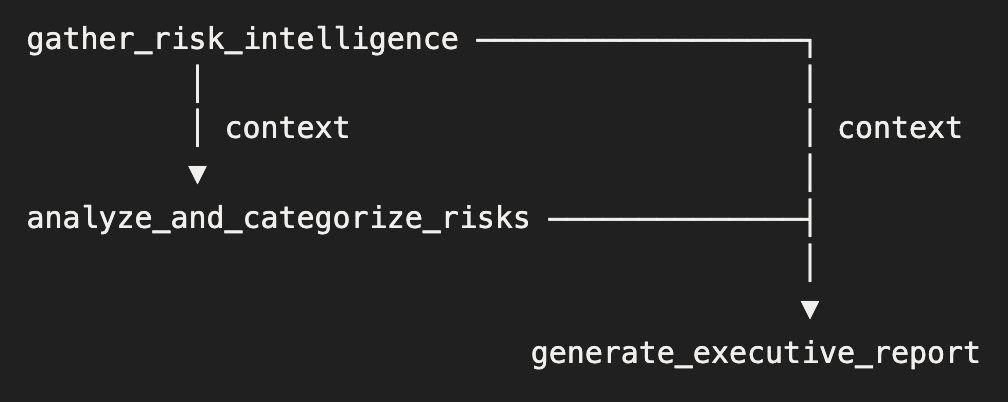
analyze_and_categorize_risksreceives output fromgather_risk_intelligencegenerate_executive_reportreceives output from both previous tasks- Each stage builds on the analysis of previous stages
Assembling the Crew
The crew wires agents and tasks together. The @crew decorator creates the execution pipeline.
from crewai import Crew, Process
from crewai.project import crew

@CrewBase
class RiskManagementCrew:
    agents_config = 'config/agents.yaml'
    tasks_config = 'config/tasks.yaml'

    # ... agents and tasks defined above ...

    @crew
    def crew(self) -> Crew:
        return Crew(
            agents=self.agents,      # Auto-collected from @agent methods
            tasks=self.tasks,        # Auto-collected from @task methods
            process=Process.sequential,
            verbose=True,
            memory=False,            # Disable cross-run memory
            planning=False           # Disable pre-execution planning
        )
Crew Configuration Options
| Setting  | Value              | Purpose                          |
|----------| ------------------ | ---------------------------------|
| process  | Process.sequential | Tasks run in order               |
| verbose  | True               | Show agent reasoning             |
| memory   | False              | No persistence between runs      |
| planning | False              | Skip pre-execution planning steps|
Key Patterns
self.agentsandself.tasksare auto-populated by the decoratorsProcess.sequentialensures Stage 2 waits for Stage 1, etc.output_fileon the final task saves the report automatically
Running the Pipeline
Complete the main.py entry point:
import json
from datetime import datetime
from risk_management_agent.crew import RiskManagementCrew

def run(mode: str = None, source_id: str = None):
    """Run the risk management pipeline."""

    # Get data (using one of the ingestion methods)
    if mode == "monitor":
        data = fetch_from_monitor(source_id)
    elif mode == "job":
        data = fetch_from_job(source_id)
    else:
        data = create_job(
            query="Supply chain disruptions at German car manufacturers",
            context="Focus on semiconductor, logistics, labor, geopolitical risks",
            schema="Supplier [NAME] Event [TYPE] Impact [DESCRIPTION] Severity [Level]"
        )

    # Prepare inputs for the crew
    inputs = {
        'target_manufacturers': 'BMW, Mercedes-Benz, Volkswagen, Audi',
        'current_date': datetime.now().strftime('%Y-%m-%d'),
        'news_data': json.dumps(data, indent=2),
        'valid_records': str(data.get('valid_records', 0)),
        'date_range_start': data.get('date_range', {}).get('start_date', ''),
        'date_range_end': data.get('date_range', {}).get('end_date', ''),
        'focus_areas': 'semiconductor, logistics, labor, geopolitical, supplier financial'
    }

    # Run the crew
    result = RiskManagementCrew().crew().kickoff(inputs=inputs)

    print(f"\\nReport saved to reports/")
    return result


if __name__ == "__main__":
    import sys
    mode = sys.argv[1] if len(sys.argv) > 1 else None
    source_id = sys.argv[2] if len(sys.argv) > 2 else None
    run(mode, source_id)
Execute
# Interactive mode
crewai run
Sample Output
# GERMAN AUTOMOTIVE SUPPLY CHAIN RISK REPORT

**Date:** 2025-12-16
**Period:** 2025-11-29 to 2025-12-04
**Records Analyzed:** 3

## Risk Dashboard

| Category | Count | Highest Severity |
|----------|-------|------------------|
| SEMICONDUCTOR_SHORTAGE | 2 | HIGH |
| GEOPOLITICAL | 1 | CRITICAL |
| LABOR_DISRUPTION | 1 | HIGH |

## Critical Risks

### German Auto Industry Crisis
**Category:** GEOPOLITICAL
**Severity:** 🔴 CRITICAL
**What’s Happening:** Multiple German automakers facing production threats
due to combined pressures from Chinese competition, US tariffs, and weak
domestic demand.
**Impact:** €13B refinancing obligations, 50,000 job cuts planned
**Affected:** BMW, Volkswagen, Mercedes-Benz
**Sources:** [Reuters](https://...), [Handelsblatt](https://...)

## High Risks
...

## Key Metrics
- Financial Exposure: €15.5 B
- Jobs at Risk: 52,000
- Production Capacity Affected: 12%
Summary
This integration combines:
- CatchAll for structured news extraction with enrichment
- CrewAI's Crews for multi-agent sequential processing
- Domain-specific agents encoding industry expertise
The result is a risk monitoring system that transforms raw news into executive-ready reports with categorization, severity scoring, and business impact analysis. CatchAll covers the open web. If you only need publisher news, our news API is the narrower path.







.png)

.png)