










Two products, one index, and a decision that's easier than it looks once you understand the architectural split. News API is synchronous and filter-driven; you query it like a database. CatchAll is asynchronous and event-driven; you describe what happened and let the pipeline find it. If your team is comparing both, the sections below lay out exactly where each one fits and where it doesn't.
TLDR:
- The News API queries a curated editorial index with keyword filters; the CatchAll API processes 50,000+ web pages per job using natural-language descriptions and returns deduplicated, clustered records.
- Article-level news retrieval suits RAG pipelines, financial sentiment, and brand monitoring; event-based retrieval fits regulatory enforcement, M&A tracking, and supply chain signals from government portals and niche sources ranking-first indexes miss.
- Index-time enrichment ships sentiment scores and named entities in every response; query-scoped enrichment uses a 1-10 score to measure whether a company is the central subject of an event or a peripheral mention.
- The two architectures are complementary within the same pipeline: editorial coverage with pre-computed enrichment handles traceable article-level monitoring, while recall-first event search handles broader enumeration across the open web.
What is the core architectural difference between CatchAll and News API?
The table below shows where the two products split at the architectural level.
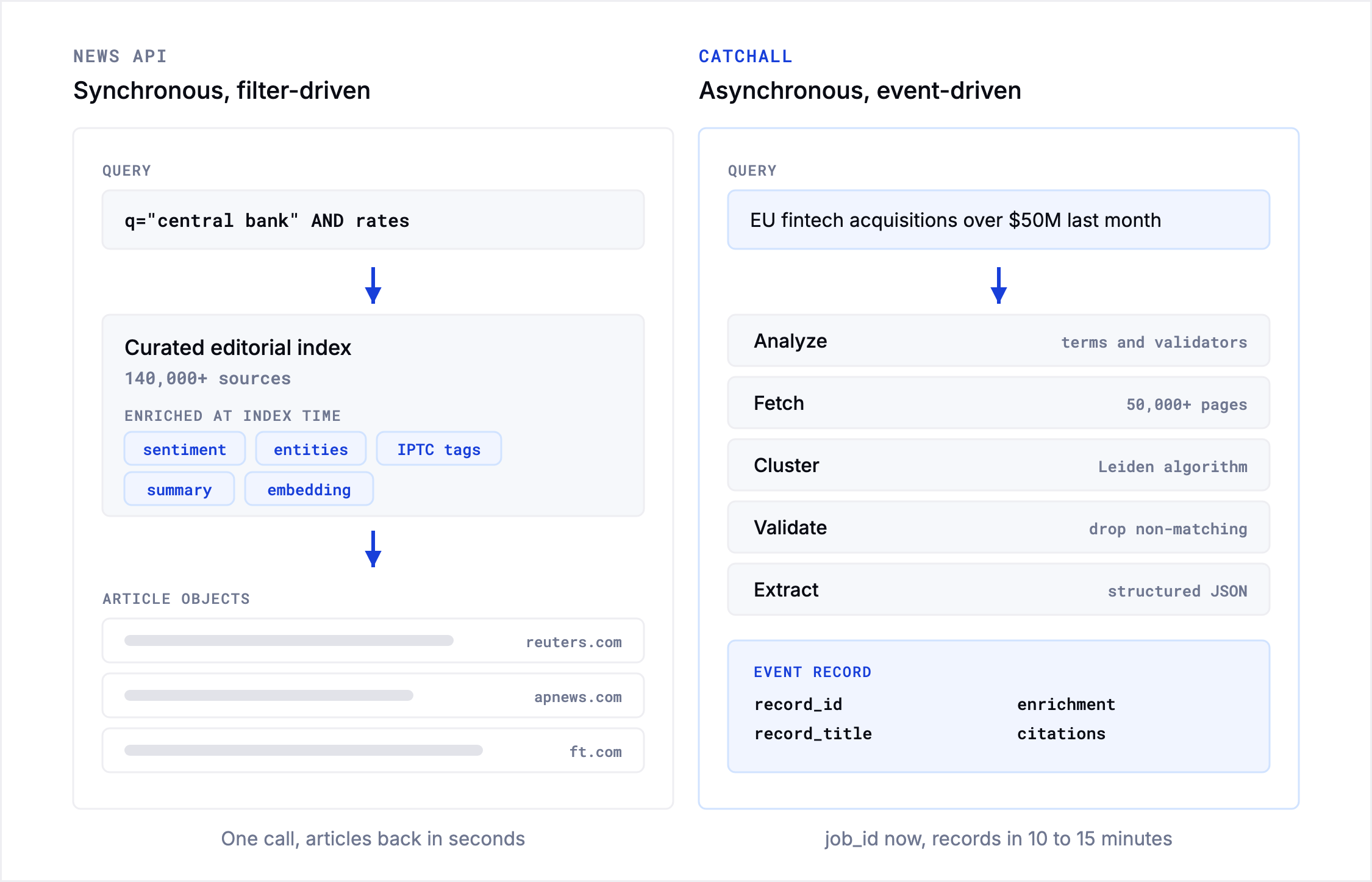
News API is a curated index of published editorial content. Query it with keywords or boolean logic and it returns article-level JSON: headline, publication date, source name, sentiment scores, named entities. Coverage spans 140,000+ monitored sources updated continuously.
CatchAll is built around a different problem. You describe an event in plain language, it processes 50,000+ web pages per job across a 2B+ page index, and returns structured event records with query-specific schemas. Those records are deduplicated and clustered before delivery, so you are not sorting through dozens of syndicated copies of the same story.
The query model difference is where teams most often get tripped up. News API is synchronous and filter-driven. CatchAll is asynchronous; each submission creates a job you poll until results are ready, which requires a different integration pattern than a millisecond-response REST call.
How does the News API retrieval pipeline work?
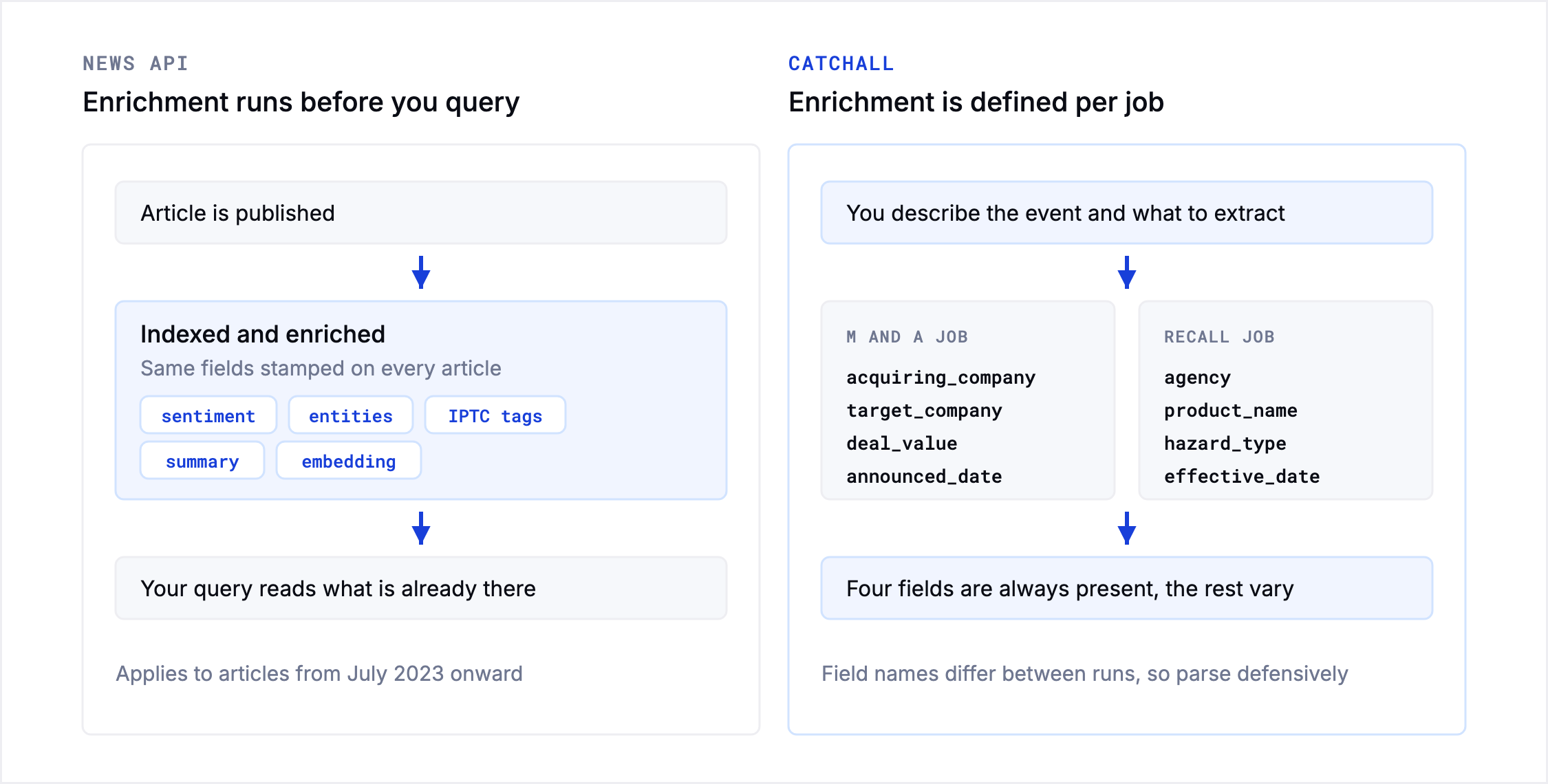
By the time you call the endpoint, sentiment scores, named entities, IPTC topic tags, and AI-generated summaries are already attached to each article object in the index. Language enrichment in News API runs before any query executes.
That enrichment covers original-language content across all 50+ indexed languages. You can search using English keywords against non-English articles, retrieve named entities by English name, and get English translations alongside the original text in the same response.
Filtering options include keyword, boolean logic, theme, language, country, source domain, and date range. Articles appear in the index 5-10 minutes after source publication, which works for near-real-time monitoring. For millisecond-sensitive financial feeds, that lag rules it out.
Rate limits on News API subscriptions are modeled across three dimensions: concurrent calls (up to 10 on an example subscription), a monthly call quota (250,000 calls), and a historical data window (400 days). Concurrency limits cap how many in-flight requests a single API key can hold at once, so parallel consumers share that concurrency budget rather than competing against a per-second counter.
How does the CatchAll event discovery pipeline work?
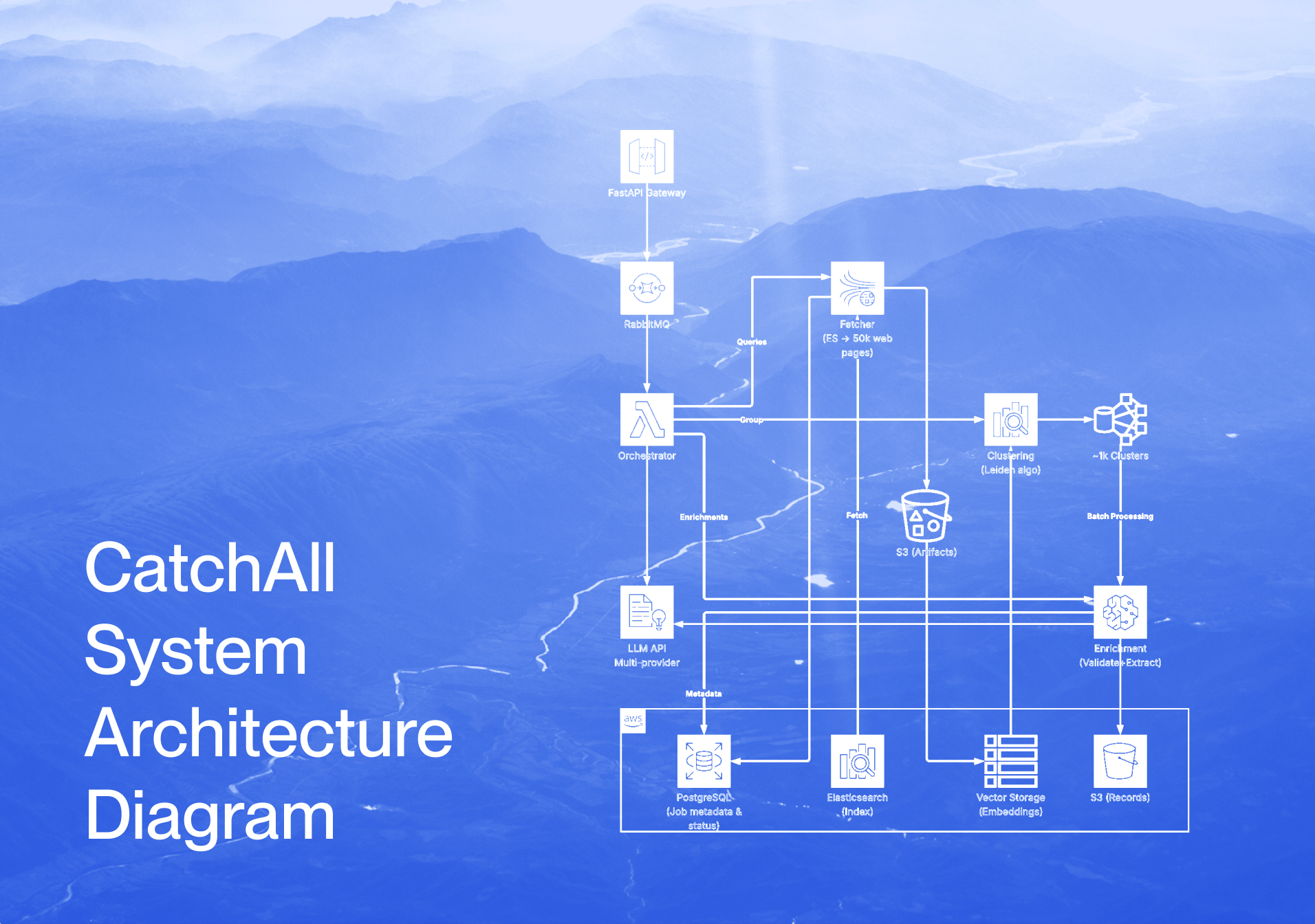
CatchAll processes a natural-language query through five sequential stages before returning a single structured record.
Stage 1 parses your plain-language description into targeted search queries and auto-generates validation rules and extraction patterns. Stage 2 retrieves 50,000+ candidate pages from the proprietary web index. Stage 3 groups related pages into distinct real-world events, treating the same story covered across 40 sources as one event instead of 40 results. Stage 4 applies the generated validators and rejects irrelevant clusters, recovering precision after the earlier stages maximized recall: a deliberate trade-off explained by why recall beats precision for real-world AI research. Stage 5 converts validated clusters into structured JSON with query-specific schemas.
Every record guarantees four fields: record_id, record_title, an enrichment object, and a citations array. Fields inside enrichment are query-scoped and vary by job. Custom enrichments like acquiring_company appear on every validated record; auto-generated field names will differ between runs.
Two job types are available. One-off jobs are submitted manually and results are pulled via API in JSON or CSV; these suit ad hoc research and dataset builds. Recurring monitors run on a scheduled cadence, deduplicate records across all runs, merge the results, and deliver a webhook notification when new results are available, covering JSON and CSV delivery.
The asynchronous model is the biggest integration difference from the News API. Each submission returns a job_id; you poll the status endpoint every 30-60 seconds until results are ready, typically 10-15 minutes. Recurring monitors skip resubmission entirely and push to your webhook on their schedule.
When does the News API fit your use case?
News API fits when your workflow is article-centric and the editorial record matters. If you need to know which outlet broke a story, how sentiment is shifting across a topic over time, or which companies are being mentioned alongside a regulatory announcement, the article-level index is the right layer.
Specific workflows that belong here:
- Media monitoring, PR intelligence, and brand tracking where provenance matters: publication source, geography, and first-coverage timing are first-class fields in every response.
- Financial sentiment pipelines: title-level and body-level sentiment scores are pre-computed at index time, combined with named entity arrays for company and ticker disambiguation, so no separate enrichment step is required before your signal logic runs.
- RAG pipelines and AI agent grounding: full article body text, pre-computed summaries with key fact extraction, and 1024-dimensional embeddings reduce preprocessing before vector ingestion; the corpus is timestamped, multilingual, and source-attributed out of the box. Entity extraction in RAG pipelines benefits directly from pre-computed entity arrays that ship in every News API response.
- Historical research and backtesting: coverage starts January 2019, giving you over five years of enriched articles for training datasets or temporal reasoning workflows.
Where News API does not fit: anything requiring coverage of government portals, regulatory sub-pages, trade publications, or non-indexed domains belongs in CatchAll. Ingestion latency runs 5 to 10 minutes, so sub-5-minute freshness requirements are outside scope. Social media is not covered by either product.
When does CatchAll fit your use case?
CatchAll fits when the answer to your query is spread across thousands of pages and not concentrated in top search results. A ranking-first index surfaces the five most-cited sources and misses the enforcement notice buried on a state agency sub-page or the recall announcement in a niche trade journal. CatchAll indexes government portals, Federal Register filings, state agriculture departments, PMRA, and regulatory press that editorial news indexes systematically underrepresent. For a deeper look at recall in AI search, the architectural reasons behind this gap are covered separately.
Workflows that belong here:
- Regulatory enforcement and compliance monitoring: capturing ingredient bans, registration cancellations, and tolerance changes across .gov, state portals, and niche regulatory press in one structured job
- M&A, funding rounds, and product recalls where you need enumeration across the full web, not a ranked sample of top outlets
- Supply chain disruption tracking: port strikes, border closures, and geopolitical escalations affecting cold chain, delivered as structured event records with location, severity, and transport mode already extracted
- Structured dataset generation: when the downstream system expects validated JSON with extracted entities and citations, not a list of articles to review manually
- Competitive intelligence with company watchlists: scoping a job to a predefined company list via
connected_dataset_idsand filtering byed_score(1 to 10) to separate events where a company is the central subject from records where it is a peripheral mention
Sub-15-minute freshness requirements are incompatible with the 10 to 15 minute async processing window.
How do language enrichment and entity disambiguation differ between the two products?
The enrichment architecture diverges between the two products, and that divergence affects which one fits a given pipeline design.
News API enrichment runs at index time. Every article from July 2023 onward arrives pre-enriched: named entity arrays (ner_PER, ner_ORG, ner_LOC, ner_MISC) with mention frequency counts, title and body sentiment scores, AI-generated summaries, and IPTC topic tags ship in the JSON response. Pre-2023 articles are available but carry no language enrichment metadata.
CatchAll enrichment is query-scoped. You define validators and enrichments either manually or auto-generated per job. The ed_score field (1 to 10) per company record measures whether a company is the central subject of an event or a peripheral mention, which matters when filtering incidental references from material signals in financial or risk workflows.
How do CatchAll and News API work together in a production AI pipeline?
Both products share NewsCatcher's proprietary index but serve different pipeline roles. News API is the retrieval layer for article-level monitoring and RAG, pulling from 140,000+ verified sources with 3M+ articles processed daily. CatchAll is the event discovery layer, searching across 2B+ indexed web pages with 2M+ pages fetched daily.
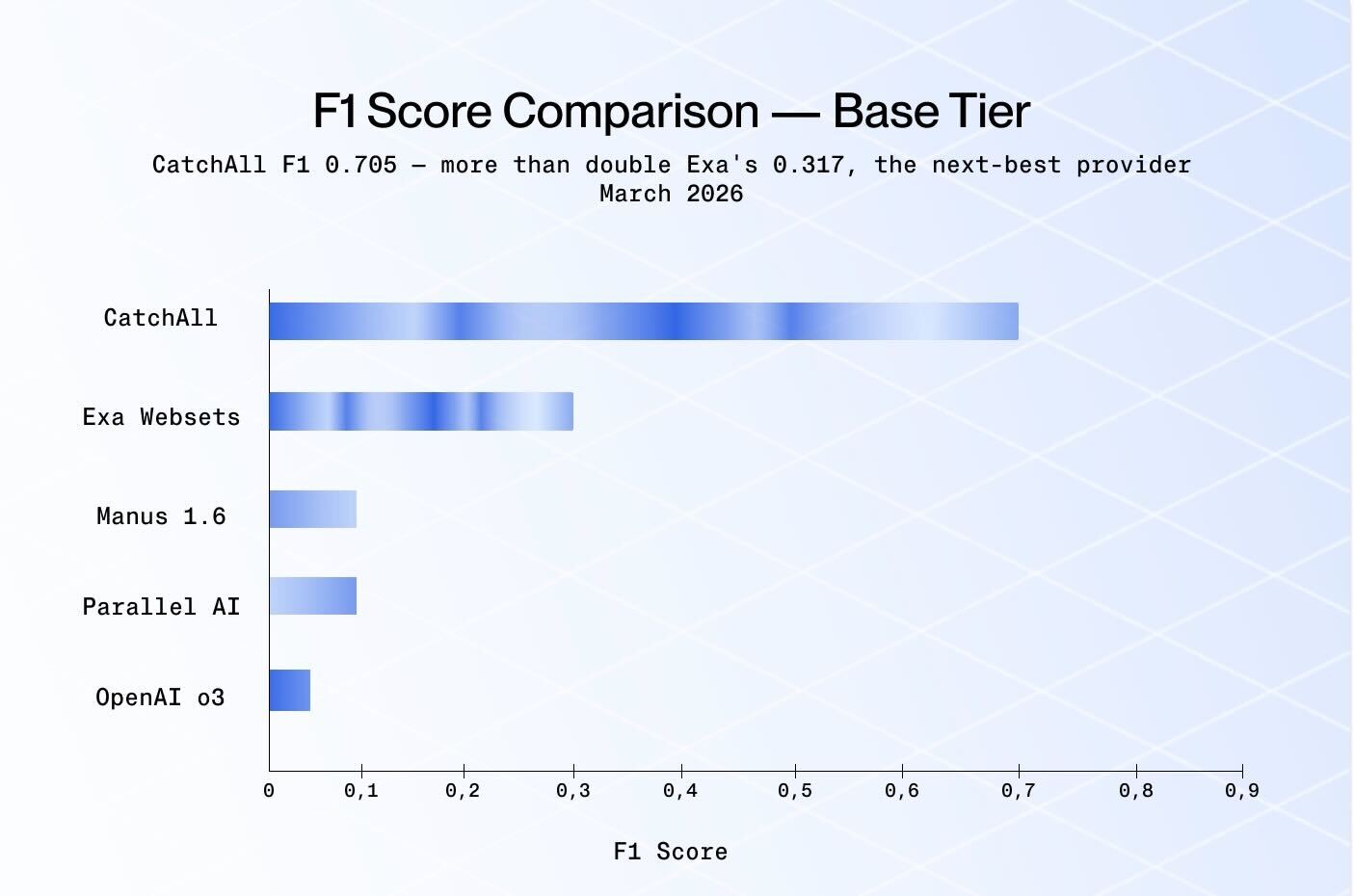
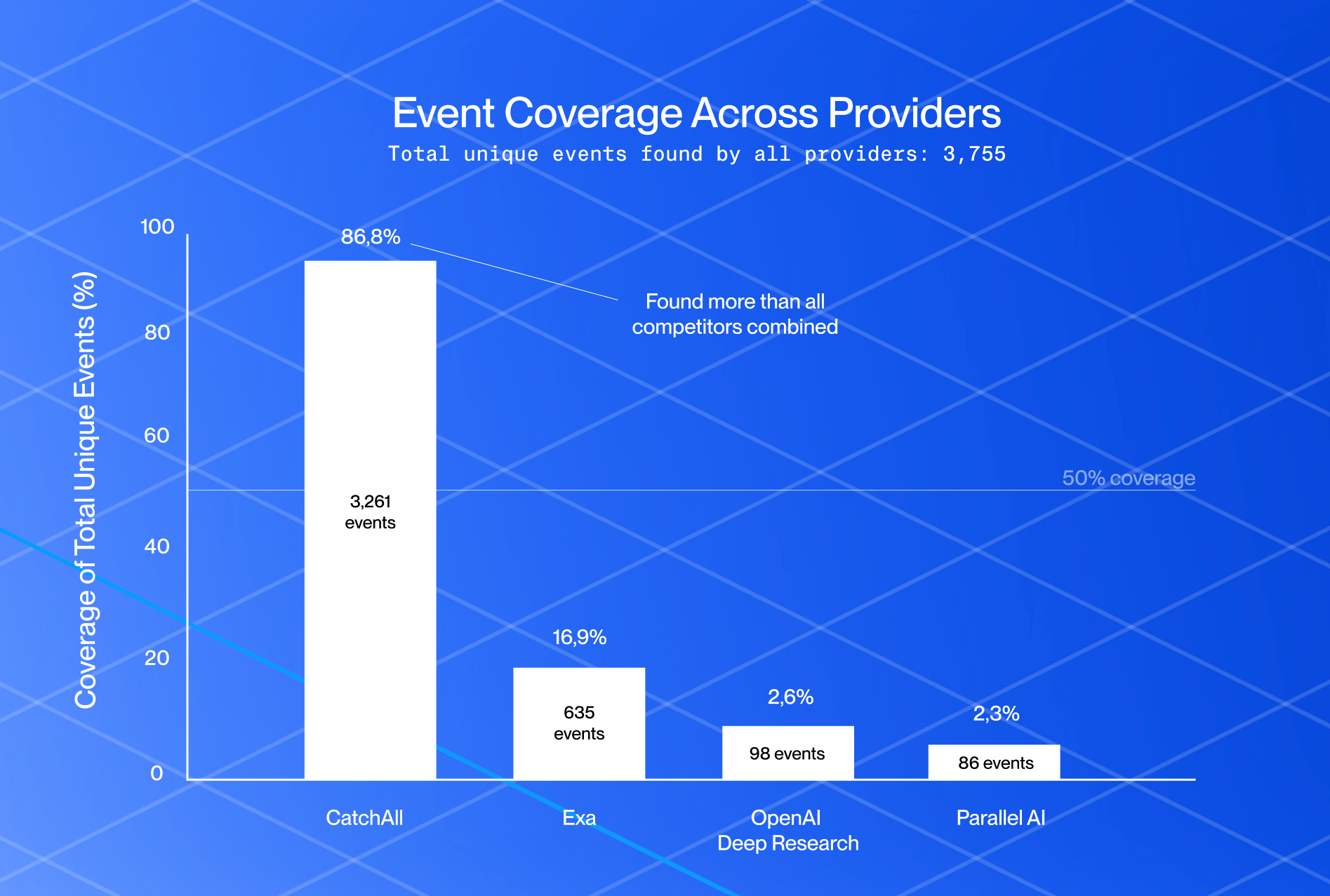
In NewsCatcher's Q1 2026 benchmark across 32 event-detection queries, CatchAll posted an F1 of 0.705 against Exa's 0.317, with recall of 0.798 versus Exa's 0.196, detailed in the full CatchAll vs OpenAI vs Exa recall comparison. That gap reflects architecture, not tuning, as the web search API benchmarks for Q1 2026 show in detail. Ranking-first retrieval concentrates results in top-authority domains; recall-first retrieval collects all matching records before filtering.
A few infrastructure details worth noting for vendor evaluation:
- SDKs cover Python, TypeScript, and Java. Both products have dedicated MCP servers: the News API MCP server (open-sourced at Newscatcher/news-mcp) ships nine tools including
search_articles,get_latest_headlines, andget_breaking_news; the CatchAll MCP server covers job submission, status polling, result retrieval, event monitors, and webhooks. Both support Claude, Cursor, VS Code, Windsurf, Zed, Warp, Gemini CLI, and Roo Code.
The News API free trial gives 2,500 API calls and one year of historical data access over seven days. CatchAll's free tier includes 2,000 credits and 10 searches per month on sign-up, with a structured seven-day enterprise trial that includes a dedicated Slack channel and pre-built query playbooks.
Which product should you choose for production pipelines?
Both products do their jobs well within the scope they were designed for. The decision comes down to whether your pipeline needs filtered article objects in near real time or validated event records from a recall-first web index.
FAQ
How does NewsCatcher's CatchAll compare to Exa for event recall and web coverage?
CatchAll posted an F1 of 0.705 against Exa's 0.317 in NewsCatcher's Q1 2026 benchmark across 32 event-detection queries, with recall of 0.798 versus Exa's 0.196. The gap is architectural: Exa uses a ranking-first retrieval model that concentrates results in high-authority domains, while CatchAll processes 50,000+ pages per job across a 2B+ page proprietary index, deduplicating and clustering related pages into single event records before delivery.
When should you use CatchAll vs. News API for financial intelligence workflows?
Use News API when you need per-article sentiment scores, company entity mentions, and near-real-time article delivery for continuous ticker-level monitoring; pre-computed title and body sentiment scores ship in every article response with no separate enrichment step required. Use CatchAll when you need validated, deduplicated event records for M&A activity, funding rounds, or executive changes across the full web, especially where coverage of niche trade publications and government sources matters more than millisecond latency.




.png)

.png)