









A hands-on comparison of 7 deep research tools, ranked on the six criteria that actually decide research quality, from source coverage to citation accuracy and cost.
Introduction
Deep research tools have been a thing since late 2024, when the first one came out as a feature inside Gemini. The other big AI labs quickly followed, and in 2026, every major AI chatbot has some version of it under slightly different names. The concept is the same: ask a hard question, come back in about 10 minutes, and get a researched report.
Deep research goes beyond a regular AI answer. A basic answer typically searches one time, and then responds based on what it finds. AI deep research tools are basically the same models taking things one step further. They plan a search strategy, run a series of queries, read the results, and put together a report with citations. This can be done through a chat app, although most labs now expose this type of functionality through API as well, making it possible to create automated workflows around your use case.
Most guides stop at which assistant to pick. For example, one recent guide suggests adding Perplexity when you need real research, and leaves it there. That tells you little about the things that actually decide research quality: how it deals with citations and accuracy, and what source coverage and depth the tool is able to provide. That’s why, in this article, we’re comparing the major options on those factors. And we found that a research report, as it turns out, is only as good as the retrieval underneath it.
What Are Deep Research Tools and How Do They Work?
Deep research tools are basically agents that run their own investigation of your question. They plan and carry out a set of searches, read what comes back and figure out the information gaps, then search again until they have a reasonable foundation to answer that question. This typically takes several minutes, and the multi-step process is what separates deep research AI tools from a basic AI answer.
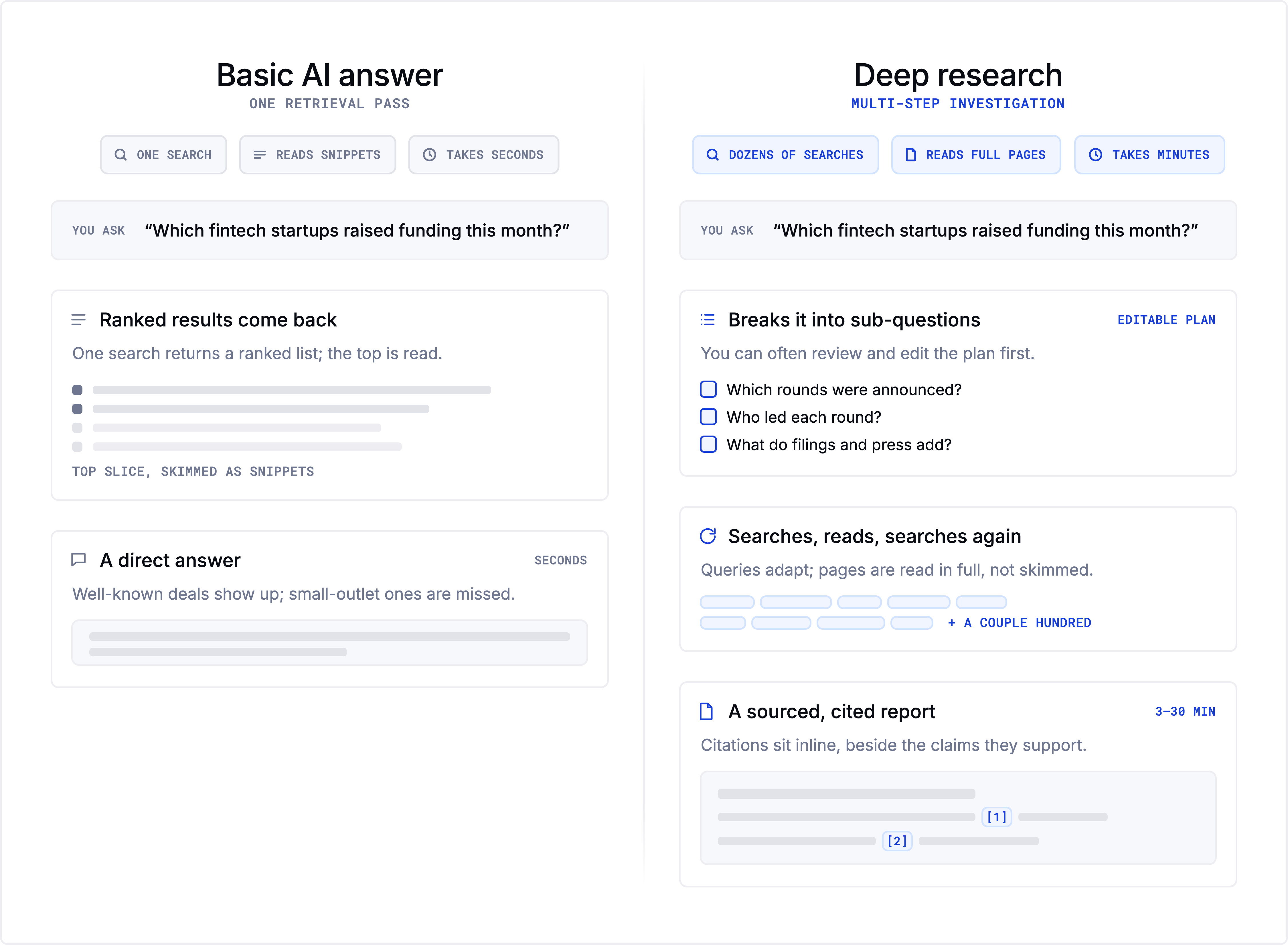
The output you get is usually a structured report with citations. Some domains where it’s often used include market research, journalism backgrounding, investment diligence and literature reviews.
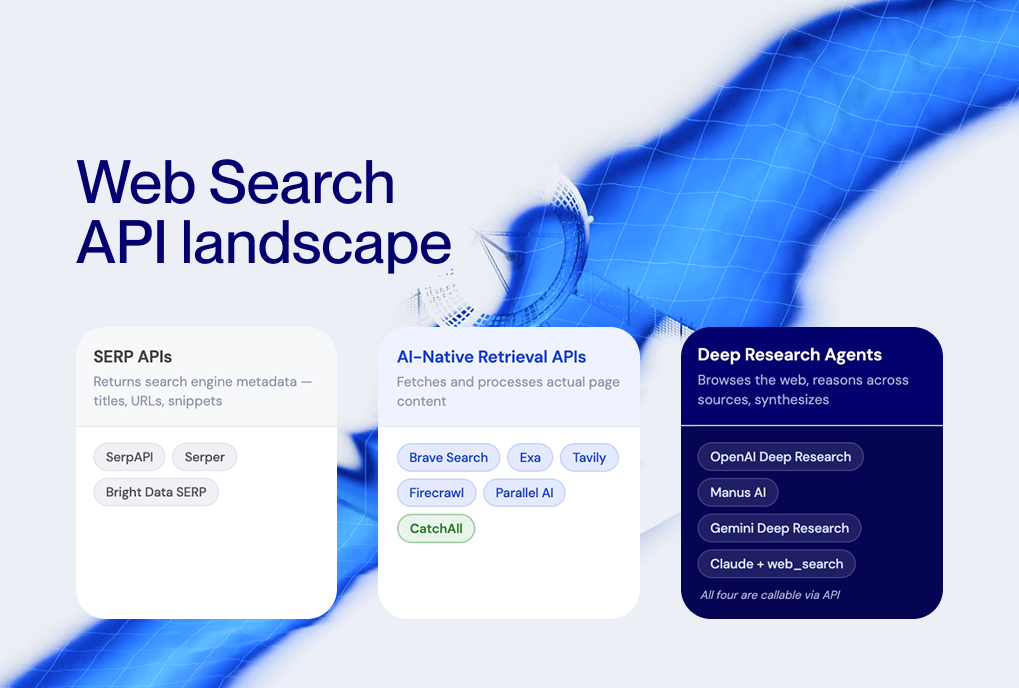
While leading deep research tools are great for most questions, their depth of investigation falls short when the question requires a review of everything that’s relevant about the topic. The reason is that the leading AI agents rely on traditional search engines with a ranking-first approach. This means that, even though they’re going deeper than a single search would, they still operate on a ranked sample that often just scratches the surface of the topic when the information is spread across thousands of pages. You get a good picture of what’s most visible to the search engine underneath, but everything beyond that is ignored.
If what you’re looking for is more of a structured table of events than a report, as part of a pipeline that an agent consumes on a regular basis, there are solid solutions for that too, ones that use a search engine focused on maximizing recall rather than just top-ranked results. We’ll get back to those.
What Makes a Deep Research Tool Actually Effective?
The quality of AI research is less about the model itself than about the information it had access to. We evaluate deep research software on six criteria.
- Source coverage. What the tool actually has access to acts like a ceiling on your research. Chatbots typically use ranking-first search engines (such as Google), where they look within the first pages of results, but not more. Recall-first web search APIs like CatchAll sit at the other end of the spectrum, enumerating every relevant record instead of just the best-ranked ones.
- Citation transparency. All the leading AI tools have inline citations nowadays, so knowing which source the AI used is not really an issue. The real question is whether the cited links actually support the sentences written from them. Independent audits show they often don’t.
- Data freshness. Tools search the live web through a search engine, so freshness comes down to the underlying crawl of that engine.
- Research depth. The number of searches an agent makes can be misleading. What’s often more important is how many sources a search run actually finds, and how many it reads in full rather than judging from a snippet. Again, the underlying search architecture is key. Agents that revise their plan after a first round also tend to do better. And time is typically a decent proxy for how thorough the search is.
- Accuracy and verification. There are benchmarks to help evaluate this aspect, like Humanity’s Last Exam, BrowseComp and DeepResearch Bench. Like most benchmarks, they suffer from being gameable, and are best treated as claims.
- Scalability. A chat window doesn’t scale past one person. If research has to run on a schedule or feed a pipeline, API access, quotas and per-result costs are decision factors you should consider.
What Are the Best Deep Research Tools in 2026?
We ranked these tools on the criteria above, after lots of web research and our own hands-on tests of each platform in July 2026.
| Tool | Source coverage | Citation quality | Freshness | Runtime | Entry price |
|---|---|---|---|---|---|
| CatchAll (recall-first retrieval API, NewsCatcher) | Own 2B+ page event index: regional press, trade publications, filings | Citations on every record; output is structured data, not prose | Continuously updated index (2M+ new events daily); recurring monitors | ~15 min (Base) | Free 2,000 credits, then $0.10 per result |
| OpenAI Deep Research | OpenAI’s own search and browsing stack | Best citation record (2025 agent audit) | Live browsing | 5–30 min | Free (limited); $20/mo Plus; API from $2/1M tokens |
| Gemini Deep Research | Google’s search index, the widest web reach here | Most broken or made-up URLs (2026 URL audit) | Live browsing | 5–30 min | Free (limited); $19.99/mo AI Pro; API ~$1–7/task* |
| Perplexity Deep Research | Perplexity’s own web index | Most unsupported statements (2025 agent audit) | Live browsing | ~3 min (fastest) | Free (5/day); $20/mo Pro; API ~$0.30–1.30/query |
| Claude Research | Anthropic’s own web search | Fewest broken URLs (2026 URL audit) + a citation-checking pass | Live browsing | 5–30 min | $20/mo Pro (no free tier); search API $10/1k |
| Grok DeepSearch | Web search + live X posts, the only one with X access | Worst record (2025 search-engine audit) | Live browsing + real-time X posts | A few minutes | Free (limited); $30/mo SuperGrok; API tools $5/1k |
| Manus | Searches the live web from its own cloud browser | Replayable trail of every page visited | Live browsing | Varies by task (async) | Free (300 credits/day); from $20/mo; API runs on the same credits |
* Vendor-reported / preview pricing. Audits referenced: the 2025 agent audit, the 2025 search-engine audit, and the 2026 URL audit.
CatchAll
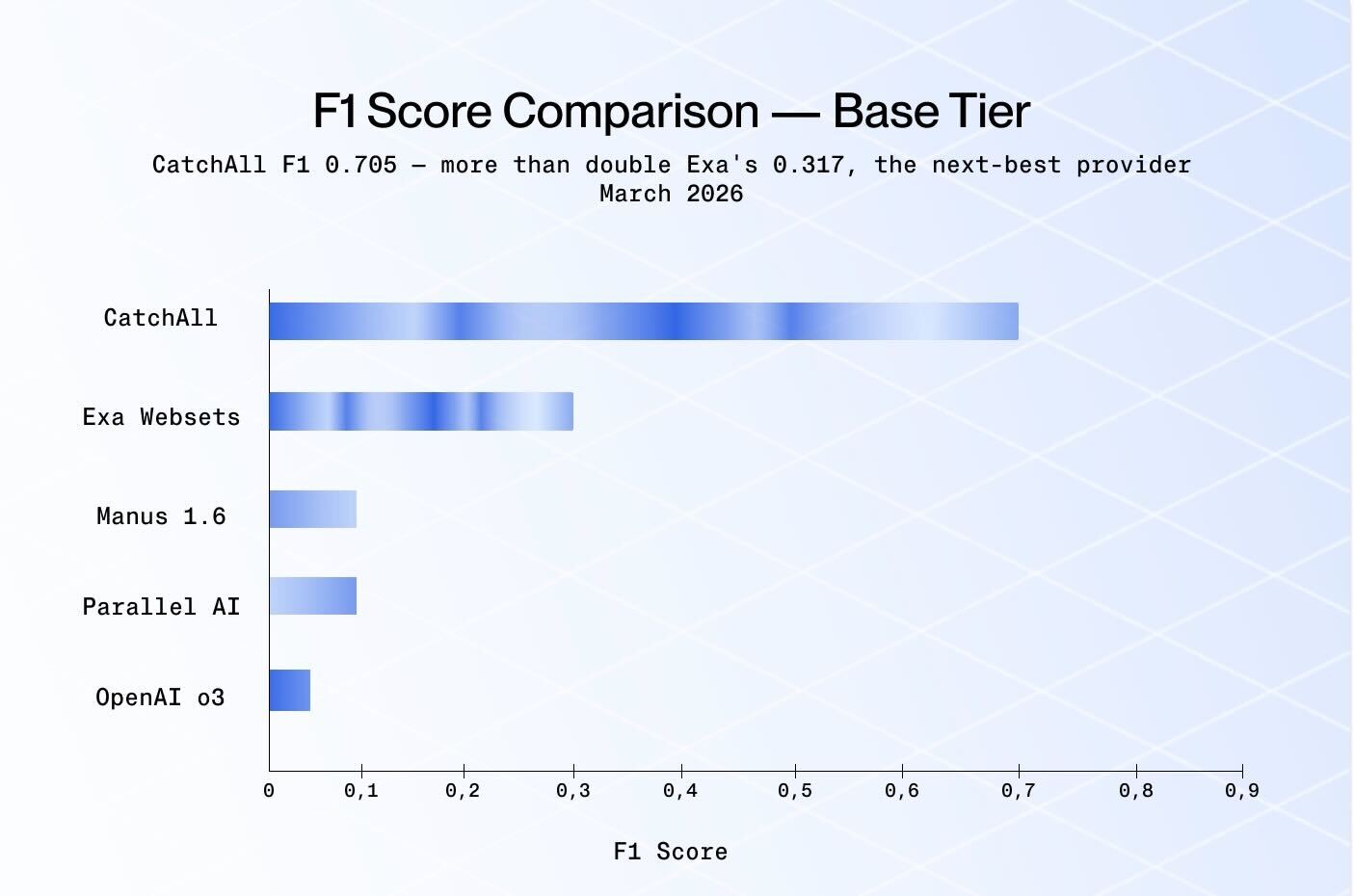
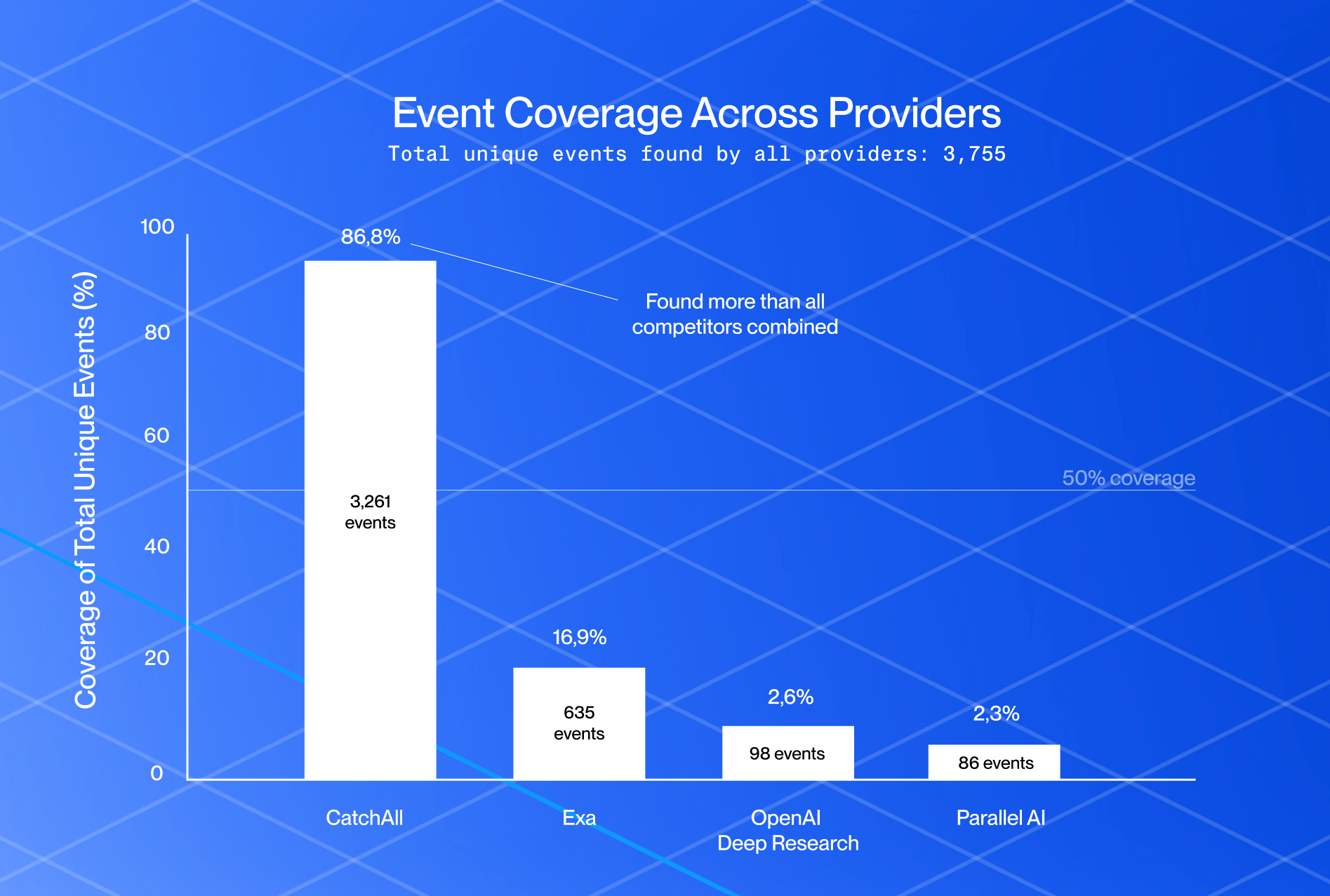
CatchAll is our product, and it sits at a different layer of the research process than the rest of these tools. It’s a recall-first web search API that lets you build datasets based on your query. It gives you structured records of real-world events, after scanning tens of thousands of pages. This allows much better recall than other tools: in our own Q1 2026 benchmark across 32 event queries, CatchAll found 4,807 relevant events. Manus found 342, and OpenAI’s deep research found 53.
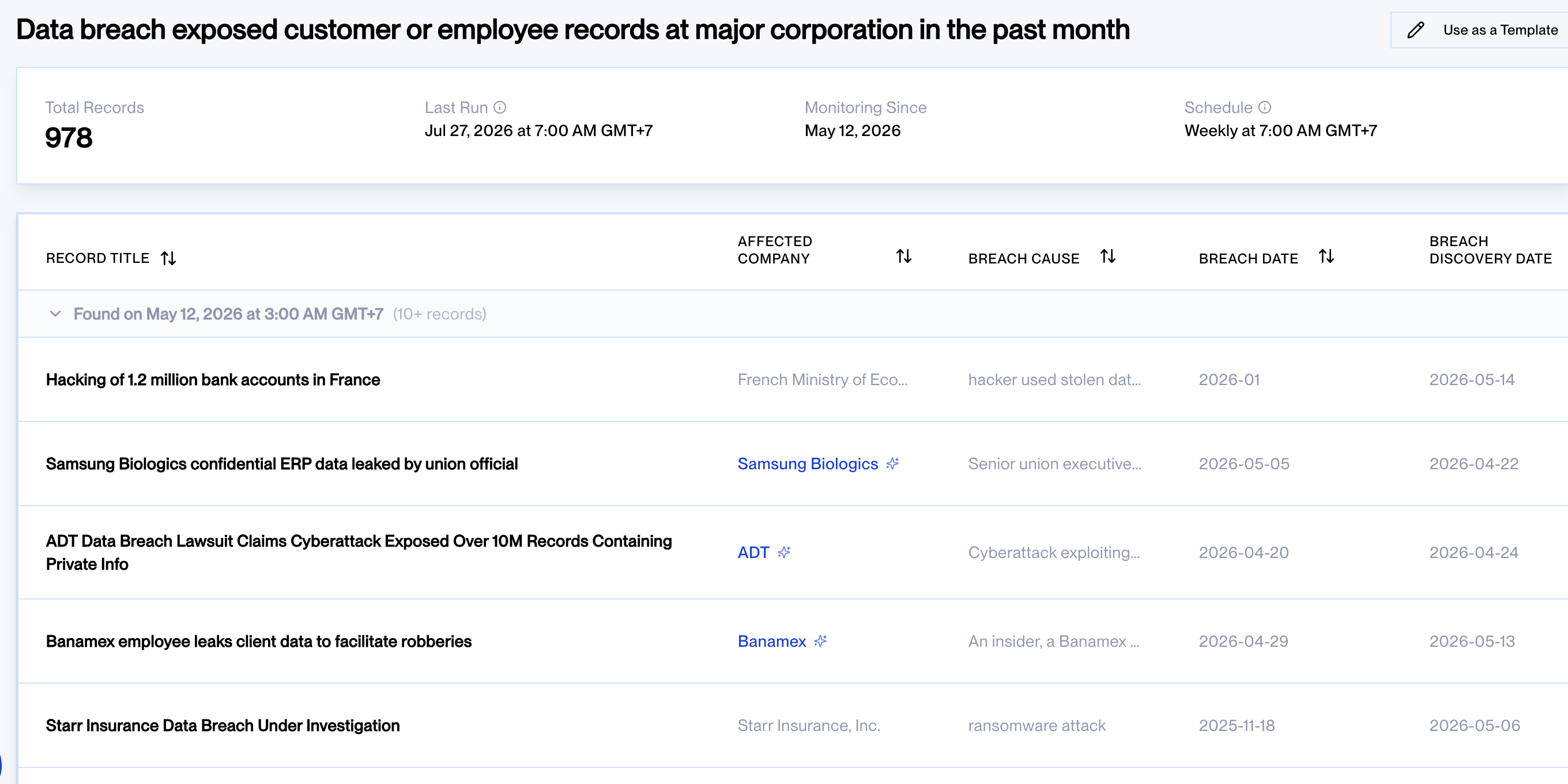
Going beyond top-ranked results does take time; CatchAll typically takes 15 minutes or more on a search job, in exchange for much better coverage.
OpenAI Deep Research
OpenAI’s Deep Research has the best citation record of the tools tested in 2025, scoring highest on both citation accuracy and how thoroughly it backed its claims. They’ve also made it easy to give the agent access to uploaded files and context from connected apps.
On DeepResearch Bench it sits right next to Gemini for instruction following, meaning how accurately it follows the brief it was given.
A run takes 5 to 30 minutes. Through the API it costs around $2 per million tokens, which is decent for automation.
Gemini Deep Research
Gemini has an edge on search volume and price. Unsurprisingly, it uses Google to search, and often does anywhere from dozens to more than a hundred queries for a research question. It’s worth keeping in mind that searching broadly isn’t the same as covering everything; it still very much works from ranked search results. Gemini also lets you review and edit the research plan before it starts, which helps steer things in the right direction.
Deep Research is included on all of Google’s AI plans with caps that rise by tier, and it’s the cheapest of the major options to run through an API.
Perplexity Deep Research
Perplexity is the fastest alternative, and with most runs finishing in under three minutes, a good choice for a quick overview of a topic. The catch is how little you can actually verify. In a 2025 audit of deep research systems, it was found to source its claims the least thoroughly of anything tested, with 97.5% of the statements in its reports being unsupported by the sources it had listed. So you get an answer fast, and directionally it’s useful, just know that the details it writes probably won’t hold up to scrutiny.
Claude Research
Claude is a solid choice when your sources aren’t only on the web. It has strong integrations with apps like Gmail, Docs and Jira, and can use them as context, alongside the web results. There’s also a dedicated step in the process for tying claims back to sources after drafting, which means well-supported citations.
Unlike most tools, with a paid Claude subscription, you can use Research on your plan’s general usage limits rather than a separate allowance.
Claude also doesn’t have a Research endpoint in its API. To use Research programmatically, you’ll need to assemble the process from the parts (Messages API’s web search tool and Managed Agents). Luckily, they’ve documented this properly: there’s an engineering write-up and a working demo agent.
Grok DeepSearch
Grok’s DeepSearch is best reserved for when you need access to information from X. It runs search across web and X together, which makes it strong on breaking stories and sentiment. As with Perplexity, citations are where it struggles. In a 2025 audit Grok came last of the eight engines tested, with 154 of its 200 citations leading to error pages. That audit covered its search product rather than DeepSearch, and it predates the current model, but nothing published since has cleared it either.
Manus
Manus is positioned as an “action engine” that does things rather than just reporting on them. It has its own cloud browser so you can watch while the agent searches. It also keeps a convenient trail of every page it visits, which you can replay. That’s strong documentation of provenance alongside the citation list.
Manus is known to be hungry on credits, though. On the $20 plan, you typically only have enough credits for 4 to 8 deep runs per month.
Which Deep Research Tool Is Best for Different Use Cases?
| Use case | Top pick | Runner-up | Why |
|---|---|---|---|
| Market intelligence | Gemini Deep Research (for ad-hoc scans) + CatchAll (for continuous monitoring) | OpenAI Deep Research | Gemini’s source breadth and price win on one-off scans of the landscape. For continuous monitoring of a query, deduplicated retrieval, and more, CatchAll is the best alternative. |
| Journalists | OpenAI Deep Research | Grok (live X reaction) | Best citation record of the tools tested, which is the thing you cannot compromise on here. Grok is the only one reading live X, so it is the runner-up for public reaction. |
| Investors & analysts | OpenAI Deep Research | Claude Research (citation checking) | Longest, most structured reports, and it reads PDFs, filings and investor decks. |
| AI agents & automation | CatchAll | OpenAI Deep Research API | Structured JSON event records, recurring monitors, webhooks, deduplication, and 79.8% observable recall in our Q1 2026 benchmark. |
Best Deep Research Tool for Market Intelligence
For market research tasks you’ll run once, Gemini Deep Research is the strongest pick, with a wide source reach at a low price. That said, market intelligence tasks are often also better to run on a schedule, as the landscape develops quickly.
Furthermore, its search depth is still shallow compared to dedicated web search APIs. Tracking things like competitors, funding rounds, and product launches works much better with a recall-first search tool that deduplicates events and makes scheduled runs easy. CatchAll is made exactly for this. It returns events as structured data, which you can use directly in your research pipeline.
Best Deep Research Tool for Journalists
OpenAI Deep Research is the pick when the work has to stand up to scrutiny. Its citation record was the best of the tools tested, which counts for more in journalism than most other domains.
Grok is the runner-up, but for a different reason. It’s the only one reading live X posts, which might be the quickest way to see how a story is received by the public. Its own citation record is poor though, so don’t treat results as facts.
Best Deep Research Tool for Investors and Analysts
OpenAI’s Deep Research wins this use case for its strong citation record. It also reads and cites PDFs seamlessly, which is the format of most filings and investor decks.
One gap quickly becomes obvious for investment research with AI. Earnings call transcripts, broker research and expert network calls are licensed rather than public, so open-web agents can’t reach them. That’s what platforms like AlphaSense or Hebbia are for, and analysts typically run both. The open web gets you some of the picture, but not all of it.
Best Deep Research Tool for AI Agents and Automation
For building agents and pipelines that do research, coverage is what matters most. Agents also benefit from structured data, ideally deduplicated, cited, and arriving on a schedule.
CatchAll is built for this: it has far better recall than a traditional search engine which uses rankings to decide what’s relevant. To illustrate the difference: in our own Q1 2026 benchmark across 32 queries about real-world events, CatchAll found 80% of everything findable, while OpenAI’s deep research found 1%. CatchAll’s index also carries the full page context, not just snippets, which helps find relevant sources.
It’s also built to fit directly into your pipeline and pair well with any agent: it returns JSON event records, uses webhooks, and makes recurring monitors easy. We walk through a working setup in our CatchAll and LangChain guide.
Why Do Some Deep Research Tools Find Better Sources Than Others?
The source coverage of a given deep research tool is strongly tied to the characteristics of the search underneath it.
A search engine like Google, which is the type most AI tools use, is designed to answer a question well. It puts the pages with the most authority first, which is exactly what you want when one good answer is enough. At the same time, that leaves a lot of what’s actually out there undiscovered, which might or might not be a problem depending on your use case.
For example, a legitimate event that only got covered by a regional paper or a niche trade blog rarely ranks in Google, because those outlets often carry little authority weight. Paywalled archives and social platforms sit outside most crawls entirely.
How deep a search goes on each page also matters. A tool that judges twenty snippets and a tool that reads two hundred pages in full end up with very different pictures of the same story. What doesn’t seem to help is making the model think harder. In independent testing, three of the four leading agents scored the same or worse when their effort settings were turned up, a result known as the effort paradox. The bottom line is that if the search didn’t surface something, no amount of reasoning brings it back.
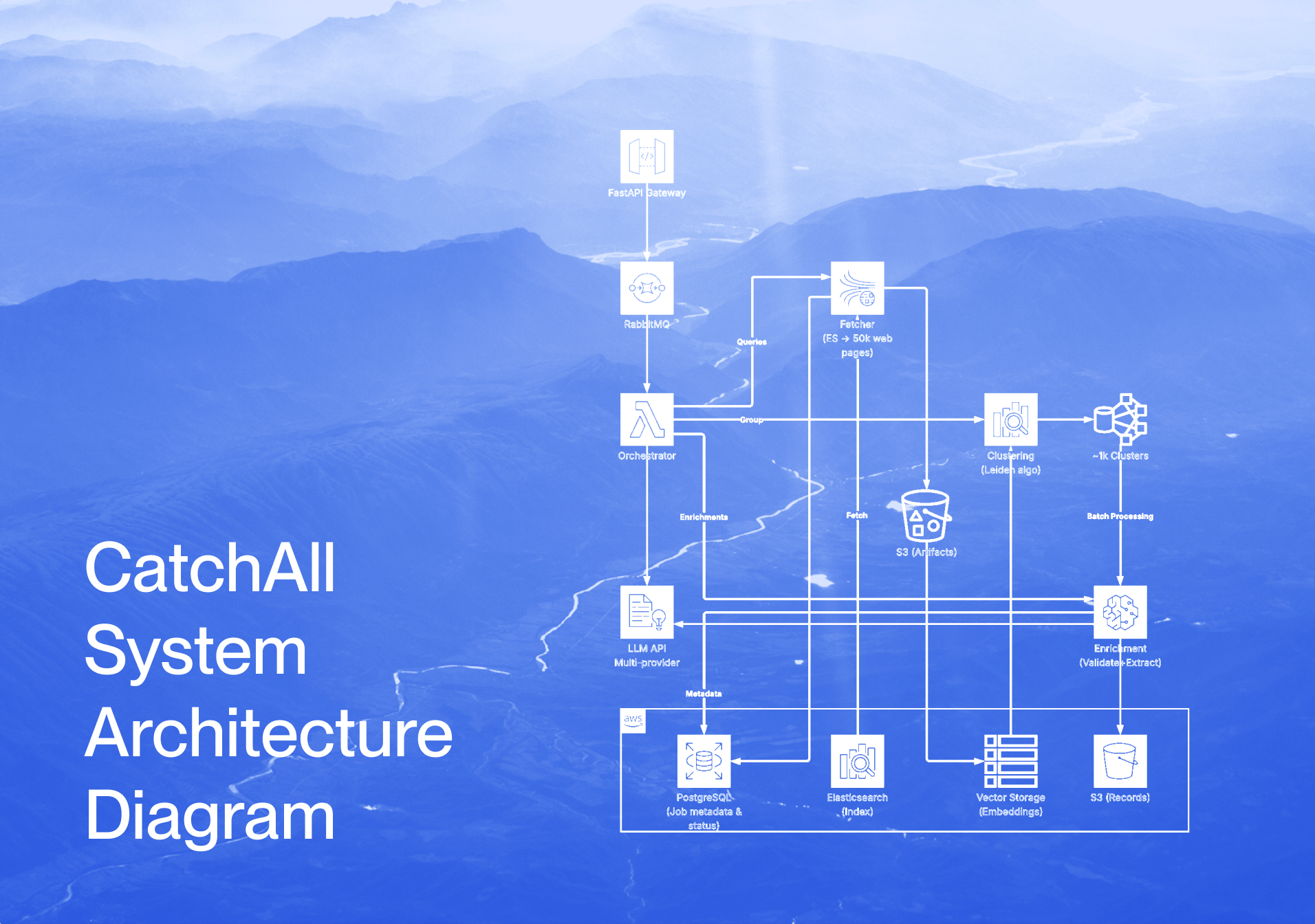
On the opposite end of ranking-first search engines, you have tools built for comprehensive retrieval. Our CatchAll web search API doesn’t settle for the ten best pages for a query, but instead searches and collects every record that matches your description. A typical search job reviews around 50,000 pages, then validates and deduplicates what it found based on the actual page content into structured event records with citations, no manual searching or HTML scraping involved. That completeness is what improves the accuracy, source diversity and fact verification of whatever report or agent sits on top. We wrote up how we rebuilt search around this idea, and our guide to the best web search APIs compares the options.
Can AI Research Tools Miss Important Information?
They can, and the way in which they do can often seem a bit cunning. A deep research report typically gives an idea of completeness. But as we’ve shown, a lot of what is actually out there is never reviewed when that research is based on ranking-first search infrastructure. A finished report typically gives no hint of what was never considered, so it’s easy to assume it’s complete when it isn’t.
An important reason for this is source bias. Ranking-first search engines favor high-authority websites and heavily covered stories. That preference carries straight into the report. Our own security-breaches analysis shows how skewed things get; of the 272 incidents we found in a three-day window, the top 20 pulled almost three quarters of the coverage, while two thirds were mentioned in just one place. Single-source events like that rarely make it into a ranked result set, so the more fragmented the coverage of a topic, the more a report built on ranked search will miss.
The second failure mode is about inaccuracy. These are the cases where a source was found, but the report misuses it. When Tow Center tested eight AI search engines, most of them answered citation questions wrong more often than right. A 2025 audit measured the extreme of it, finding that 97.5% of the statements in Perplexity’s deep research reports weren’t supported by their own cited sources. A study from 2026 added that the worst offenders invent roughly one cited URL in eight. All of this makes unverified output a real risk wherever a wrong answer costs you something, which is why the better teams build verification into the workflow itself.
How Can You Build a Better Deep Research Workflow?
Start with your goal, then pick a tool. For a quick view of a topic, Perplexity gets you a cited overview in minutes. For a one-off piece of research with citations that hold up, OpenAI’s deep research is the strongest option right now. It is not either-or — you can combine tools depending on what you’re trying to achieve.
Verifying sources is made easier by tools with strong accuracy on citations, like OpenAI’s and Claude’s research modes. Double-check the links behind claims you plan to act on. It’s also important to understand what your tool is likely to hand you. Any research running on ranked search (such as Google) inherits its bias toward high-authority outlets, so assume the long tail of information is missing.
If you have the same research need over and over again, it’s time to move it out of the chat window entirely. The best way is to run it through an API, on a schedule. CatchAll lets you attach a monitor to a search job, so new results keep arriving automatically. And it comes in the form of structured data, meaning your team or pipeline can consume it easily.
If you’re considering using a deep research tool in your pipeline, one number worth checking is the cost per usable result. In our own Q1 2026 benchmark, each validated event cost $0.185 through CatchAll, roughly 4x cheaper than through Manus or OpenAI’s deep research. Most tools charge the same whether a run comes back with two events or two hundred, so thin recall could easily get expensive per record even when the per-call price looks cheap.
The table below shows what each tool offers programmatically, as of July 2026.
| Tool | API | What you pay for (as of July 2026) |
|---|---|---|
| CatchAll | REST API + MCP + recurring monitors | Per result found: $0.10 per validated record |
| OpenAI | Deep research via the Responses API (background jobs + webhooks) | Per token: $2 to $40 per 1M depending on model tier, so cost tracks report length |
| Perplexity | Sonar API (async deep research jobs) | Per query: about $0.30 to $1.30, known before you run it |
| Gemini | Interactions API (preview) | Per task: about $1 to $7, known before you run it |
| Claude | Web search tool in the Messages API + Managed Agents for scheduled runs | Per search plus tokens: $10 per 1,000 searches |
| Grok | web_search and x_search tools in its API | Per call plus tokens: $5 per 1,000 calls |
| Manus | REST API + webhooks (runs on plan credits) | Prepaid credits: 500 to 900 per deep run |
Summary
We compared the major deep research tools of 2026 hands-on, from OpenAI and Gemini to Perplexity, Claude, Grok and Manus. They’re genuinely useful, and there’s no single winner. Gemini has the widest reach, Perplexity is the fastest, OpenAI has the citation record that holds up, Claude brings your workspace into the research, Grok reads live X, and Manus turns research into finished deliverables.
The pattern behind all of them is that report quality is capped by retrieval. Every tool takes on the strengths and blind spots of the search underneath it, and ranked search only reads the visible top of the pile. Independent audits also keep finding citations that don’t support their claims, so verify anything you plan to act on.
When your research question is really a dataset question, that’s what our CatchAll web search API is built for. It returns complete, structured event data instead of a ranked sample, you can try it with 2,000 free credits, and a monitor will keep the dataset updating on its own.
FAQs
Which AI tools are better for deep research?
It depends on the job. As of 2026, Gemini Deep Research covers the widest slice of the open web, OpenAI produces the longest, most structured reports, Perplexity is the fastest first pass, Claude Research blends your own workspace with the web, and Grok adds live X (Twitter) coverage. When completeness matters more than a polished report, or when you’re feeding an automated pipeline, a recall-first retrieval API like CatchAll finds the events those tools miss.
Are there free deep research tools?
Yes, as of 2026, Gemini, ChatGPT and Grok all include limited free deep research runs, Perplexity gives free users five a day, and CatchAll includes 2,000 free credits on signup.
Can you trust deep research citations?
Not blindly. In one 2025 audit, AI search tools failed citation tests more than 60% of the time, and a 2026 study found that even the top agents hallucinate roughly 3–13% of cited URLs. Spot-check the claims you plan to act on, and remember that report quality is capped by what the retrieval step actually found.



.png)
.png)