










Pulling news into a model or monitoring tool is one of those jobs that's easy right up until it isn't. Getting the articles was never the hard part. What you need is labeled data, and if the labels don't come with the feed, someone on your team is building that layer — which takes time most teams just don't have. So it pays to know what a news API can pre-compute for you. Sentiment scores, entity tags, topic clusters: once you see the list, the build-or-skip decisions mostly make themselves.
TLDR:
- News API enrichment converts raw article text into pre-labeled metadata fields, including sentiment scores, named entities, and topic tags at index time.
- Article-level sentiment returns two independent scores (one for the title, one for the content), each ranging from -1.0 to 1.0.
- Embedding-based clustering deduplicates articles by meaning, reducing token costs for LLM pipelines before your model processes any content.
- IAB and IPTC taxonomy tags attach to articles as machine-readable codes, letting you filter by category without parsing raw text.
- Pre-computed enrichment works well for general news domains; domain-specific corpora like clinical or legal text require a custom model on top.
- Summaries computed at index time keep retrieval fast, no added latency per query.
What is NLP enrichment in a news API?
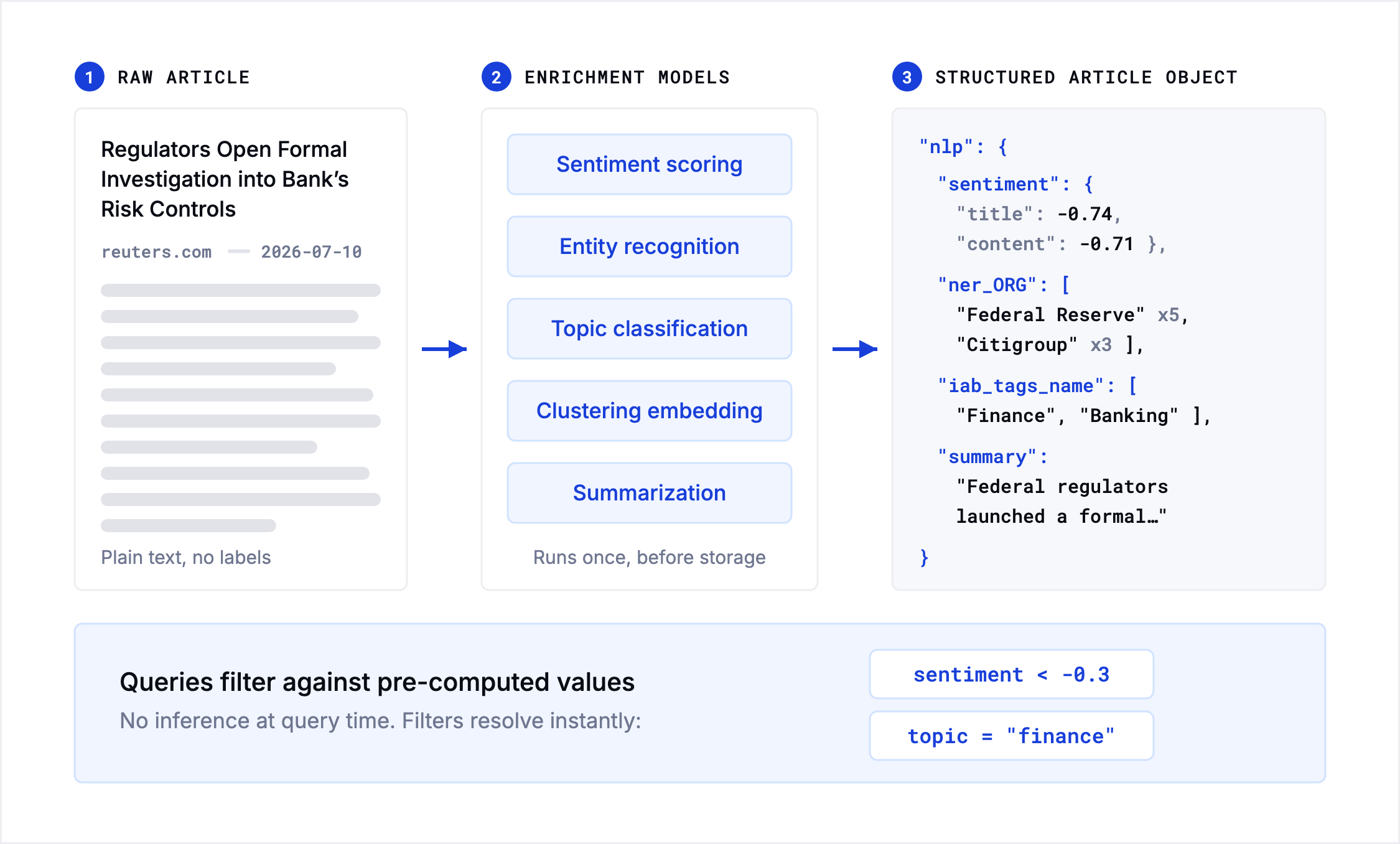
NLP enrichment is the processing the API does to an article before you ever see it. The raw text goes in; what comes out the other side is an article object carrying its own metadata: sentiment scores, named entities, topic tags, a summary. You query the labels, not the prose.
Why engineers care is simple enough. Fine-tuning, RAG, signal detection — every one of them runs on labeled data, and labels that arrive with the article are labels nobody on your team has to produce.
How is NLP enrichment applied at index time?
The enrichment happens the moment an article lands in the index, before anything gets stored. Each article is parsed and handed off to a series of models that extract entities, assign sentiment scores, classify topics, and tag relevant categories. All of that output gets written into structured fields alongside the raw content. By the time a query hits the API, the enrichment is already done, so filters like sentiment < -0.3 or topic = "finance" resolve instantly against pre-computed values rather than running inference on demand.
What does article-level sentiment analysis return?
Article-level sentiment returns two independent scores: one for the title and one for the content body, each ranging from -1.0 to 1.0. Running news sentiment analysis across both fields gives a more complete picture of tone than headline-only models.
Having separate title and content scores matters in practice. A headline's job is to get clicked, and tone mostly gets in the way of that. Score headlines alone and you'll mark a pile of articles neutral when the body text is anything but. "CEO steps down amid investigation" — is that bad news? From six words, who knows. By the third paragraph there's no question. Comparing title and content scores also surfaces cases where a neutral headline masks a strongly-toned article body.
For volume-level tracking, this is the field you'd aggregate. If you're monitoring brand coverage or a regulatory topic across thousands of articles per day, plotting the numeric score over time shows directional tone changes without requiring you to read individual pieces.
What named entities does a news API extract?
Named entity recognition (NER) might be the single most useful thing a news API hands you. The who and the what of every article, already pulled out and structured. No running your own models over raw text to find out that an article about Citigroup is, in fact, about Citigroup.
What Entity Types Are Typically Extracted?
Most news APIs with NER support extract entities across several core categories:
- Persons: named individuals mentioned in the article, often with role or affiliation context, plus a mention count
- Organizations: companies, government bodies, NGOs, and other institutions, plus a mention count
- Locations: countries, cities, regions, and geographic landmarks, plus a mention count
- Miscellaneous entities: other named references that don't fit the above categories, each with a mention count
Higher-quality APIs go further, using entity resolution to link extracted entities to knowledge bases so "Apple" in a tech article resolves differently than "Apple" in an agriculture piece.
How do IAB and IPTC taxonomy tags work for news categorization?
Two taxonomies do most of the heavy lifting for news categorization: IAB Content Taxonomy and IPTC Media Topics.
IAB Content Taxonomy
The IAB Content Taxonomy groups content into standardized tiers. A tier-1 label might be "Finance," while tier-2 narrows it to "Investing," and tier-3 to "Stocks and Bonds." Ad tech systems and brand-safety filters read these natively, so articles tagged this way slot into existing pipelines without extra mapping work.
IPTC Media Topics
The IPTC Media Topics schema covers editorial categorization at similar depth, with roughly 1,400 subject codes organized hierarchically. It's the journalism industry's standard, widely adopted by wire services and newsrooms.
Both taxonomies attach to articles as machine-readable codes alongside human-readable labels, letting you filter by category without parsing raw text.
How does embedding-based clustering reduce news noise?
Article embeddings group articles by meaning, not by shared keywords. When fifty outlets write up the same event, all fifty land in the same cluster, and your pipeline gets one story instead of fifty takes on it. The noise is gone before your LLM reads a single token — which is exactly where you want it gone if you're paying by the token or trying to keep an agent fast. There's a bonus, too: clusters keep collecting related coverage as days pass, so Tuesday's announcement and Friday's follow-up arrive as one thread without you connecting them by hand.
What are news article summaries used for in AI pipelines?
Summarization enrichment is what it sounds like: each article carries a short version of itself in a separate field. How that short version gets made varies. Some are extractive, meaning real sentences pulled straight out of the text. Some are abstractive, meaning the content gets rephrased into something tighter.
For RAG pipelines, summaries cut token costs by feeding compact representations into the context window instead of full articles. For monitoring dashboards, they let analysts triage dozens of stories without opening each piece individually.
Running summarization at query time adds latency to every request. Summaries computed at index time absorb that cost once, keeping retrieval fast regardless of how many articles a query returns.
What does an enriched news API JSON response look like?
Below is a trimmed but representative response. The full response wraps articles in a top-level envelope. The nlp field is where all enrichment lives, nested inside each article object.
{ "status": "ok", "total_hits": 1, "page": 1, "total_pages": 1, "page_size": 1, "articles": [ { "title": "Regulators Open Formal Investigation into Bank's Risk Controls", "published_date": "2026-07-10 09:15:00", "domain_url": "reuters.com", "nlp": { "theme": "Finance, Politics, Law", "summary": "Federal regulators launched a formal investigation into compliance failures at a major US bank, citing inadequate internal risk controls.", "sentiment": { "title": -0.74, "content": -0.71 }, "ner_PER": [], "ner_ORG": [ { "entity_name": "Federal Reserve", "count": 5 }, { "entity_name": "Citigroup", "count": 3 } ], "ner_LOC": [ { "entity_name": "Washington D.C.", "count": 2 } ], "ner_MISC": [], "iab_tags_name": ["Finance", "Banking", "Government and Politics"], "iptc_tags_name": [ "economy, business and finance", "banking and credit", "crime, law and justice" ] } } ], "user_input": { "q": "bank risk controls investigation", "lang": "en", "include_nlp_data": true }
}
Both sentiment.title (-0.74) and sentiment.content (-0.71) read as clearly negative. Named entities are split across four typed fields (ner_PER, ner_ORG, ner_LOC, ner_MISC), each returning an array of objects with an entity_name and a count of how many times it appears in the article. The iab_tags_name and iptc_tags_name arrays carry both taxonomies, so downstream filters can read either without extra mapping. Every field resolves at query time against pre-computed values.
When should you use API-native NLP vs. a custom pipeline?
The right choice depends on two variables: how specialized your domain is and how much engineering time you can spend before shipping.
API-native enrichment makes sense when your use case covers general news categories like finance, politics, or business, when you need to ship in days rather than quarters, or when your team has no dedicated AI research capacity.
A custom pipeline earns its cost when your content is domain-specific (biomedical literature, legal filings, regulatory text), when you need to train a custom NER model for entity types the API doesn't extract by default, or when your volume is high enough that a fine-tuned model's accuracy gains justify training and maintenance overhead.
What are the limits of pre-computed enrichment?
Pre-computed enrichment has a real ceiling. Models run at index time are general-purpose, so they perform well across broad news but degrade on niche corpora. Sentiment scoring on clinical trial coverage, for instance, will misread neutral scientific language as negative. If precision matters in a specialized domain, a custom layer on top of the raw article text is the more defensible choice.
Which NLP enrichments matter most for each use case?
The enrichment fields that matter depend entirely on what your pipeline does with the data.
| Use case | Article sentiment | Named entities | Clustering | Topics (IAB/IPTC) | Summaries |
|---|---|---|---|---|---|
| Media monitoring | Critical | Useful | Critical | Useful | Useful |
| Financial intelligence | Critical | Critical | Useful | Optional | Optional |
| AI training / RAG | Optional | Critical | Critical | Critical | Critical |
| Competitive intelligence | Optional | Critical | Optional | Useful | Useful |
Across most general news use cases, named entities and clustering do the heaviest lifting. For financial intelligence and competitive intelligence, named entities are what make the signal specific: knowing which companies and people an article covers shapes what you can filter and aggregate.
How does NewsCatcher's News API deliver NLP enrichment?
NLP enrichment runs at index time across 140,000+ global sources, processing 1.5 million+ articles daily in 50+ languages. Set include_nlp_data to true in any News API request and the response returns sentiment scores, named entities, IAB and IPTC tags, clustering embeddings, and summaries alongside the article body. No preprocessing required on your end.
One scope detail worth knowing upfront: enrichment applies to articles indexed from July 2023 onward. Earlier content returns an empty nlp object, so account for that gap when planning any historical backfill.
The API supports AI training and RAG pipelines, financial intelligence, media monitoring tools, and competitive intelligence workflows. SDKs are available in Python, TypeScript, and Java.








.png)

.png)