










Your AI agent's retrieval layer is only as effective as the freshness and structure of the information it retrieves. If you're working with a general-purpose search API, you're probably already hitting the limits: inconsistent schemas, stale results, and no concept of an event, just a list of links. The case for a dedicated AI agent search API built around event-driven web search is about giving your agent something it can actually reason over.
TLDR:
- Event-driven web search organizes data around real-world events and delivers results via webhook push, so your agent receives event records without managing any polling logic
- A structured web search API for AI agents needs schema consistency, event metadata, and API-layer filtering to be useful
- The pipeline is asynchronous: you submit a query, get a job ID, and poll for results, jobs take 10-15 minutes
- Match monitor cadence to signal type: daily for cyberattacks, weekly for enforcement actions, monthly for M&A
So what is it?
Event-driven web search organizes retrieval around real-world events instead of ranked links. Pages across the open web are crawled, clustered into distinct event records, and delivered as structured JSON. Scheduled monitors run on a cadence you define and push new event records to your system via webhook when results are available, so your agent receives a clean, deduplicated data feed without managing its own polling loops.
The architecture matters here. Machine-readable outputs, filtering by source, date, language, and topic, and low-latency delivery are what separate a web search API for AI agents from a general-purpose search engine. AI agents need data they can act on immediately, not a list of blue links.
This is why the design of a structured web search API is inseparable from the use case it serves.
How does event-driven search differ from request-response search?
Request-response search works on demand: a query goes in, results come back, done. The agent moves on. If something changes an hour later, the agent has no idea unless it queries again.
Event-driven search architecture changes that flow. Monitors run on a schedule you define and deliver structured event records via webhook when new results are available, so your agent receives a clean, deduplicated data feed without polling logic in your code.
For AI agents operating on live workflows, this distinction matters. Polling wastes compute and introduces lag. By the time an agent re-queries, the window for action may have already closed.
What are the core components of an event-driven web search pipeline?
Each stage in an event-driven pipeline has its own failure mode worth understanding before you build on top of one.
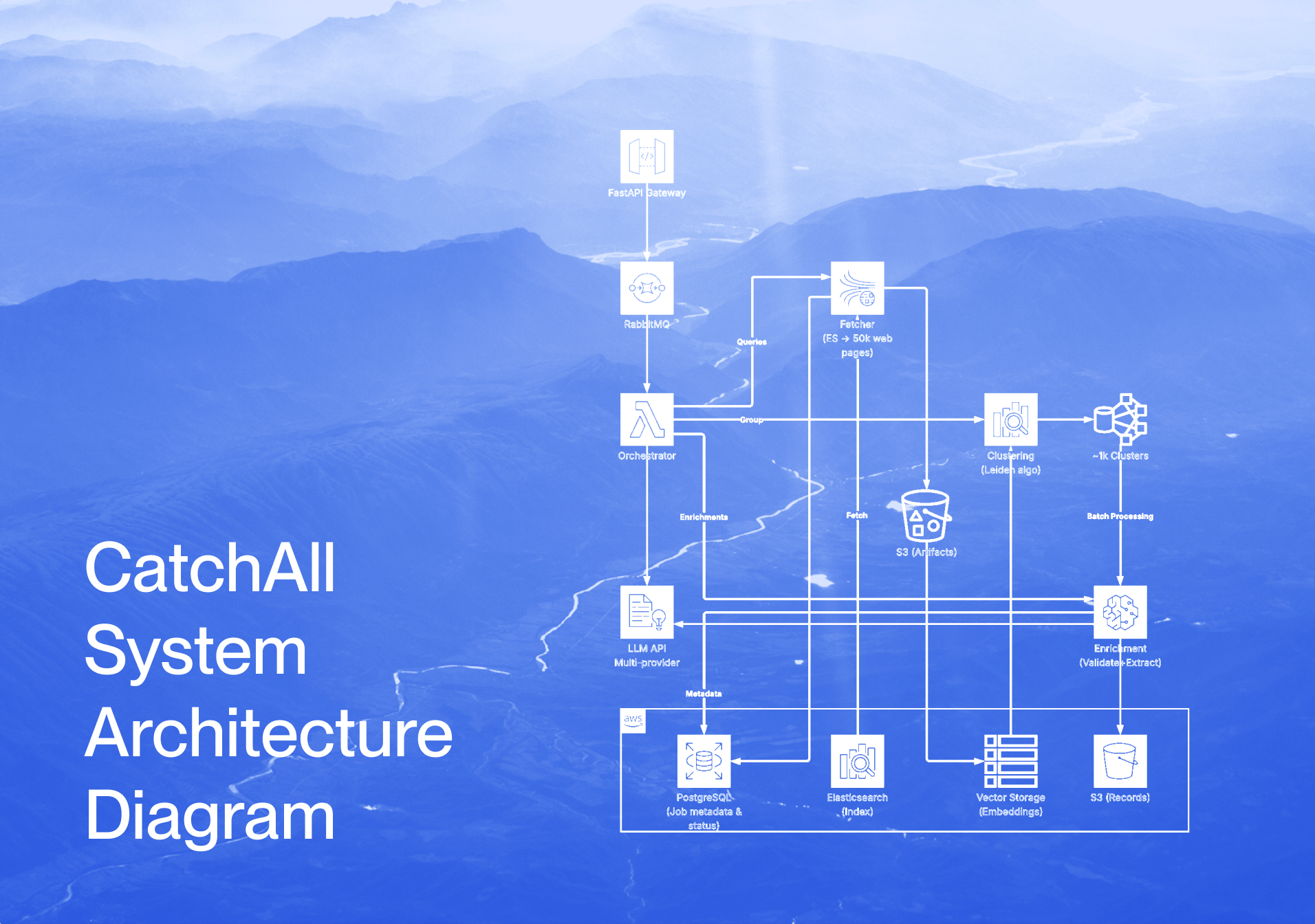
Because each stage depends on the previous, the web search API architecture is inherently asynchronous. You submit a query, receive a job ID, and poll for results (jobs take 10-15 minutes). Expecting a synchronous response is a frequent source of integration errors, and any API you consider should make this behavior explicit in its design.
Why do AI agents need event-driven search?
Most search APIs were built for humans with keyboards, but AI agents run autonomously, react to external signals, and never type a prompt. The mismatch between that workflow and a request-response API shows up fast.
An agent tracking FDA enforcement actions, port closures, or competitor moves can't query every few minutes hoping something changed. It needs a retrieval layer with scheduled monitors and webhook delivery, so structured event records arrive without the agent managing any poll loop. Writing your own polling logic burns compute and still misses events between intervals.
The stakes are practical. As agent pipelines move from prototype to production, retrieval latency and missed events translate directly into downstream failures: wrong decisions, stale context, and compounding errors across multi-step chains. Search infrastructure has to be designed for this from the start.
What to look for in a structured web search API for AI agents?
Choosing the right web search API for AI agents comes down to a few factors that separate tools built for automation from those built for human browsing.
- Schema consistency: Responses should return predictable, typed fields so your agent doesn't spend cycles parsing inconsistent HTML or guessing field names across queries.
- Event metadata: Timestamps, source credibility signals, and geographic tags let agents reason about when and where something happened, beyond what was returned.
- Filtering at the API layer: The ability to scope queries by date range, domain, language, or category before results hit your agent reduces noise without extra preprocessing steps.
- Latency and freshness guarantees: Agents operating on live workflows need indexed content measured in minutes, not days.
- Rate limits and throughput: High-volume agent pipelines require clear concurrency limits and predictable quota behavior, not vague fair-use policies.
- Webhook and push delivery: The API should support webhook callbacks so your agent receives records when a monitor fires, without polling an endpoint on your own schedule.
A structured web search API should behave less like a search engine wrapper and more like a data feed your agent can reason over directly.
How does event detection differ from link retrieval?
Event detection pipelines run the clustering and deduplication before your agent ever sees the data. Related articles get grouped, canonicalized, and surfaced as a single event object with structured metadata: what happened, when, where, and which sources corroborated it. Your agent reasons over the event, not the noise around it.
For AI agents operating under token constraints, this distinction matters. A SERP response gives you raw links. An event-aware web search API for AI agents gives you signal: context your agent can act on directly.
When to use one-off queries vs. recurring monitors?
The choice between a one-off query and a recurring monitor is an architectural decision that shapes how your agent retrieves information over time. One-off jobs work for bounded research tasks where you want a complete picture of events within a defined window. Recurring monitors fit continuous workflows where the agent acts on net-new events automatically, with no manual resubmission and delta detection built in.
Choosing the wrong cadence is as costly as choosing the wrong pattern: wiring a cyberattack detection agent to a monthly monitor is roughly the same as not having one.
Get the cadence wrong and your agent either misses the event window entirely or burns quota re-fetching signals it already processed.
Where does event-driven search actually outperform polling?
Event-driven search proves its value most clearly when you look at where polling-based retrieval breaks down under real production load.
How do financial intelligence agents use event-driven search?
Trading systems and web search API for risk monitoring need sub-minute awareness of earnings releases, regulatory filings, and macroeconomic announcements. A structured web search API that surfaces these events with metadata like source, timestamp, and entity tags lets agents act on signal, not noise.
How does event-driven search support competitive and market monitoring?
Product teams continuously track competitor pricing changes, press releases, and job postings. Event-driven retrieval delivers only the delta since the last query, cutting down on irrelevant data and token overhead.
How does event-driven search help with crisis detection and brand monitoring?
PR and trust-and-safety teams need agents that catch reputational events the moment they surface. Waiting for a scheduled crawl means the story has already spread.
What breaks when you mis-scope this architecture?
Four constraints worth mapping to your use case before you build.
- Latency: Jobs take 10-15 minutes to complete. If your agent needs a response in under a second, this retrieval layer does not fit that step. Event-driven search suits asynchronous workflows, not synchronous request chains.
- Non-determinism: Identical queries can return different results across runs. LLMs may generate different keywords, crawled pages shift between job executions, and schema field names inside
enrichmentobjects may change. - Coverage gaps: No web index captures the full web equally. Paywalled content, niche registries, and deep government sub-pages may be underrepresented depending on the index.
- Cost structure: Billing by validated record differs from per-query SERP pricing. High-volume pipelines should model costs against expected event density per time window, not raw request count, a tradeoff worth modeling before you build.
These are architectural tradeoffs, not defects. The same properties that make event-driven search unsuitable for real-time chat retrieval make it well-suited for scheduled intelligence workflows where completeness matters more than speed.
What makes CatchAll suited for production AI agents?
CatchAll is NewsCatcher's web search API built for AI agents that need structured, real-time information from across the web. Where general-purpose search APIs return noisy, inconsistent results, CatchAll returns clean, machine-readable data ready for RAG pipelines, tool-calling agents, and autonomous workflows.
Every record includes guaranteed fields: record_id, record_title, an enrichment object, and a citations array. Fields inside enrichment are dynamic and tailored to the query. No scraping logic required on your end.
Key capabilities include:
- Event-aware retrieval that surfaces content tied to real-world triggers, beyond keyword frequency, so agents get contextually relevant results when something actually happens
- Freshness controls that let you scope queries to specific time windows, which matters when your agent needs to distinguish what happened today from what happened last quarter
- Custom validators that let you define relevance and source-quality criteria at the API level, so only records matching your specifications are extracted and counted toward billing
- Structured JSON output by default, meaning agents and LLMs can parse and act on results without additional preprocessing steps
CatchAll fits directly into agentic architectures where search is a tool call, not a user interaction.
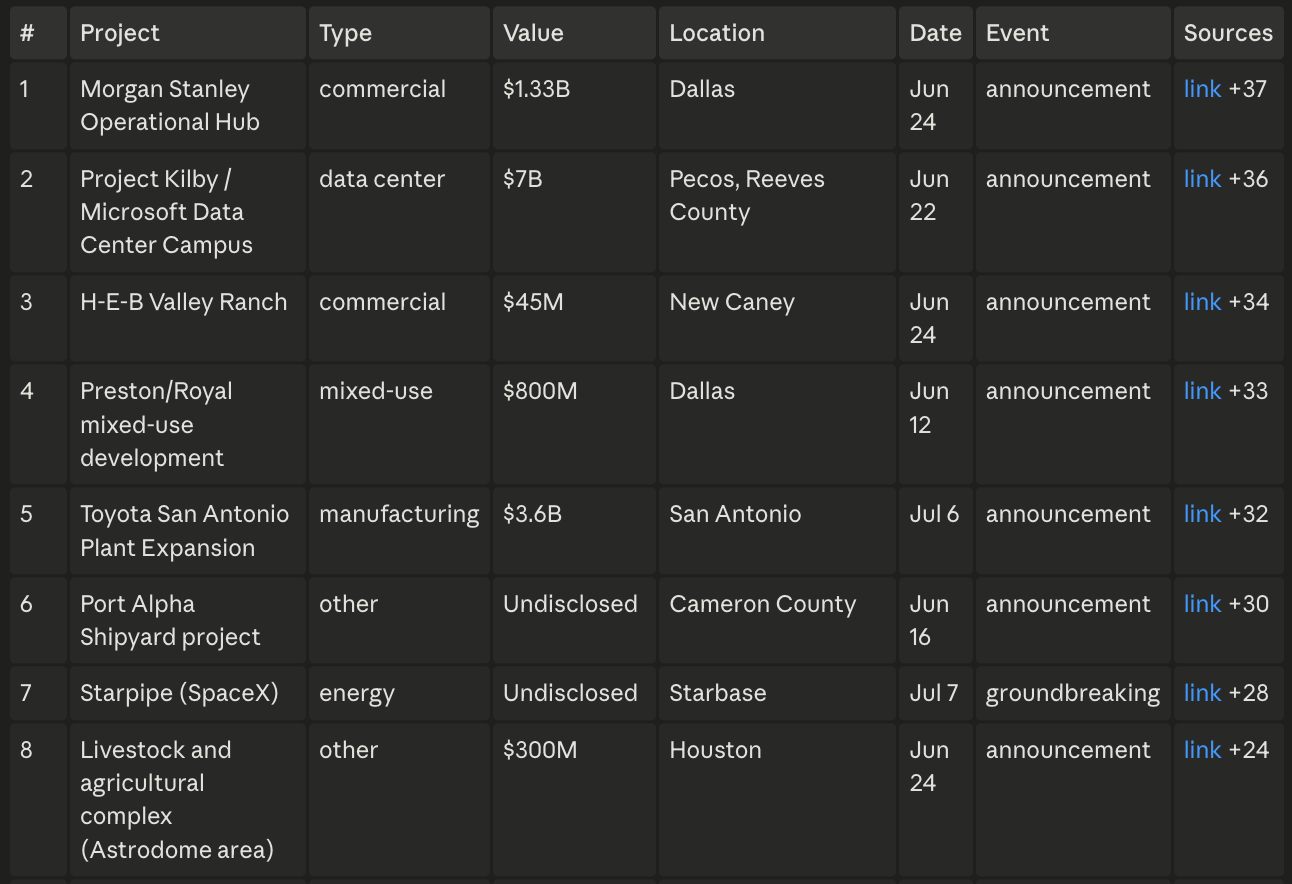
First rows of results for the query "All announced construction projects in Texas in the last month":
Final thoughts on event-driven search architecture for AI agents
Event-driven retrieval closes the gap between when something happens and when your agent can act on it. The tradeoffs covered here (latency, non-determinism, cost) are real constraints worth working through before you commit to this architecture. If you want a production-ready starting point, CatchAll is built around this model, with webhook delivery, custom validators, and machine-readable JSON output for agent pipelines.
FAQ
What's the difference between event-driven web search and a standard web search API for AI agents?
A standard web search API returns ranked links in response to a query: your agent asks, gets results, and has no awareness of what changes afterward. Event-driven web search uses a different data model: crawled pages are clustered into typed event records that group related sources around a single real-world occurrence. Scheduled monitors run on a cadence you define and push new event records to your system via webhook, so your agent receives machine-readable records covering what happened, when, and which sources corroborated it. The agent never polls an endpoint; records arrive when the monitor executes and the index has new results to deliver.
How do I choose the right monitor cadence for an event-driven AI agent search pipeline?
Match cadence to how quickly a missed event becomes an unrecoverable problem. Cyberattacks, strikes, and weather disruptions warrant daily monitors; enforcement actions and recalls work well on weekly cycles; M&A and ESG signals are stable enough for monthly runs. Running a cyberattack detection agent on a monthly monitor is functionally the same as not having one: the event window closes long before the next execution fires.





.png)