










The search for a LexisNexis alternative usually comes down to one mismatch: LexisNexis was built for people doing research, and the team using it is building software. Data pipelines and AI applications need programmatic access and structured output. The LexisNexis research platform was designed around human search sessions. LexisNexis has made efforts to offer its data programmatically, but that access is sold separately and isn't part of the research plans.
The alternatives below treat news as data. Our comparison shows which parts of LexisNexis each one replaces, and which it does not.
TLDR:
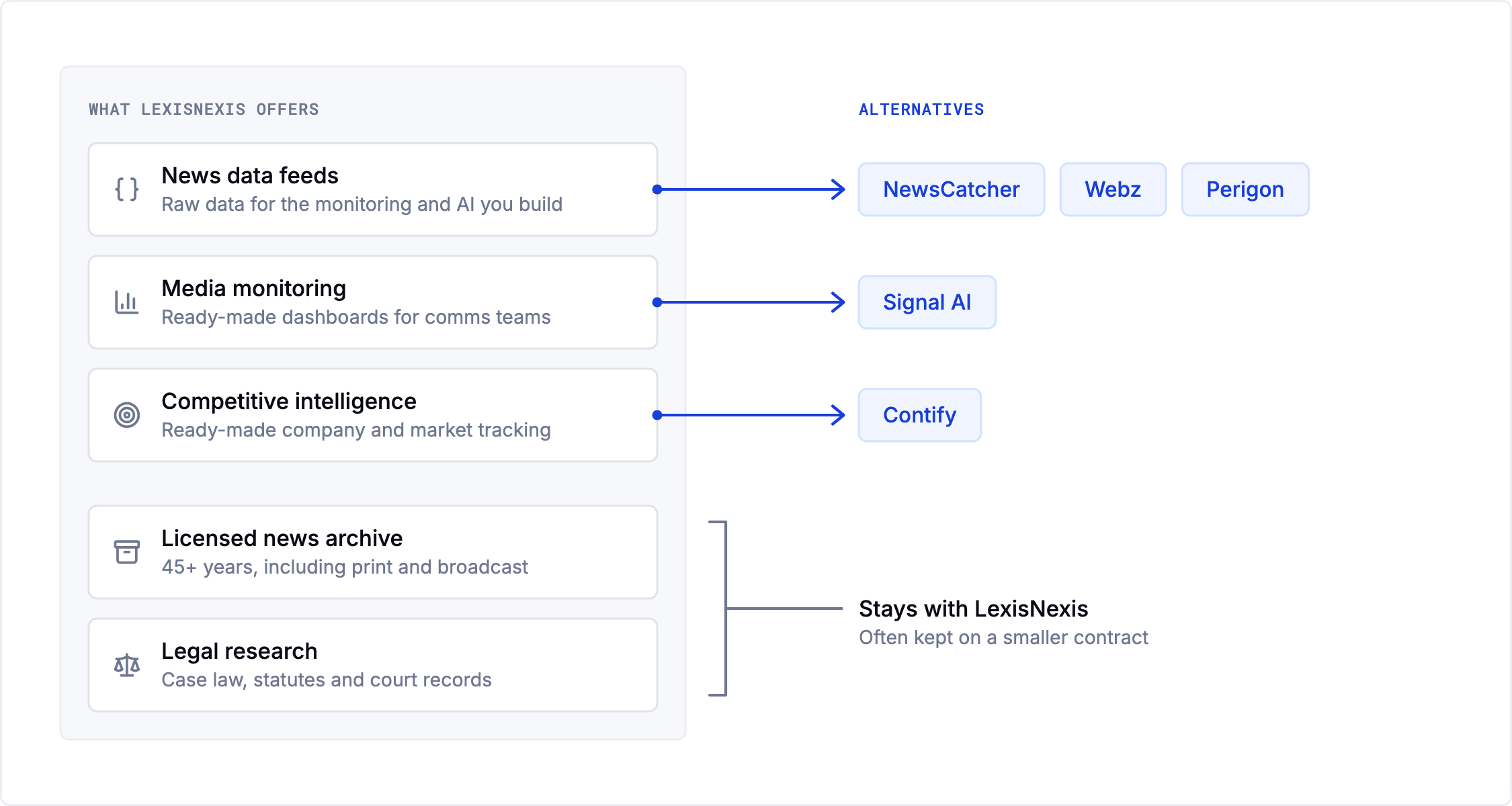
- LexisNexis is strongest as a licensed research archive: 45+ years of news across tens of thousands of licensed sources, plus legal databases open-web crawlers cannot legally replace.
- The contracts companies typically have with LexisNexis often bundle legal content that many data teams never open.
- Getting data from LexisNexis in a structured format costs extra: its API product is sold separately from its research plans.
- Each alternative in this guide replaces a part of LexisNexis, not the whole: news APIs take over the data feed, media intelligence platforms the monitoring dashboards, and competitive intelligence tools the company tracking.
- A switch can be tested before you commit: run the same searches on both side by side, compare the results, then move over.
What is LexisNexis and how does it work?
LexisNexis is a data and legal research service that aggregates news, legal documents, court records, company filings, and public records into a single searchable database. Enterprises use it for due diligence, compliance monitoring, litigation research, and media analysis.
The archive is the strongest part of LexisNexis: 45+ years of news across tens of thousands of licensed publications, including print and broadcast sources not available on the open web. Much of it is paywalled material an open-web crawler cannot legally return, and that is what legal and compliance teams pay for.
The teams that outgrow LexisNexis are usually automating those same workflows. An adverse-media screening service checking thousands of entities a day. A compliance feed pushing structured alerts into an internal dashboard. An AI agent that needs news context as JSON. LexisNexis can technically feed those systems, because it sells a news API as an additional product. But a team already paying for LexisNexis research then pays again for the data it needs, licensed dataset by dataset.
Why consider LexisNexis alternatives?
The problems below are mismatches between what LexisNexis was built for and what a production data pipeline needs.
- Bundled content. Contracts tie news access to legal and compliance databases that an engineering team may never query.
- Structured data costs extra. The API product that delivers it is sold separately from the research plans.
Every alternative below can be reached efficiently through an API. What separates them is coverage, enrichment, and licensing terms.
Best LexisNexis alternatives in 2026
No single product replaces exactly the mix of features LexisNexis offers. The list covers the news and web data layer: structured news APIs, broader web feeds, and media intelligence platforms. None of the alternatives here matches LexisNexis on legal research, and teams that rely on it often keep a smaller LexisNexis contract for exactly that.
NewsCatcher
NewsCatcher is the closest to a direct replacement for the news data layer. Its News API indexes 140,000+ sources across 50+ languages, processes more than 1.5 million articles a day, and returns full article text with named entities, article-level sentiment, summaries, and deduplication signals in one structured JSON response. A 7-day free trial lets you validate coverage on live queries and see whether it fits your use case.
Two limits against LexisNexis. The archive reaches back to January 2019, not 45 years, which is more than enough for most use cases. The index is open web only, so paywalled and licensed publications are out of scope: NewsCatcher replaces the news pipeline, not the legal library.
Webz
Webz is the breadth option. One API family covers news, blogs, forums, and dark web content, returns full article text, and offers web data archives reaching back to 2008, the deepest history in this group. Articles arrive in their original language, so a pipeline that works in English needs its own translation step.
Perigon
Perigon leads with AI enrichment. Summaries, clustering, topic tags, and entity data arrive together with the article body in a single call. The limitation is the license: as of 2026 the entry tiers are gated to startups and carry limited-use terms.
Signal AI
Signal AI is a media intelligence platform for communications and reputation teams, built around narrative tracking and executive briefing dashboards. Its API lets you do search and analysis of its enriched index. What it does not offer is raw article delivery: you get Signal AI's insights about coverage, not the articles themselves. For analysts that can be a better format than a raw API. As a pipeline data source it is the wrong shape.
Contify
Contify is about market and competitive intelligence. Its Business News API delivers company-level news over REST and webhooks, tagged with entities, events, and sentiment across a curated set of business sources. What you give up is depth per article: the API returns AI-written summaries and metadata instead of full article text, which is insufficient for pipelines that need the body text for downstream AI or analytics work.
Feature comparison: LexisNexis vs top alternatives
The table compares all six providers on the axes that matter when you're building an API pipeline.
| Provider | Full Article Body Text | Article-Level Sentiment | Self-Serve Entry Point | API-First Access | Agentic AI Licensing | Enterprise Contract Flexibility | Firehose / High-Volume Delivery |
|---|---|---|---|---|---|---|---|
| LexisNexis | Varies by source | Yes | No | Yes (Nexis Data+) | Yes (licensed content) | Multi-year bundles | Yes |
| NewsCatcher | Yes | Yes | 7-day trial | Yes | Yes (commercial use permitted) | Custom | Yes |
| Webz | Yes | Yes | Pay-as-you-go credits | Yes | Varies | Custom | Yes |
| Perigon | Yes | Yes | Free tier | Yes | Varies | Custom | Yes |
| Signal AI | No | No (entity-level only) | No | No | Unclear | Enterprise only | Limited |
| Contify | No | Yes | 7-day trial | Yes | Unclear | Custom | Limited |
If you're looking for a licensed archive and need decades of print and broadcast content, LexisNexis remains a strong choice. Signal AI is great if the goal is dashboards for a communications team. Webz is the answer if you're looking for history before 2019.
For building an automated news pipeline, NewsCatcher is the better choice: it pairs full article text and article-level sentiment in one API, with licensing that permits commercial use, including AI systems.
Why NewsCatcher is the best LexisNexis alternative for API pipelines
NewsCatcher was built for this job: it treats news as an input to software. Queries filter by keyword, source, language, country, date, entity, and sentiment. Responses come back as structured JSON with the full text and enrichment attached, so nothing needs a second parsing pass before it enters a RAG pipeline, an AI agent, or a media monitoring workflow.
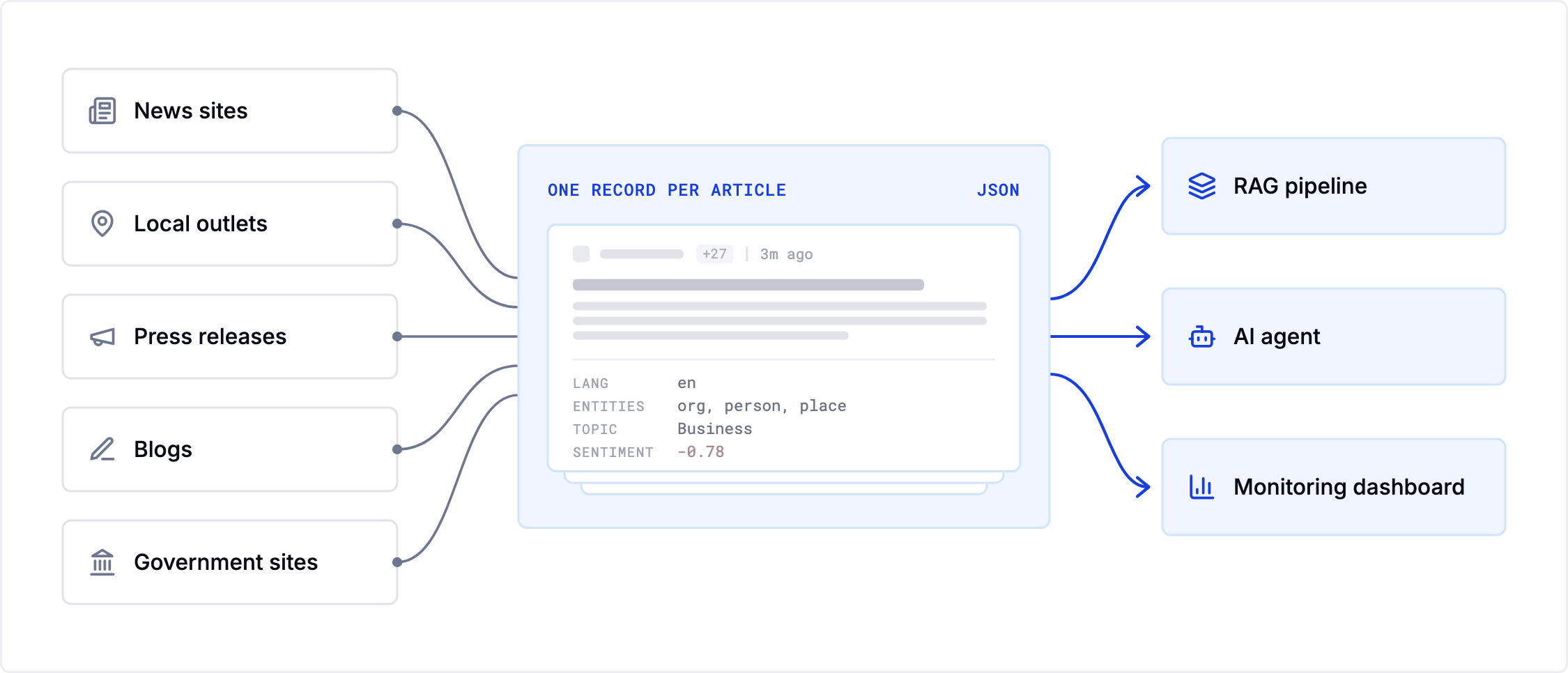
What sets NewsCatcher apart from LexisNexis shows up in each record. Full article text is a standard field, and records arrive ready for AI work, with a summary, an English translation of non-English articles, and similar stories grouped together. A free trial makes that easy to check against your current setup.
Switching is usually straightforward. Most teams map their existing LexisNexis queries onto the API filters, run both providers in parallel for a validation window, and swap the endpoint once coverage checks out, typically within a day. SDKs are available for Python, TypeScript, and Java. The free trial is self-serve, and a 30-minute onboarding session covers endpoint setup and first queries against your own watchlist.
Final thoughts on picking a LexisNexis alternative
If the value you draw from LexisNexis is the licensed archive, the legal databases, or provenance you can defend in front of a regulator, keep it, and try to negotiate the bundle down to what you use. If the contract is really funding a news feed for software, an API-first provider does that job better, and NewsCatcher is the strongest fit among the alternatives here. The cheap way to decide is empirical: run the free trial in parallel with your current LexisNexis queries and let the coverage comparison settle it.
FAQ
Why do engineering teams look for LexisNexis alternatives?
LexisNexis was built for people running searches. Its news API is sold separately from the research plans, and contracts often bundle legal content data teams never open. For teams running pipelines, such as RAG systems, event detection, or monitoring feeds, API-first providers are often a more efficient and economical choice.
What should a LexisNexis replacement offer for production news pipelines?
Structured JSON with entities, sentiment, and deduplication signals included, full article text as a standard field, and licensing terms that explicitly permit your downstream use, including AI systems. Multilingual coverage and latency are the two claims to test with live queries before trusting any sales deck.
When is LexisNexis still the right choice?
When the licensed content is what matters most. Legal research, litigation support, and due-diligence processes that must cite paywalled print or wire sources have no equivalent among the alternatives here. Data teams inside legal and compliance organizations often do best keeping LexisNexis for that work and adding a news API alongside it for the pipeline layer. The switching case is strongest when the contract is mostly funding a news feed.
How long does migrating from LexisNexis to NewsCatcher take?
About a day of engineering time in most cases. Map existing queries to keyword, source, language, country, and date filters, run both providers in parallel while comparing coverage, then swap the endpoint. Budget a longer validation window if your queries lean on licensed sources, because those will not have one-to-one matches in an open-web index.
Can NewsCatcher's licensing cover agentic AI workflows where news content is fed into LLM pipelines?
Yes. NewsCatcher's data licensing terms cover commercial use of news content, including structured delivery to downstream AI systems. Enterprise buyers in compliance-sensitive industries should request a copy of the licensing terms during procurement to confirm coverage for their specific use case, and engage their own legal counsel for downstream ingestion obligations.





.png)

.png)