






TL;DR: We’ll use CatchAll as a recall-first M&A monitoring pipeline that runs structured search queries, retrieves acquisition signals in JSON. The workflow deduplicates and filters results before routing data into tools like Airtable or Notion. It turns fragmented M&A activity into structured data for tracking, analysis, and M&A dashboards. Python code below shows the full workflow.
As of 2026, global mergers and acquisitions (M&A) activity is showing strong momentum, with global deal value reaching approximately $3 trillion in 2025.
For VC, PE, and corporate finance teams, monitoring M&A activity is critical for deal sourcing, competitor tracking, and identifying consolidation trends early.
However, many firms still rely on fragmented workflows built around Google searches, news alerts, press releases, and manually maintained spreadsheets. These approaches often make it difficult to capture complete deal activity or maintain consistent, structured records across teams.
An automated M&A deal tracker solves this by converting fragmented web signals into structured, searchable intelligence. In this article, we’ll show how to use CatchAll Web Search API to build a scalable M&A tracker for finance and strategy teams.
Why M&A Monitoring Is Still Broken
M&A monitoring is still largely a manual process. Analysts often track acquisition activity by reviewing news sites, press releases, industry publications, funding announcements, and company blogs across dozens of disconnected sources.
This creates:
- Missed deals where relevant transactions never enter analyst workflows because they appear outside monitored sources.
- Time-heavy research cycles where teams repeatedly collect and verify the same signals across multiple outlets.
- Unstructured outputs where identified deals remain inconsistent and difficult to analyze across portfolios, sectors, or regions.
The problem is not a lack of alerts. Teams receive large volumes of notifications and monitoring updates, but coverage remains incomplete and fragmented across sources.
Modern M&A monitoring addresses this by continuously capturing acquisition signals across the web. It converts broken reporting into structured intelligence that can feed CRMs, dashboards, and analytics pipelines.
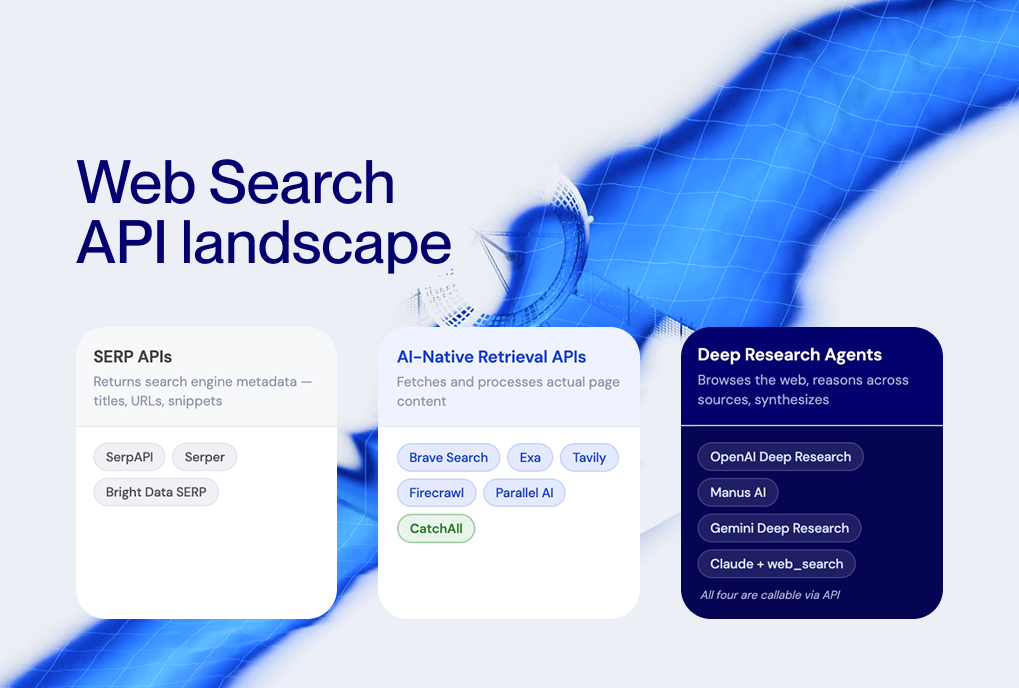
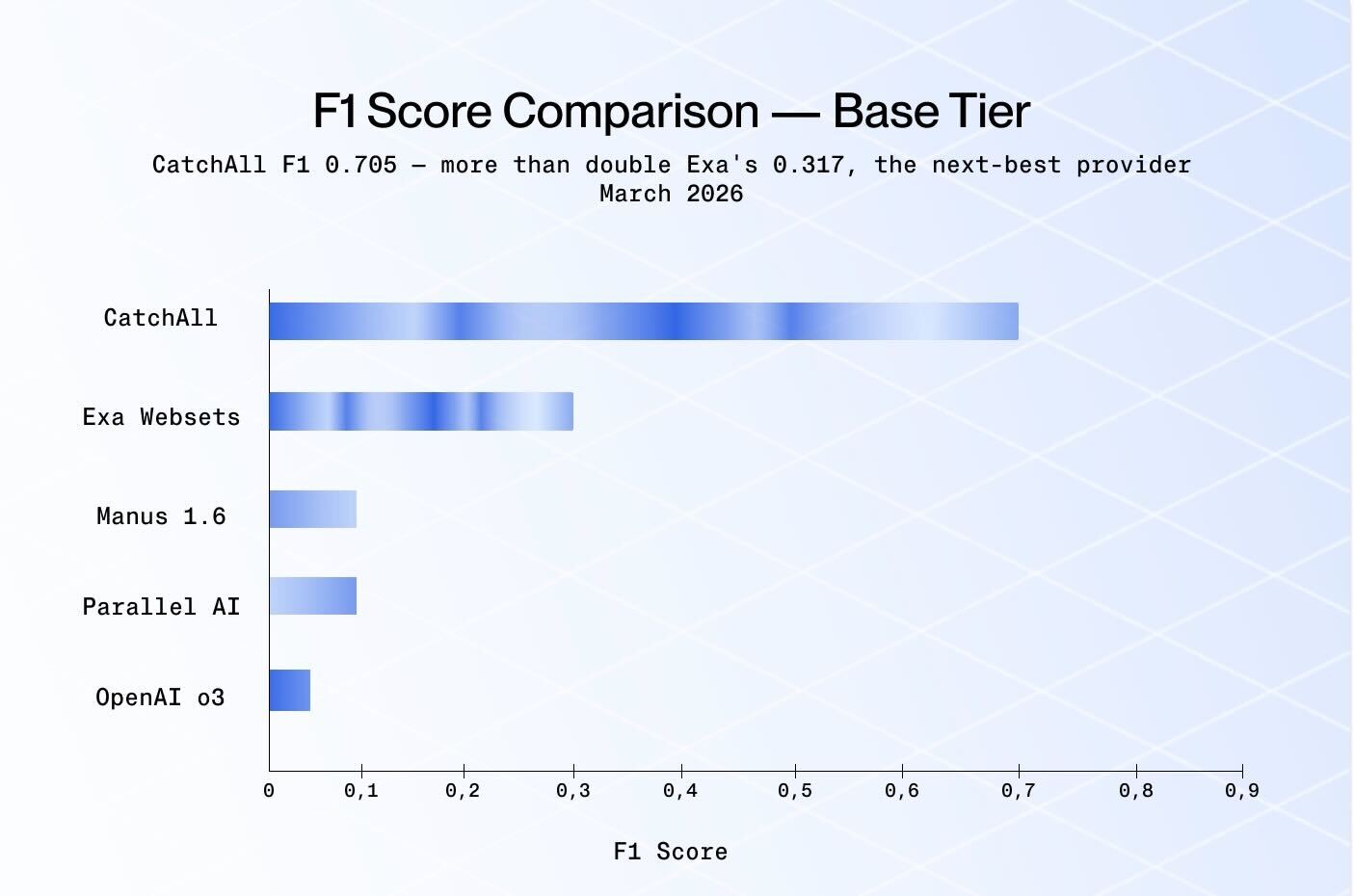
Platforms like CatchAll are designed around a recall-first approach. It enables teams to identify broader deal activity instead of relying on isolated alerts or manually curated source lists.
What an Automated M&A Deal Tracker Looks Like
Modern M&A monitoring systems are designed to collect acquisition signals from across the web, organize them into structured records, and route them into internal workflows.
A modern system should follow four stages:
.png)
- Input: Search queries that capture deal signals. Teams begin by creating natural-language queries designed to surface acquisition, merger, funding, or partnership activity across specific industries and markets. For example, they might use a query such as, “Find strategic fintech acquisitions and partnership announcements in Europe.”
- Processing: API retrieval and filtering. At this stage, raw web content is converted into structured events. The system retrieves multiple sources, validates relevance, and enriches each event with normalized metadata such as company names, sector tags, geography, and deal classification.
- Output: Structured M&A intelligence (JSON). The system returns each acquisition event as structured JSON, including acquirer, target, deal type, industry, geography, estimated deal value when available, publication date, and source references.
- Destination: CRM systems, dashboards, and data warehouses. Structured output can then flow directly into CRM-based deal pipelines, M&A dashboards, and data warehouses used for trend analysis and portfolio monitoring.
This centralized monitoring layer turns fragmented web activity into a consistent intelligence layer that teams can search, analyze, and operationalize across functions.
Key M&A Signals You Can Track
Most acquisition activity appears through early operational and market signals before deals are formally announced. Tracking these signals helps teams identify buyer interest, expansion activity, and emerging consolidation trends early.
1. Acquisition Announcements
Acquisition announcements often surface first in niche publications, regional outlets, or company press releases before reaching major financial media.
For example, Meta's acquisition of Assured Robot Intelligence in May 2026 was first reported by robotics and tech-focused outlets before wider financial reporting.
2. Funding Events
Funding rounds often indicate where strategic capital is concentrating. It also helps identify potential future acquisition targets in high-growth sectors like AI and SaaS.
For example, Wayve raised $1.05 billion in 2024, backed by Microsoft, SoftBank, and NVIDIA, signaling a strong strategic interest in mobility and AI infrastructure.
3. Strategic Partnerships
Partnership announcements can reveal commercial alignment before formal acquisition activity becomes visible in deal tracking systems.
For example, Microsoft’s expanding partnership with OpenAI signaled a broader shift in enterprise AI infrastructure and platform competition.
4. Leadership Changes
Executive hiring patterns can signal upcoming acquisition activity or strategic shifts, particularly when firms hire leaders in corporate development, finance, or product roles.
For example, Cisco expanded strategic leadership ahead of its $28 billion acquisition of Splunk, highlighting that organizational restructuring often accompanies large-scale deals.
5. Industry Consolidation Trends
Repeated acquisitions within the same subsector can indicate consolidation cycles, roll-up strategies, and platform expansion across fragmented industries.
For example, TowerBrook Capital Partners' investment preceded 20+ bolt-on acquisitions by EisnerAmper, indicating sustained consolidation in professional services markets.
These signals provide a continuous view of market activity. They help firms identify competitive and investment shifts earlier than isolated deal announcements alone.
How to Build an M&A Tracker Using CatchAll
CatchAll enables VC and PE teams to automate M&A monitoring workflows by discovering acquisition signals across the web. Structured deal data can then be routed directly into internal dashboards and CRM systems.
The workflow only requires four steps:
Step 1: Define Your Queries
Start by defining the type of acquisition or funding activity you want to monitor. You can structure queries around event type, industry, timeframe, or geographic market. Well-constructed queries directly influence the quality and relevance of CatchAll results.
In this workflow, we’ll monitor recent AI acquisition activity using queries:
Find all instances where an AI company acquires a smaller SaaS company
List Startup merger or acquisition announcements in Europe
Series B funding rounds for AI startups in Asia over the last week
Find fintech companies announcing a strategic acquisition to expand payment services
Step 2: Fetch Data via the API
CatchAll retrieval jobs can run as one-time searches or scheduled monitoring requests. Scheduled jobs allow teams to continuously monitor M&A activity by automatically retrieving new acquisition signals at recurring intervals.
Start by signing up to CatchAll and generate an API key. Then install the CatchAll client library:
pip install newscatcher-catchall-sdk
Initialize the client with your API key and submit a monitoring job:
import time
import json
from newscatcher_catchall import CatchAllApi
from newscatcher_catchall.core.api_error import ApiError

client = CatchAllApi(api_key=NEWSCATCHER_API_KEY)

queries = [
    "Find all instances where an AI company acquires a smaller SaaS company",
    "List startup merger or acquisition announcements in Europe",
    "Series B funding rounds for AI startups in Asia over the last week",
    "Find fintech companies announcing a strategic acquisition to expand payment services"
]

enrichments = [
    {"name": "company_acquired", "description": "Name of the company being acquired","type": "text"},
    {"name": "acquiring_company", "description": "Name of the company making the acquisition","type": "text"},
    {"name": "deal_type", "description": "Type of deal: acquisition, merger, or buyout","type": "text"},
    {"name": "industry", "description": "Industry or sector of the acquired company", "type": "text"},
    {"name": "value", "description": "Estimated or announced value of the acquisition or funding round in USD", "type": "text"},
    {"name": "date", "description": "Date the deal was announced", "type": "text"},
    {"name": "source", "description": "Publication that reported the deal", "type": "text"},
    {"name": "summary", "description": "One sentence on the deal and its rationale","type": "text"},
]

all_results = []

try:
    for query in queries:
        # Submit job
        job = client.jobs.create_job(
            query=query,
            context="Extract acquiring company, acquired company, deal type, industry, date, source, and a one-sentence summary.",
            limit=10,
            enrichments=enrichments
        )
        print(f"Job submitted: {job.job_id} | Query: {query}")

        # Poll until complete
        while True:
            status = client.jobs.get_job_status(job.job_id)
            print(f"Status: {status.status}")
            if status.status == "completed":
                break
            if status.status == "failed":
                raise RuntimeError(f"Job failed for query: {query}")
            time.sleep(60)

        # Pull results
        results = client.jobs.get_job_results(job.job_id)
        print(f"Found {results.valid_records} records for: {query}\n")
        all_results.extend(results.all_records)

except ApiError as e:
    print(f"API error {e.status_code}: {e.body}")
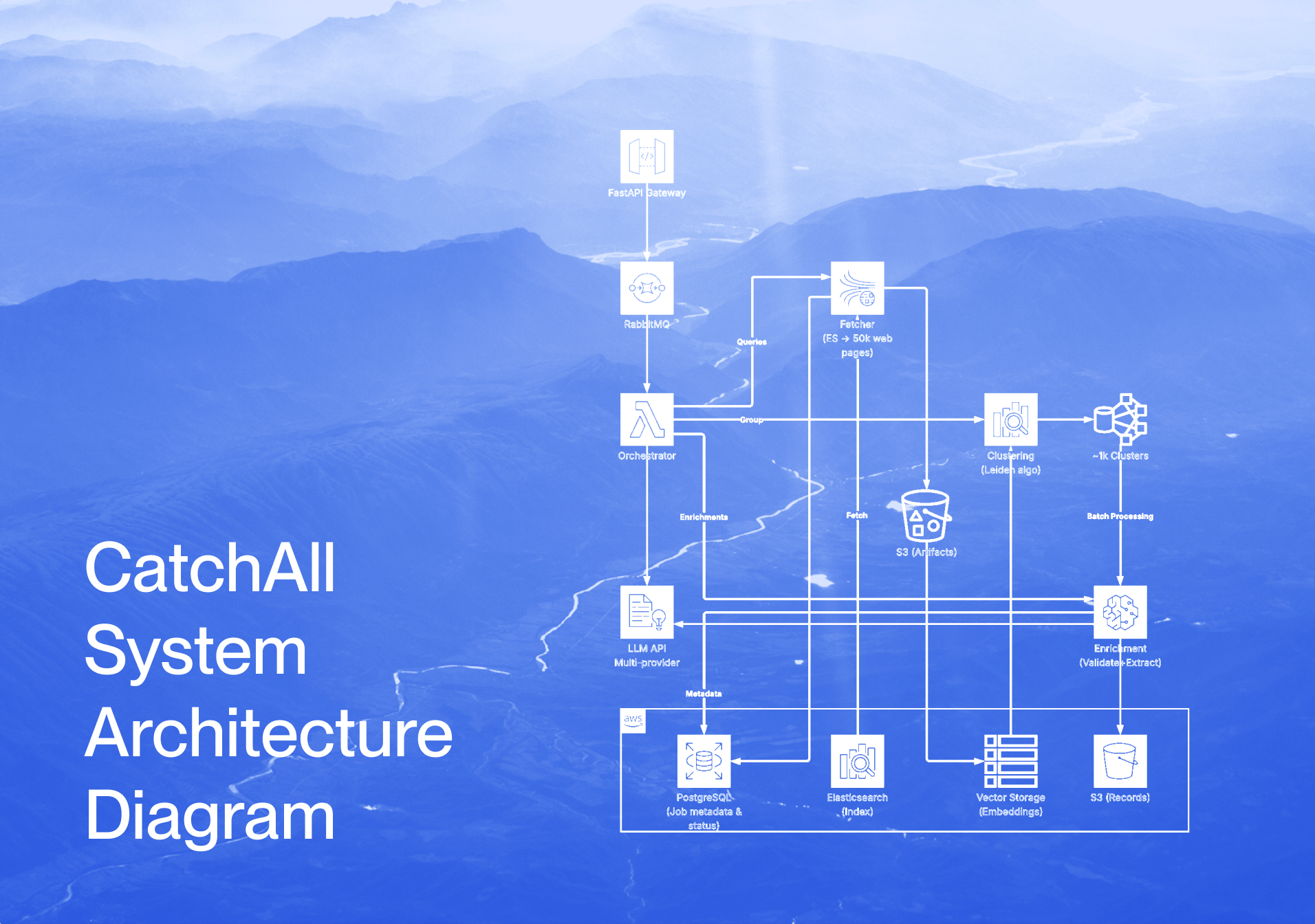
CatchAll processes each query through a five-stage pipeline: analyze, fetch, cluster, validate, and extract. Once the job completes, the API returns de-duplicated acquisition events in structured JSON format.
Step 3: Filter and Normalize Results
Once results are retrieved, the next step is to clean and standardize them so they can be analyzed consistently across deals, sectors, or geographies.
The first step removes duplicate coverage of the same acquisition event:
deduplicated = []
seen = set()

for record in all_results:
    enrichment = record.enrichment

    company_acquired  = str(getattr(enrichment, "company_acquired", "")).strip()
    acquiring_company = str(getattr(enrichment, "acquiring_company","")).strip()
    deal_type = str(getattr(enrichment, "deal_type", "")).strip()
    industry = str(getattr(enrichment, "industry", "")).strip()
    date = str(getattr(enrichment, "date", "")).strip()
    source = str(getattr(enrichment, "source", "")).strip()
    summary = str(getattr(enrichment, "summary","")).strip()

    if not company_acquired or not acquiring_company:
        continue
    dedup_key = (company_acquired.lower(), acquiring_company.lower())
    if dedup_key in seen:
        continue
    seen.add(dedup_key)

    deduplicated.append({
        "company_acquired": company_acquired,
        "acquiring_company": acquiring_company,
        "deal_type": deal_type,
        "industry": industry,
        "date": date,
        "source": source,
        "summary": summary,
    })

print(f"{len(deduplicated)} deals after deduplication")
The second step applies filtration rules to narrow results by industry, deal type, or other monitoring criteria:
# Filtration by industry  and deal type
target_industry   = "AI"
target_deal_type  = "acquisition"

normalized = []

for deal in deduplicated:
    # Filter by industry
    if target_industry and target_industry.lower() not in deal["industry"].lower():
        continue

    # Filter by deal type
    if target_deal_type or target_deal_type.lower() not in deal["deal_type"].lower():
        continue

    normalized.append(deal)
print(f"{len(normalized)} deals after filtering\n")
print(json.dumps(normalized, indent=2))
This normalization layer creates a clean, searchable dataset that can be analyzed across sectors, buyers, geographies, or consolidation patterns over time.
Step 4: Store and Route Data
After normalization, structured M&A data can be routed into operational systems such as Notion, Airtable, CRMs, or internal M&A dashboards, used by investment and strategy teams.
In this example, we’ll send the processed deal data into a Notion database. Set up Notion integration, generating an API key, and copying your target database ID.
NOTION_API_KEY = "NOTION_API_KEY"
NOTION_DATABASE_ID = "YOUR_DATABASE_ID"
Once connected, each normalized filtered deal can be inserted as a structured record:
import requests

headers = {
    "Authorization": f"Bearer {NOTION_API_KEY}",
    "Content-Type": "application/json",
}

for deal in normalized:
    payload = {
        "parent": {"database_id": NOTION_DATABASE_ID},
        "properties": {
            "Acquired Company": {"title": [{"text": {"content": deal["company_acquired"]}}]},
            "Acquiring Company": {"rich_text": [{"text": {"content": deal["acquiring_company"]}}]},
            "Deal Type": {"rich_text": [{"text": {"content": deal["deal_type"]}}]},
            "Industry": {"rich_text": [{"text": {"content": deal["industry"]}}]},
            "Date": {"rich_text": [{"text": {"content": deal["date"]}}]},
            "Source": {"rich_text": [{"text": {"content": deal["source"]}}]},
            "Summary": {"rich_text": [{"text": {"content": deal["summary"]}}]},
        }
    }
    response = requests.post("https://api.notion.com/v1/pages", headers=headers, json=payload)
This setup turns CatchAll outputs into a continuously updated M&A monitoring pipeline, where acquisition signals flow directly into internal systems.
Example Output: Structured M&A Intelligence
From the queries run above, CatchAll returns structured JSON-formatted results across multiple acquisition events.
Structured JSON records make it easier to:
- analyze M&A activity across buyers, sectors, and time periods
- route deal data into CRMs, dashboards, or internal monitoring systems
- automate workflows such as filtering, tagging, alerts, and trend tracking
Below is a sample JSON showing how each deal is structured:
 {
    "company_acquired": "Kompass",
    "acquiring_company": "Expandi",
    "deal_type": "acquisition",
    "industry": "AI, B2B commercial development",
    "date": "2026-05-12",
    "source": "Ameve.eu",
    "summary": "Expandi acquired Kompass, an AI platform for business information, aiming to triple turnover and create a \u20ac35 million European player."
  },
  {
    "company_acquired": "Aleph Alpha",
    "acquiring_company": "Cohere",
    "deal_type": "acquisition",
    "industry": "AI technology",
    "date": "2026-05-13",
    "source": "Bloomberg",
    "summary": "Canadian company Cohere acquired German startup Aleph Alpha for $20 billion due to Aleph Alpha's inability to raise capital and Cohere's aim to strengthen its position in the EU market."
  }
Once acquisition activity is returned in a consistent structure, teams can work with deal data operationally instead of manually reviewing individual sources and announcements.
Why Recall Matters in M&A Tracking
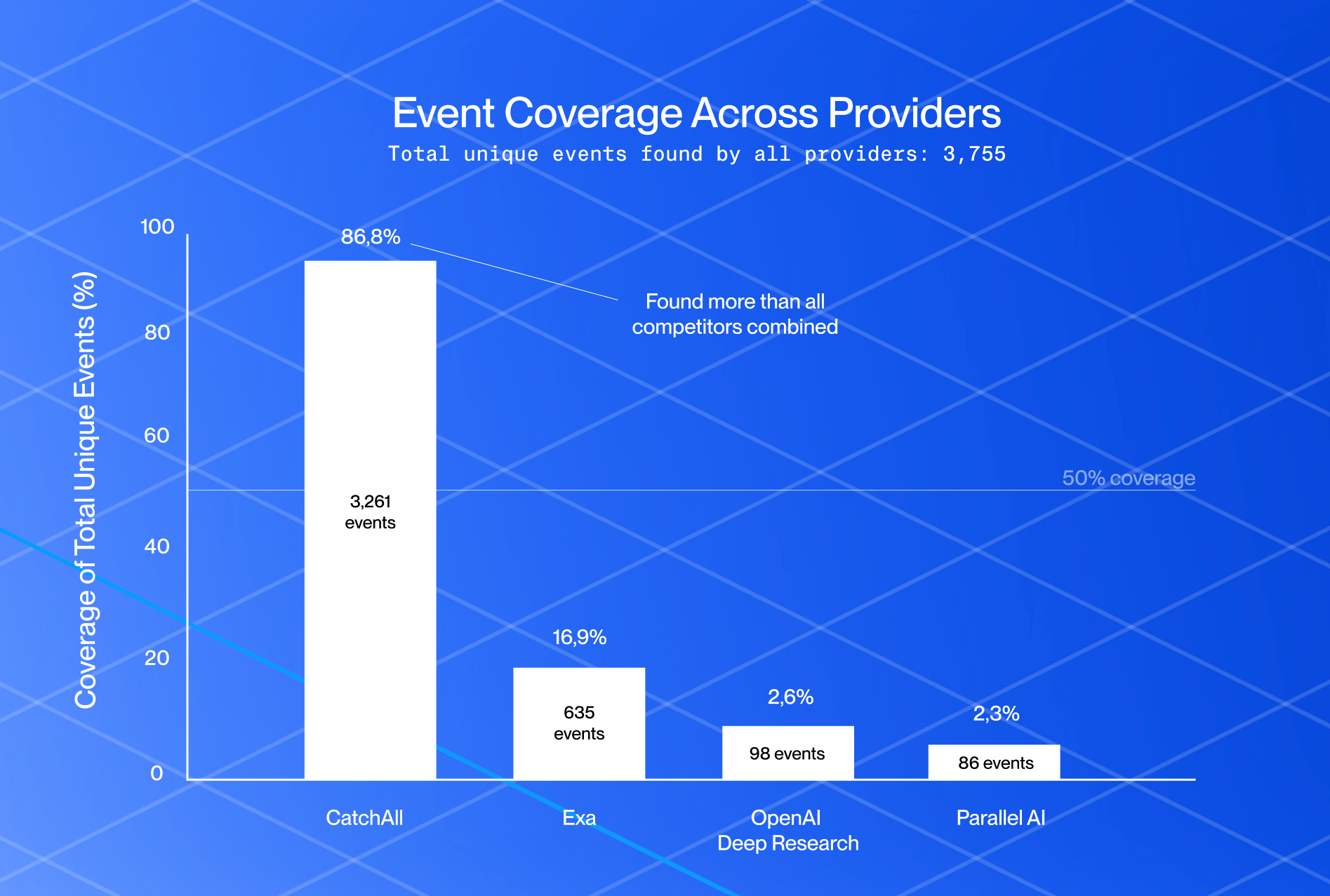
In M&A monitoring, recall refers to how comprehensively a system captures real acquisition activity across the open web. It also defines whether deal intelligence is usable for sourcing and competitive analysis.
In acquisition tracking, low recall means early deal signals may not be captured before they reach mainstream financial coverage. With an estimated 50,810 M&A transactions completed globally in 2025, the number of acquisition signals appearing across several online sources and company announcements has increased significantly. This means incomplete retrieval poses a direct visibility risk for VC and PE teams.
This is why teams need high-recall systems. CatchAll functions as a recall-first search layer for monitoring acquisition signals across the web. It helps convert fragmented coverage into usable data for tracking, automated M&A analysis, and integration into internal dashboards or analytics pipelines.
Real-World Use Cases for VC/PE Teams
M&A monitoring is no longer limited to deal sourcing. Structured acquisition data is increasingly used across investment research, competitive intelligence, portfolio management, and sector analysis workflows to understand market movement earlier and more consistently.
Deal Sourcing
VC and PE firms use M&A monitoring to surface new investment and acquisition opportunities. They track deal signals across news, startup ecosystems, and emerging company announcements.
As of 2026, technology M&A increased 66% year-over-year to approximately $1.08 trillion, driven by AI and data infrastructure. In these markets, rising acquisition density across subsectors helps investment teams identify where strategic capital is concentrating.
Competitive Intelligence
Corporate development teams use acquisition monitoring to track how competitors are allocating capital across product areas.
In cybersecurity alone, global M&A activity exceeds $84 billion, reflecting sustained consolidation across vendors and adjacent technology providers. Tracking these patterns in structured datasets helps teams identify strategic shifts and capability expansion before they appear in analyst coverage.
Portfolio Monitoring
Private equity firms are centralizing portfolio monitoring into structured analytics and reporting systems to gain real-time visibility across investments.
S&P Global Market Intelligence reports that firms have unified portfolio data across assets to standardize reporting and improve oversight. This reflects a broader shift toward continuous, data-driven portfolio risk monitoring.
Sector Trend Analysis
Structured deal monitoring is used as an early indicator of sector transformation and consolidation activity.
McKinsey reported that financial services M&A activity rose 43% to $660 billion in 2025, driven largely by consolidation among banks and financial institutions. These signals often appear months earlier through changes in acquisition frequency, buyer concentration, and funding activity.
Roll-up Identification
Roll-up strategies are becoming more prevalent across industries like healthcare services, industrial software, accounting firms, and property services.
According to IFAC, fewer than 200 PE investments in accounting firms generated nearly 900 subsequent roll-up transactions in 2025. Tracking these acquisition patterns early helps identify emerging platform companies and fragmented regional markets, before broader market visibility increases.
Summary
As M&A activity becomes more distributed across industries, geographies, and publication sources, the advantage belongs to firms that can identify market signals before they become widely visible.
For VC, PE, and corporate strategy teams, automated M&A monitoring creates a faster and more scalable way to track acquisition activity, competitor expansion, and funding momentum without relying on manual research workflows.
CatchAll provides the recall-first retrieval layer behind these systems. It helps teams transform web-scale acquisition coverage into structured intelligence that can feed M&A dashboards, analytics pipelines, and investment workflows.
Get started with CatchAll for recall-first web search and automated M&A monitoring. Start with 2,000 free credits at platform.newscatcherapi.com.